







A child home safety follow up checklist should help a household remember an agreed action and revisit it. Receiving advice and recording a completed change are different events. Neither entry, by itself, proves that a child’s injury risk has fallen.
A new rural Chinese trial reported in JAMA Network Open offers a useful evidence check. It involved 360 households across 24 communities, with children aged 3–12. The intervention added three monthly structured visits, materials and a fourth-month follow-up to routine services. It did not test a download on its own.
Child home safety follow up checklist: start with the counts
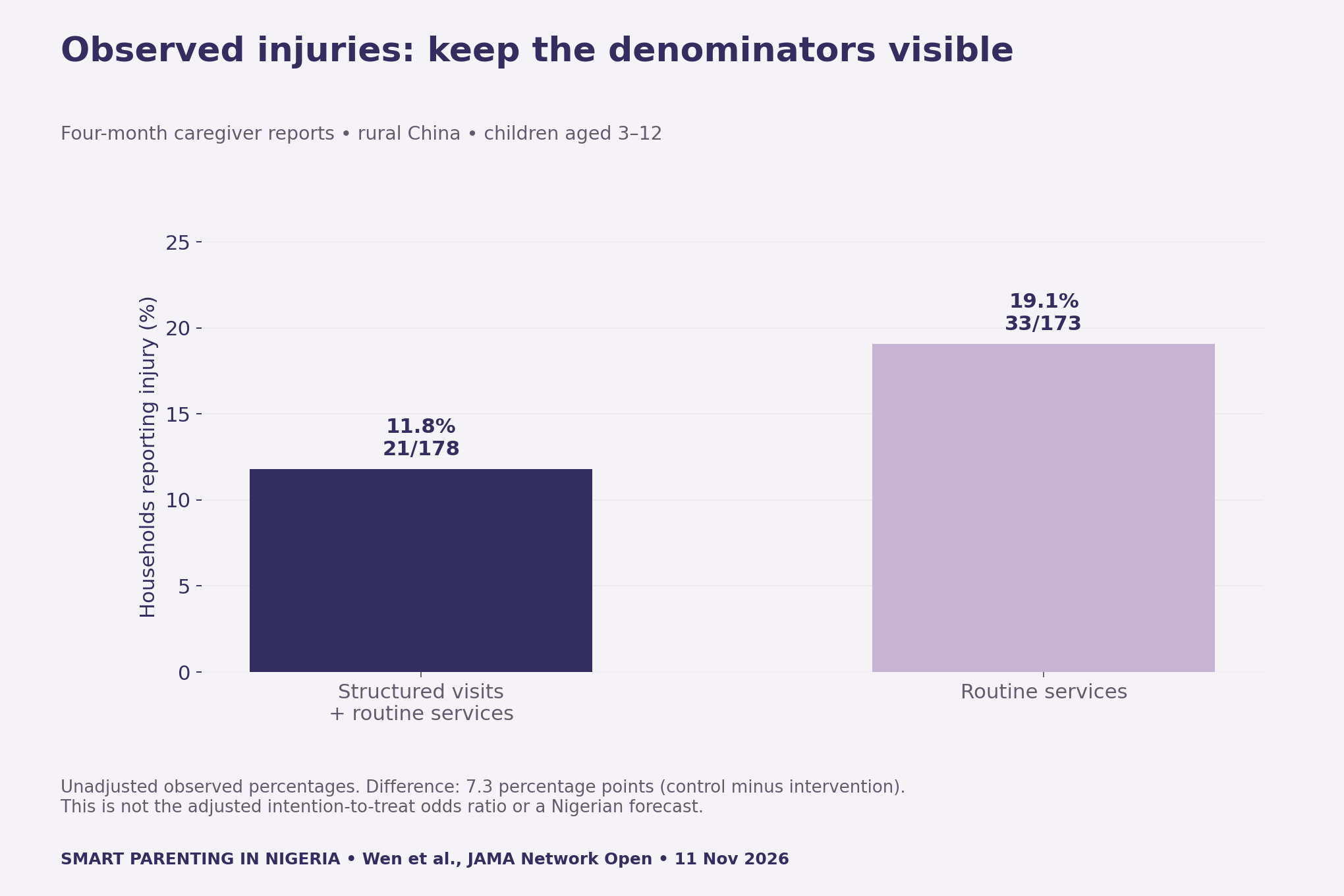
The adjusted intention-to-treat odds ratio was 0.36, with a 95% confidence interval of 0.18–0.73. That describes adjusted odds, not a 64% reduction in injury probability. The raw percentage comparison and adjusted estimate answer different statistical questions. Therefore, we keep their labels and denominators separate.
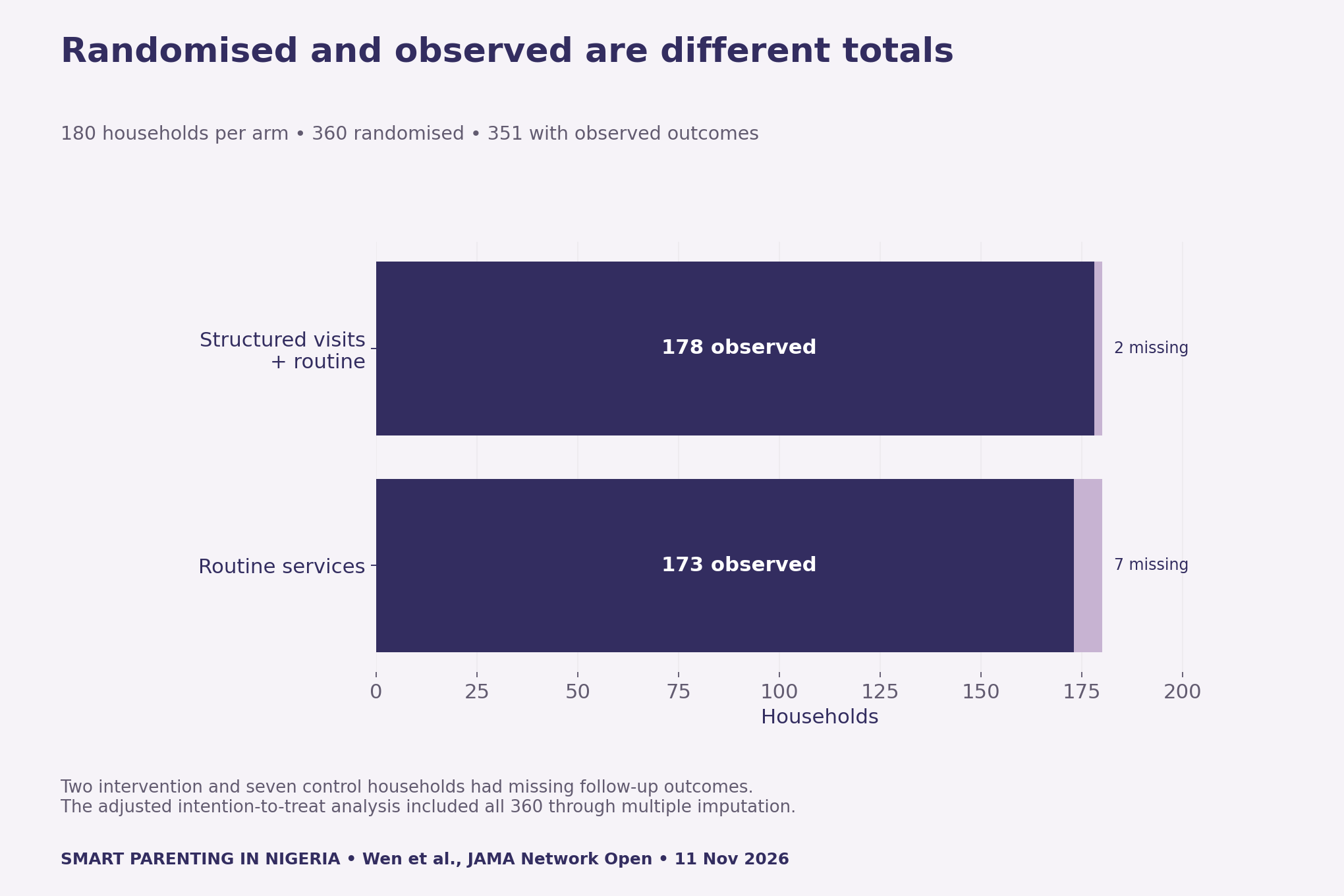
Caregivers knew their group and reported the injuries. The trial ran from May to October 2025; four-month findings do not establish lasting effects. It cannot establish the effect of our checklist, a commercial kit or a Nigerian programme. These limits matter before anyone promises a result locally.
Turn a conversation into a private action record
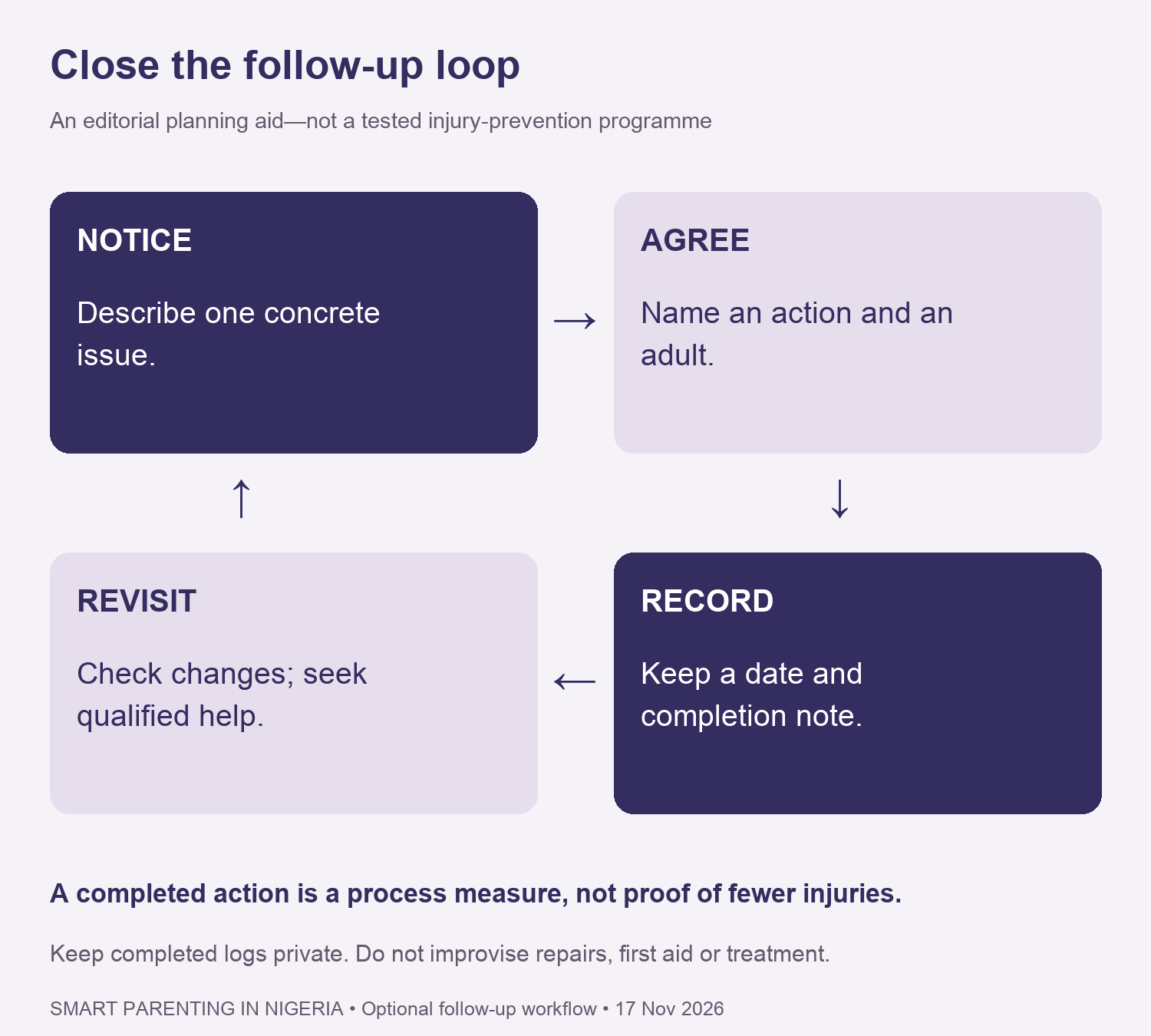
First, describe one issue in plain language. Avoid a vague entry such as “make the whole home safe”. Instead, record the specific concern raised during a conversation with an appropriate professional. The worksheet offers space for questions; it does not supply a repair method or certify an installation.
Next, agree who will take the next step and when. If the action needs a landlord, trained installer or health professional, name the kind of help required. Do not turn a target date into pressure to improvise a technical fix. Record an unresolved question honestly rather than marking it complete.
Then, note what actually happened. “Advice received”, “appointment arranged”, “work completed” and “reviewed” are useful, distinct statuses. A photograph is optional; avoid images that reveal a child, an address or a security arrangement. A short private note may be enough for the agreed purpose.
Revisit the issue when circumstances change
Finally, use a review date chosen for the situation. The blank planner has no universal inspection interval. A family move, a changed routine or a new concern may prompt a fresh conversation. A date on a spreadsheet cannot replace suitable advice about an urgent or technical problem.
For a community organisation, record whether a referral reached the intended person and whether the family agreed to further contact. Ask permission before retaining personal information. Keep identifiable household logs out of group chats, public reports and our social-media comments.
An aggregate report could count actions awaiting help or reviews completed. However, it should not relabel those process totals as injuries prevented. A programme would need an appropriate outcome definition, a suitable denominator, follow-up and a credible evaluation before claiming an injury effect.
Questions before adapting a programme in Nigeria
Ask who trains and supervises visitors, how families can decline, what qualified support is available and who pays for agreed changes. Also, ask how a household can report a concern without being blamed. Resources, housing arrangements and service access can differ from the trial setting.
Likewise, ask a provider which elements it actually delivers. A checklist bundled with a product is not automatically equivalent to repeated supported visits. For another example of separating a tested package from a download, see our parenting-app evidence guide.
Method and four downloadable tools
We checked the full paper and PubMed on 17 November 2026. The publisher and PMC show 11 November, while PubMed’s citation shows 2 November; we retain both dates rather than silently choosing one. The CSV dictionary separates reported estimates from our arithmetic.
The action register and planner are optional, private and non-diagnostic. They contain no first-aid, treatment or construction instructions. Leave unnecessary personal fields blank. No household data were collected for this article, and no effect of these editorial tools has been measured.
- Trial counts and observed-percentage calculations (CSV)
- Outcome measure and denominator dictionary (CSV)
- Blank private action register (CSV)
- Blank private follow-up planner (CSV)
Suggested citation: Smart Parenting In Nigeria, “Child Home-Safety Visits: Measure Hazards Fixed, Not Just Advice Received”, 17 November 2026. Primary source: Wen and colleagues, doi:10.1001/jamanetworkopen.2026.43140; PubMed record. Original charts, arithmetic and planning tools by this publication; no source figures reproduced.
Parenting Made Just for You
Get personalized Parenting Solutions tailored to your child’s needs. Transform your parenting journey with expert guidance in 1-3 days.
Get Started


