







Family emotional synchrony and adolescent wellbeing research does not mean everyone at home must feel the same. A parent can show interest in a teenager’s feelings without demanding a matching mood or treating a quiet evening as rejection.
A PLOS One study published on 11 November 2026 followed 40 US family triads: an adolescent aged 12–17, a mother and a father. Its 120 participants contributed 2,365 retained assessments. Those are repeated observations, not thousands of independent families.
Family emotional synchrony and adolescent wellbeing: count the right unit
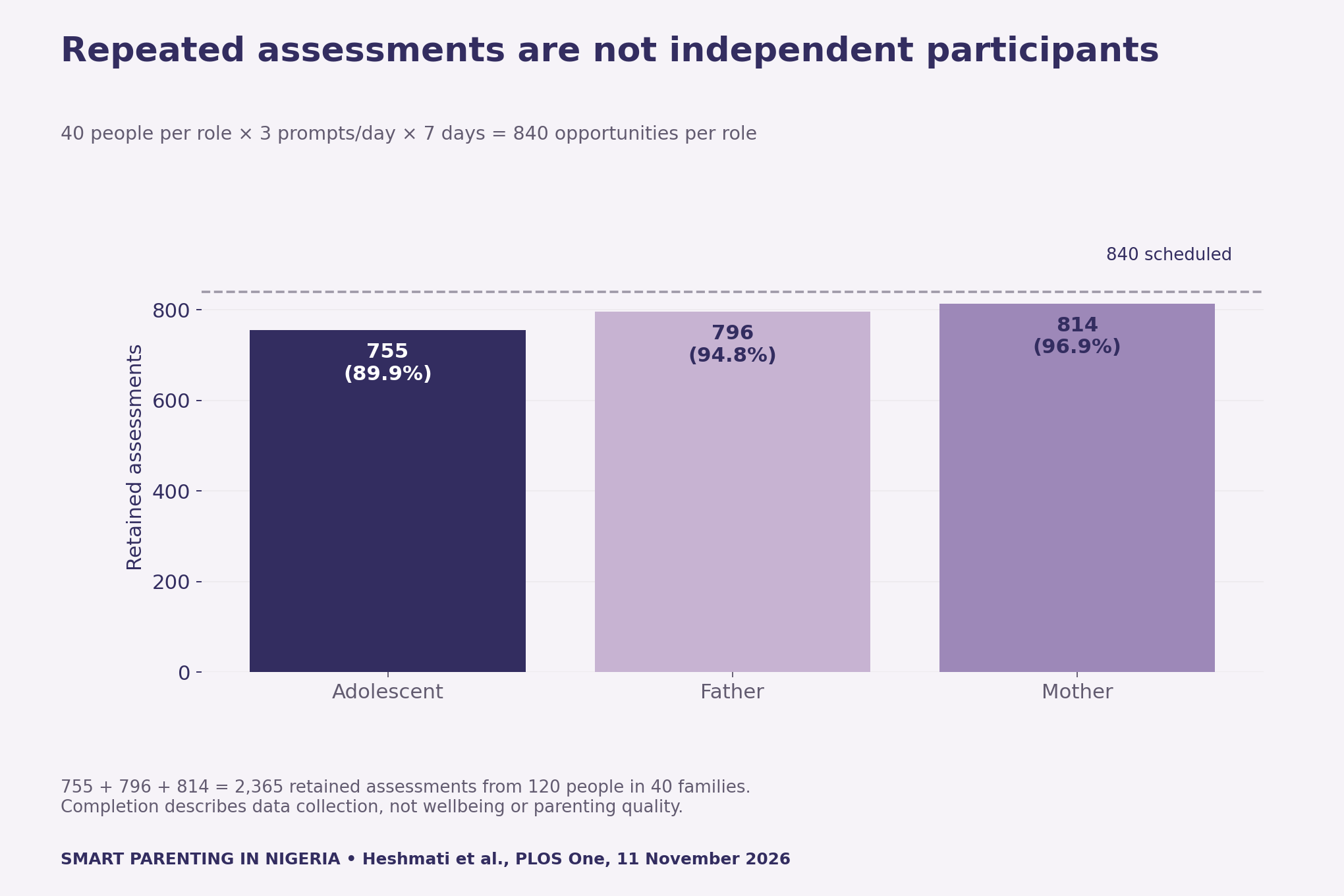
The study used brief smartphone reports three times a day for seven days. Repeated sampling can reveal changes that a single questionnaire misses. However, observations from the same person and family are related. Therefore, the number of assessments cannot replace the number of families when discussing sample size.
Our count file keeps the role, retained reports and scheduled opportunities in separate columns. The calculation is retained reports divided by 840, multiplied by 100. We have not rerun the network models or treated every report as an independent participant.
Across families and within one family are different questions
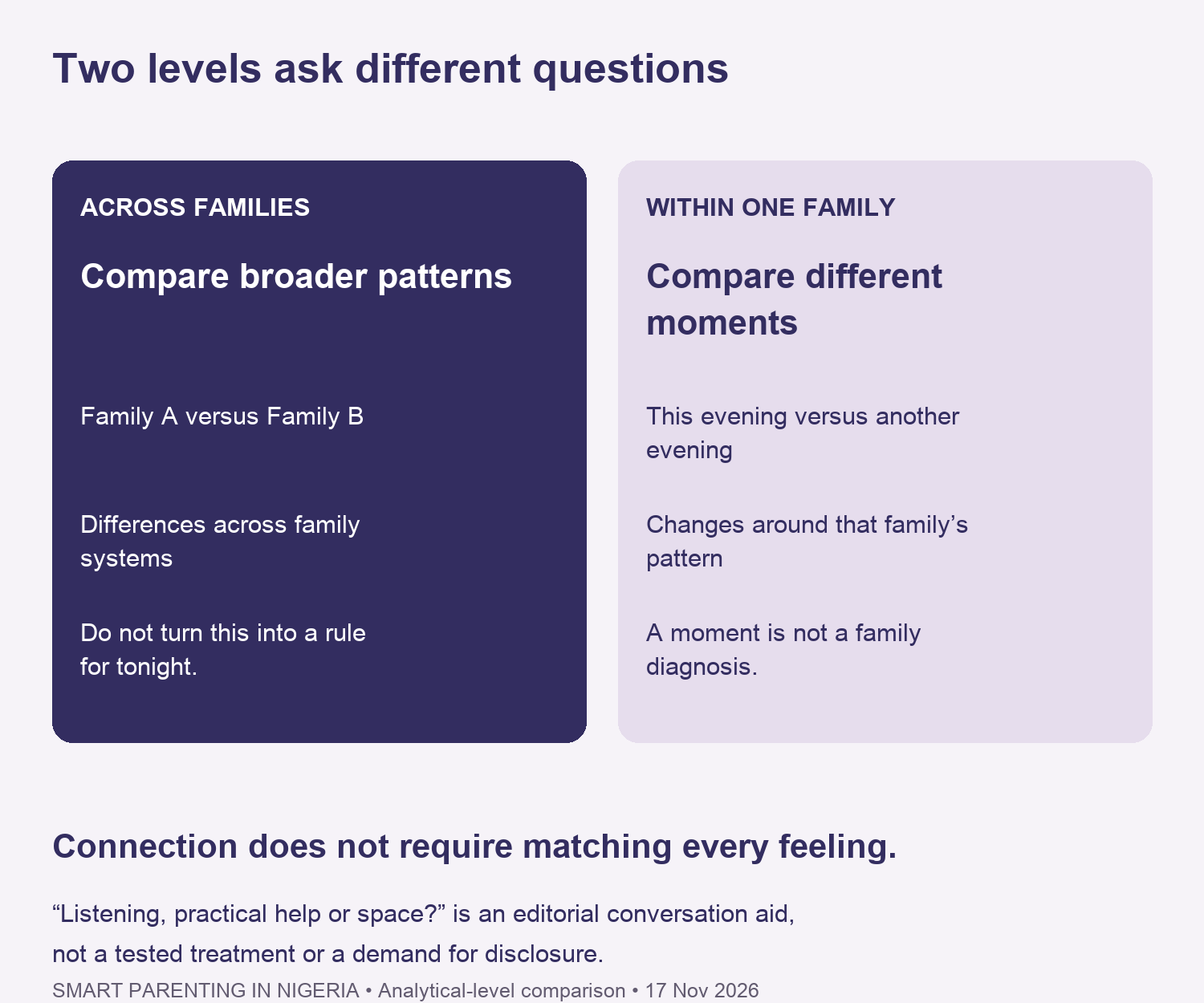
A between-family analysis compares broader patterns across families. In contrast, a within-family analysis asks about moments that differ from that family’s usual pattern. These questions can yield different associations without one being a mistake. Keep the level beside the result.
The paper reports that several person-level associations became much weaker after accounting for adolescents’ general affect. It also reports different momentary patterns. As a result, that complexity does not support a simple instruction to make everyone happier together or to avoid every shared negative feeling.
An association describes variables moving together in an analysis. It does not show that changing a parent’s mood will cause a teenager’s wellbeing to improve. The authors did not randomly assign families to a mood-matching intervention. They did not preregister the study.
Who was represented—and who was not?
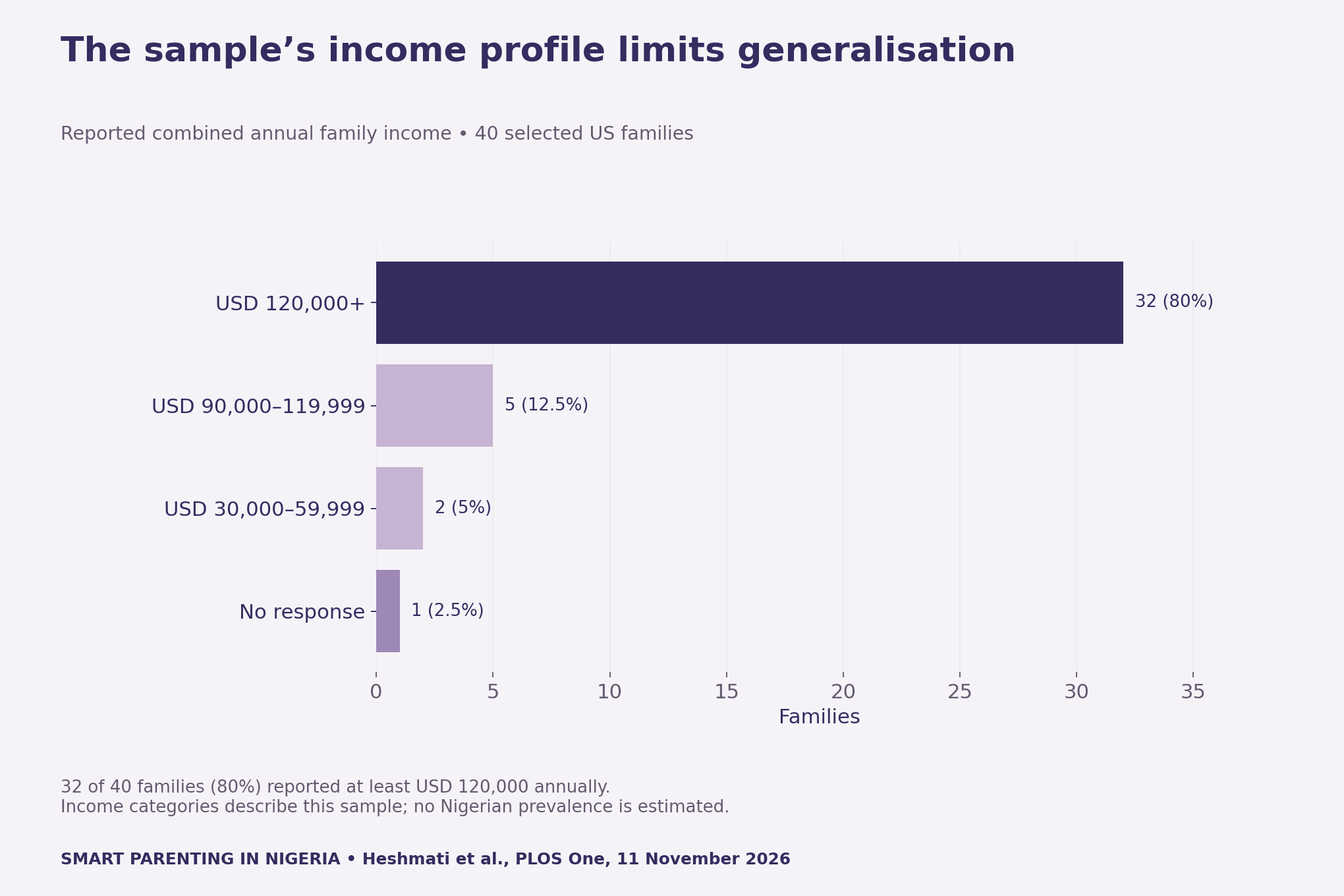
Recruitment ran from October 2024 to April 2025 using convenience and snowball methods. All three participants lived at the same US address, spoke English and owned smartphones. Eighty percent of families reported annual income of at least US$120,000.
For this reason, these features matter when Nigerian caregivers read the results. Household structure, resources, language and daily routines can differ. The study does not rank family types, establish Nigerian prevalence or show that a single-parent or extended-family household is deficient.
Offer support without asking for emotional agreement
Our optional conversation card offers one plain prompt: would you prefer listening, practical help or some space? It is an editorial suggestion for making a preference explicit. The study did not test that wording or show that using the card changes a clinical outcome.
Also, a teenager can decline to explain a feeling. Avoid turning a private note into a scorecard, surveillance log or test of gratitude. Record only what they want to share and any mutually agreed next contact. An adult’s wish for reassurance should not become pressure to disclose.
Finally, the blank card is private and non-diagnostic. It does not ask for a full mental-health history. Keep completed notes off public platforms. Persistent concerns can be discussed with a qualified professional; a research explainer cannot assess an individual teenager.
Method, boundaries and four CSV tools
We checked the open-access paper on 17 November 2026. The charts reproduce reported collection counts and sample income categories; the infographic explains analytical levels. We collected no new participant data and calculated no treatment effect.
The evidence-boundary file separates sample, units, analytical level and adjustment. For a related example of checking whether a finding applies to a local service, see our parenting-app programme evidence guide.
- Role-specific assessment counts and calculations (CSV)
- Reported sample-income categories (CSV)
- Research evidence and boundary table (CSV)
- Blank optional private conversation card (CSV)
Suggested citation: Smart Parenting In Nigeria, “Family Mood Research: Connection Does Not Mean Everyone Must Feel the Same”, 17 November 2026. Source: Heshmati and colleagues, PLOS One, doi:10.1371/journal.pone.0362751 (CC BY). Editorial explanations and calculations by this publication.
Parenting Made Just for You
Get personalized Parenting Solutions tailored to your child’s needs. Transform your parenting journey with expert guidance in 1-3 days.
Get Started


