




Baby bedtime regularity is easier to discuss when a family records more than one clock time. Preparation, lights out and estimated sleep onset answer different questions. A seven-night private log can keep those details clear without turning a research headline into a new feeding or sleep-training rule.
For Nigerian parents juggling work, care and household interruptions, the practical aim is a clearer conversation. This guide pairs a new study with three original charts, a timestamp infographic and four CSV downloads. The log observes the routine you already follow; it does not prescribe a bedtime.
What the baby bedtime regularity study measured
A Frontiers in Sleep study, published 10 November 2026, used caregiver reports from 417 families of children aged 6–36 months. Recruitment came from one Armenian hospital, December 2025–March 2026; 830 families were contacted. It is cross-sectional, not a Nigerian survey or treatment trial.
Its Infant Sleep score uses BISQ-R points, not minutes. Regularity means the same bedtime within 15 minutes, counted across zero to seven nights. This definition describes the analysis; it does not establish a target for your household. The data cannot determine whether changing one practice improves a particular child’s sleep.
Read baby bedtime regularity before and after adjustment
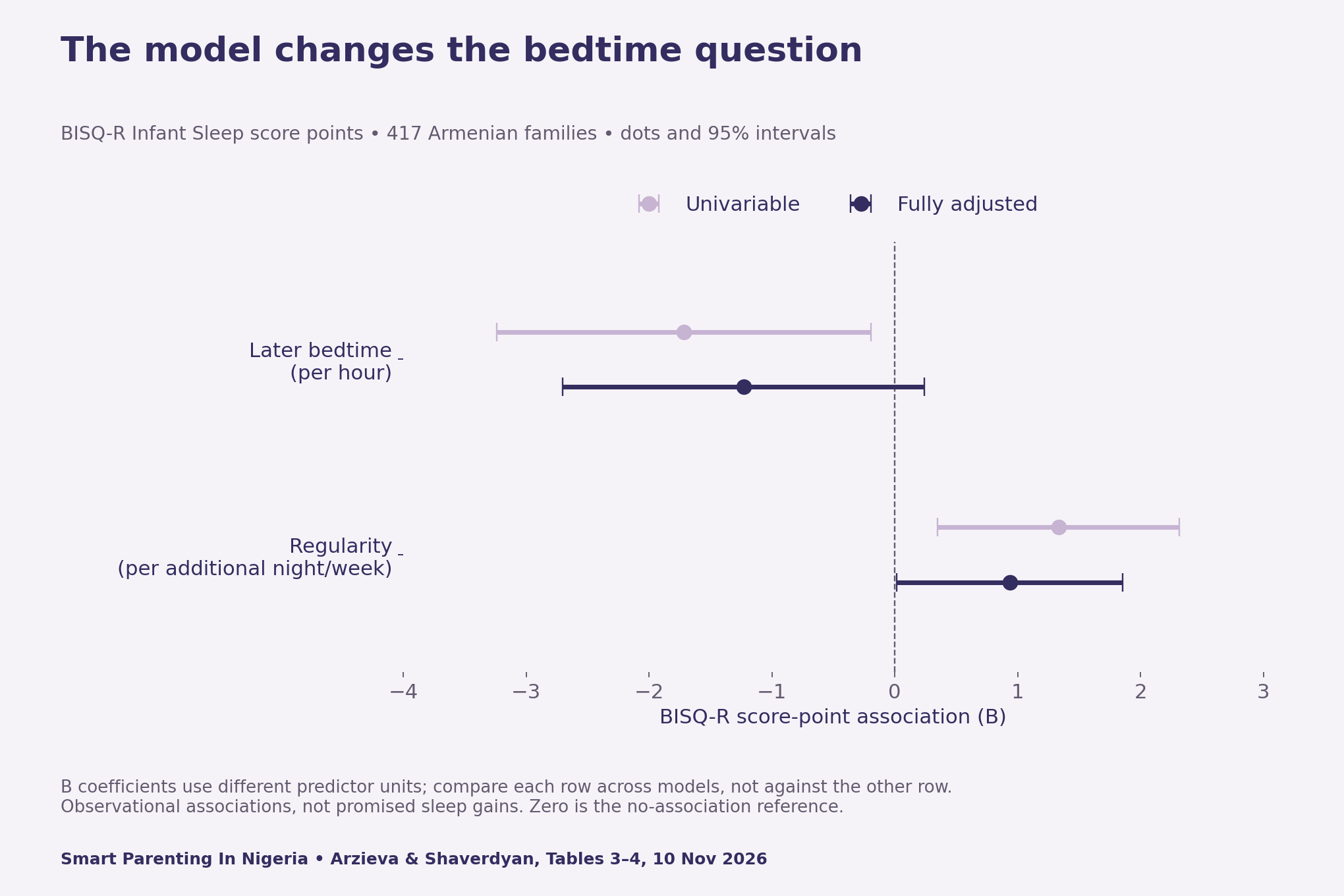
In the final model, regularity B was 0.936 (95% CI 0.015–1.857; p=0.047). Reported bedtime B was −1.230 (−2.700–0.240; p=0.101). These adjusted associations are score-point coefficients per additional regular night and per later hour, respectively—not promised gains from changing a routine.
The chart retains both intervals and the zero reference. A point alone could make the evidence look more precise than it is. Also, a result on one side of a conventional p-value threshold is not a personal instruction. Keep the model, unit and uncertainty attached whenever quoting the figure.
The model leaves most variation unexplained
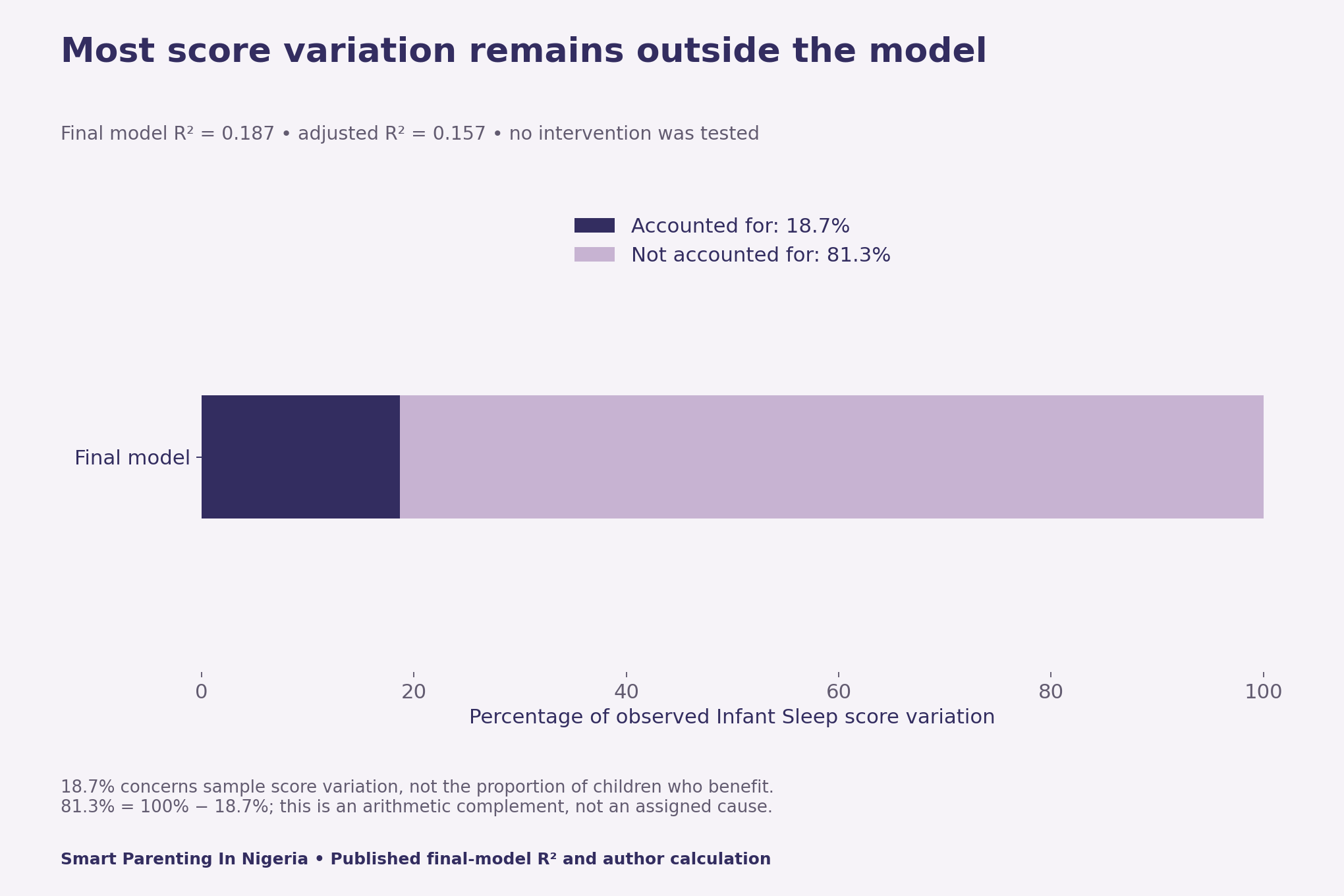
The final model R² was 0.187, with adjusted R² 0.157. Thus 18.7% of observed score variation was accounted for; 81.3% is the complement. Neither percentage describes children helped, hours recovered or the share of a family’s sleep difficulties caused by its routine.
For a reader, that distinction prevents an overly confident promise. A spreadsheet with precise times cannot remove uncertainty about a child’s health or family circumstances. Its value lies in keeping observations legible enough to discuss, rather than creating a new score to optimise.
Keep three timestamps separate
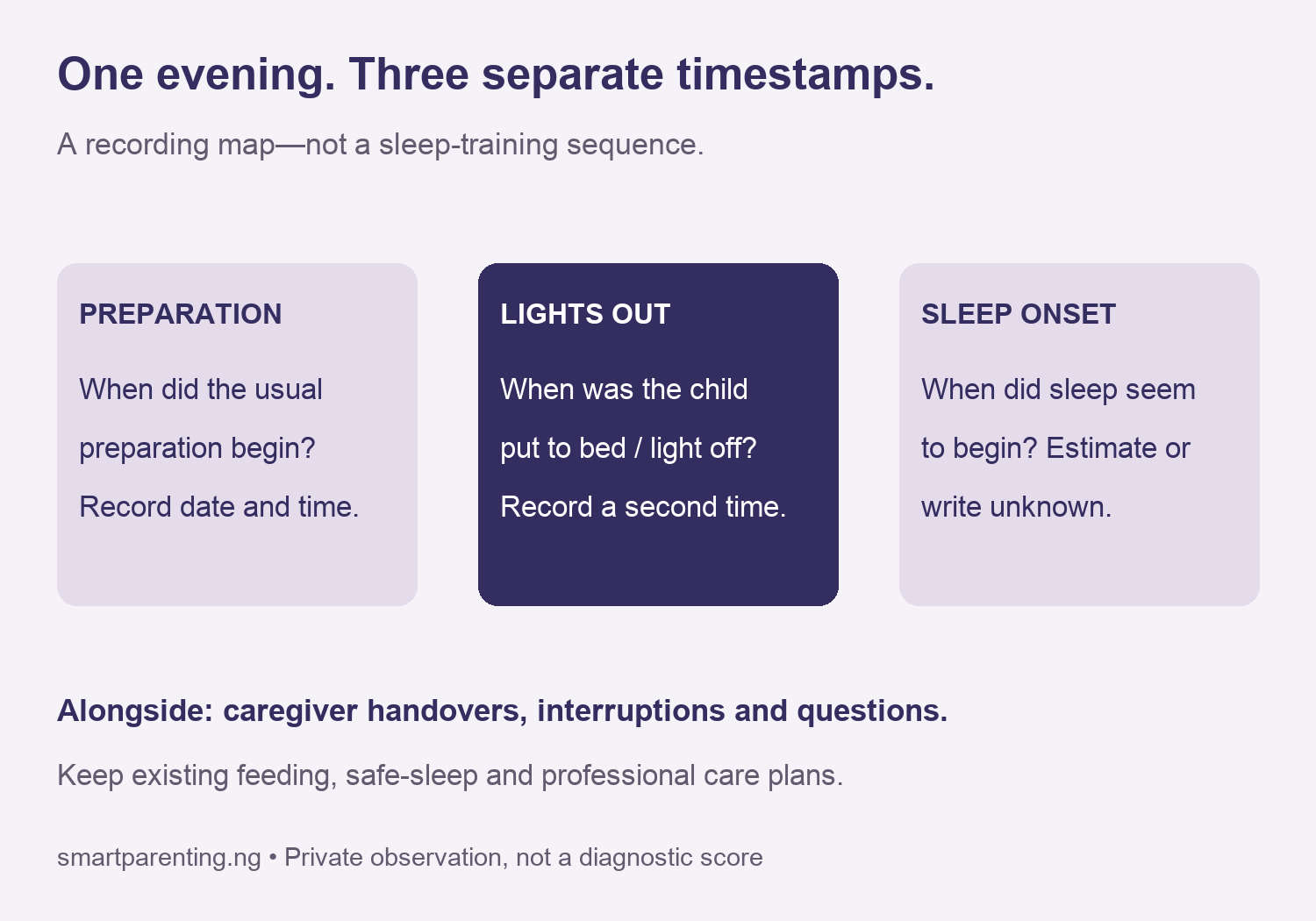
Start with one row per night. Record the calendar date and time when the usual preparation began. Then record lights out separately. Finally, estimate when sleep seemed to begin, or write unknown. Do not invent an exact minute to make the row look complete.
A short context note can explain a caregiver handover, an interrupted evening or an uncertain observation. Use neutral wording that another caregiver can understand. “Preparation restarted after a handover” is more useful than “bad night” when your question concerns the sequence of events.
Avoid asking anyone to watch constantly, delay responsive care or change an established feeding plan to improve the record. A blank cell is acceptable. This is a private communication aid, not a test of parenting, a validated diagnostic instrument or a reason to buy monitoring equipment.
Handle midnight with dates, not guesses
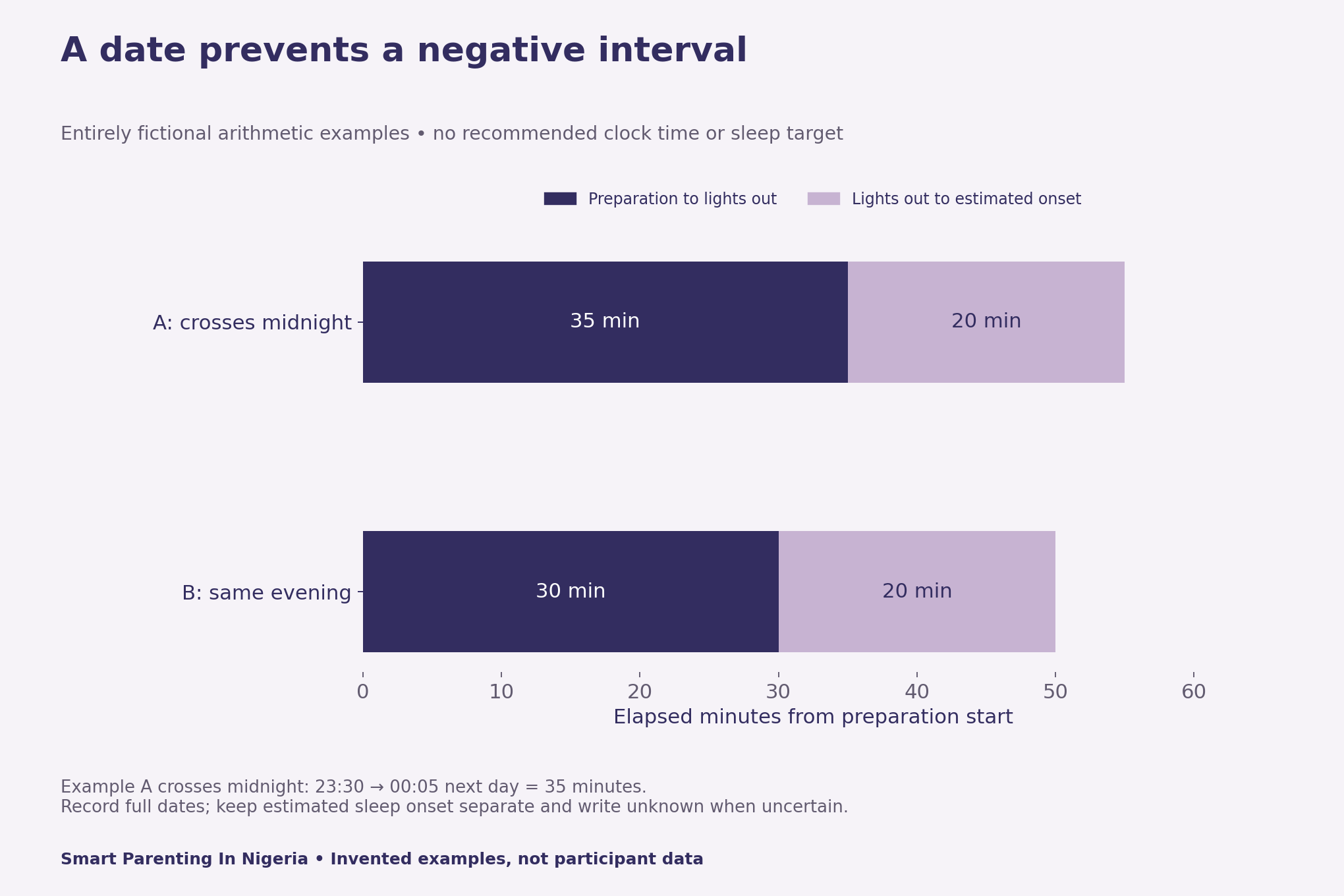
Suppose preparation starts at 23:30 and lights out is 00:05 the following day. The elapsed interval is 35 minutes. Subtracting the clock numbers without a date can produce a negative answer. Store the full date and time in each field, especially when the evening crosses midnight.
Keep preparation-to-lights-out separate from lights-out-to-estimated-onset. Combining them hides which interval your question concerns. The example CSV deliberately contains only two invented rows, clearly labelled. Do not compare your child with them or treat either row as a desired schedule.
Use the log for a focused question
| Observation | Question it can support | What it cannot establish |
|---|---|---|
| A caregiver handover changes the recorded sequence | Which time does each caregiver mean by bedtime? | Which caregiver caused a sleep problem |
| Some onset estimates are unknown | What observation would be useful to discuss? | A precise sleep measure from missing entries |
| A night crosses midnight | Are dates recorded consistently? | That a clock time is suitable for a child |
Choose one question for the next appropriate professional conversation. You might ask which details would help explain an existing concern. Bring the child’s current care plan into that conversation. This article does not recommend changing feeding, settling, medication, sleep surfaces or safe-sleep arrangements.
Our guide to reading childhood eczema evidence makes a similar distinction between a study association and individual advice. That review supplies no bedtime result. The transferable habit is to keep the measured outcome separate from a personal decision.
Parenting Made Just for You
Get personalized Parenting Solutions tailored to your child’s needs. Transform your parenting journey with expert guidance in 1-3 days.
Get StartedDownload the four bedtime record tools
- Selected study coefficients and confidence intervals (CSV)
- Bedtime measure dictionary (CSV)
- Blank seven-night private bedtime log (CSV)
- Fictional midnight arithmetic examples (CSV)
Method, privacy and limits
We transcribed the selected published coefficients and R², retained their units, and created the charts and blank log. No participant microdata were reanalysed. The first chart is a model comparison, the second a variation display, and the third an explicitly fictional time calculation. The log has no clinical scoring rule.
Keep completed records privately. Do not send a child’s identity, health history or completed log to us or post it publicly. There is no need to collect photographs or precise home locations. A useful record can remain brief, incomplete where necessary, and limited to the question you want to discuss.
Suggested citation: Smart Parenting In Nigeria (13 November 2026), “Baby Bedtime Regularity: A Private Seven-Night Log”, selected-source analysis and original record-keeping tools. Retain the observational limits and fictional-example labels when reusing the figures.


