





A child nosebleed first aid checklist should give caregivers one clear reference. It should not turn a survey’s answer key into treatment instructions. A new Syrian study highlights knowledge gaps, while established clinical guidance supplies the practical steps. Nigerian families also need verified local care contacts and a clear handover.
Featured image: AI-generated conceptual preparation scene. The blank-faced timer and household items are illustrative, not treatment products or a timing instruction.
First aid and urgent-care signs: read this block together
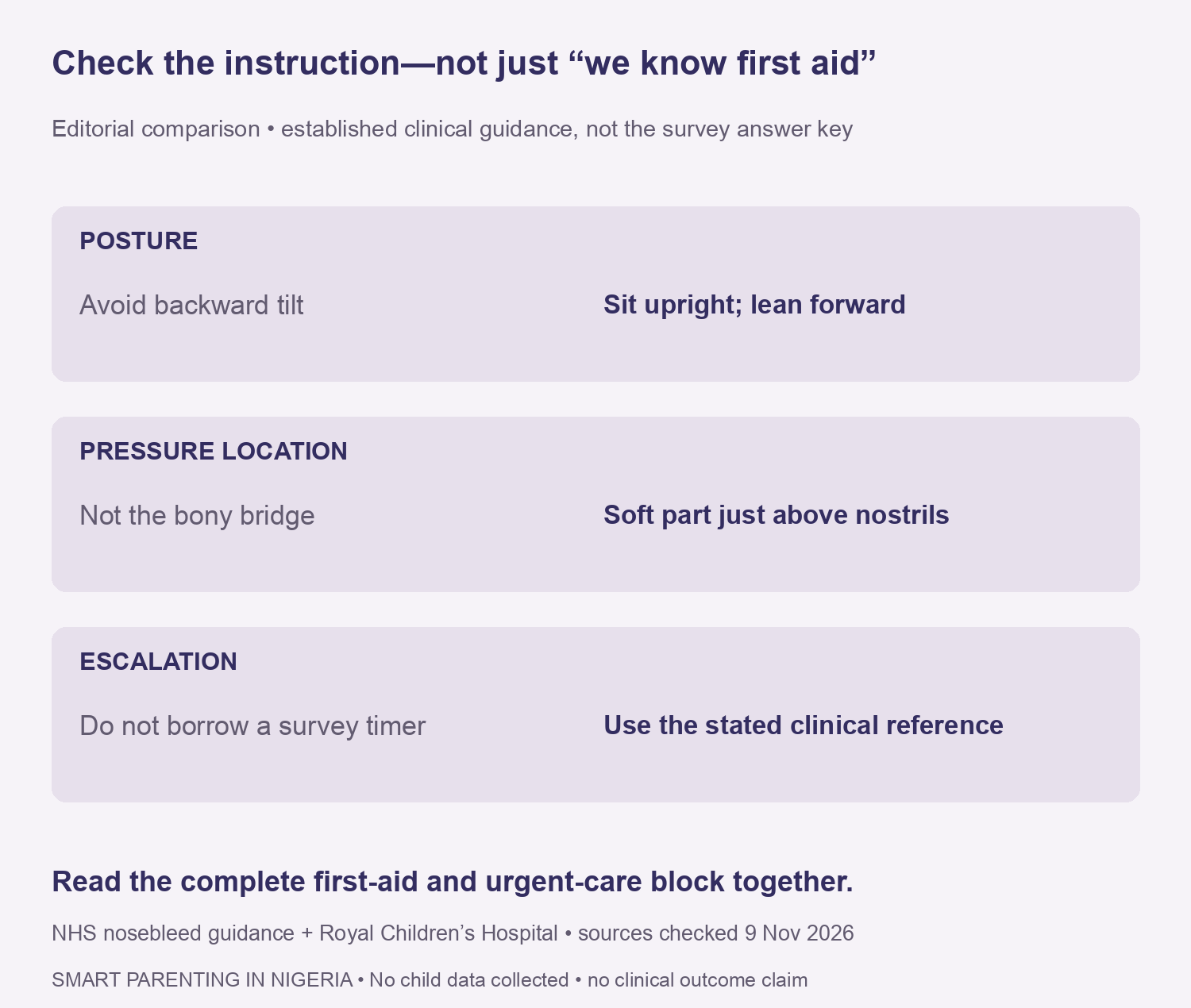
- For an uncomplicated nosebleed, sit upright, lean forward and breathe through the mouth. Pinch the soft part of the nose just above the nostrils for 10–15 minutes.
- Seek urgent medical assessment if bleeding lasts beyond 10–15 minutes, seems excessive, follows a blow to the head, or causes weakness, dizziness, breathing difficulty or vomiting after swallowing much blood. Do not wait for a timer if serious symptoms are present.
- Arrange medical advice for recurrent episodes or a nosebleed in a child under two.
- Use a verified local emergency or clinical service in Nigeria. This page does not supply a foreign service number or replace an individual clinician’s plan.
We therefore keep the first-aid block together. The research discussion below is background for planning; it is not a reason to delay care during an episode. If a child has an individual clinical plan, ask their treating professional how the household reference should reflect it.
What the child nosebleed first aid survey actually measured
The BMC Public Health paper by Hamdi and colleagues appeared on 6 November 2026. It describes an online convenience survey of 643 Syrian parents conducted from December 2025 to February 2026. It measured questionnaire responses, not recorded performance during actual nosebleeds or treatment outcomes in Nigerian children.
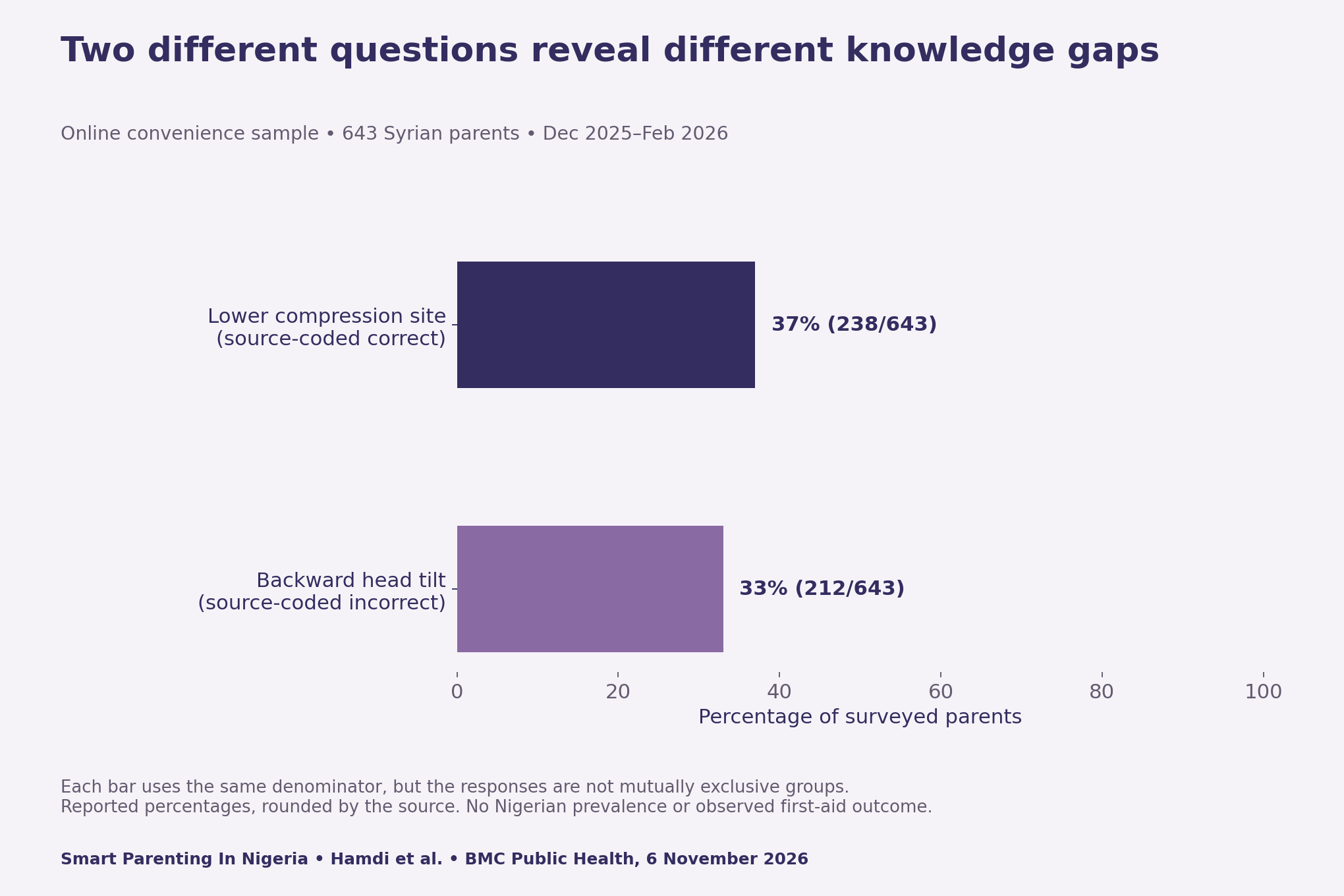
In the source’s multiple-choice table, 238 respondents, reported as 37%, selected the lower compression location. Separately, 212, or 33%, chose backward head tilt. Those are answers to different questions. However, they do not form two exclusive groups, so their percentages should not be added to describe a combined error rate.
A knowledge score cannot certify a caregiver
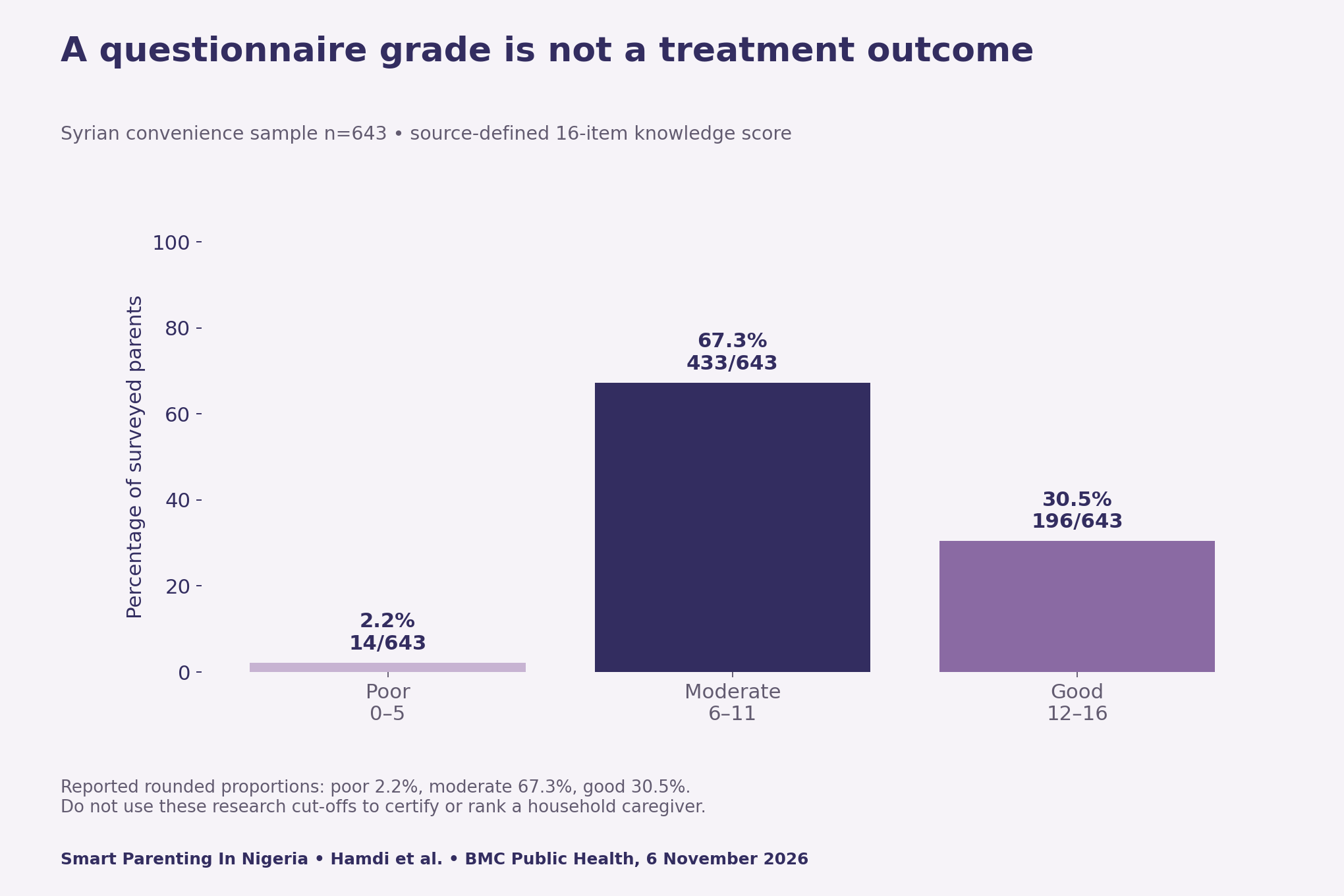
For comparison, the source grouped 196 respondents, or 30.5%, as having good knowledge. The other reported groups were moderate, 433 or 67.3%, and poor, 14 or 2.2%. The source’s score bands describe its research instrument. They are not a clinical licence, a household assessment or a reason to shame a caregiver.
In addition, first-aid course attendance was not significantly associated with the knowledge measure in the reported comparison, p=.16. That is not evidence that training never works. The researchers did not randomly assign a standard course or measure a common clinical outcome. A family can still ask a qualified professional to check its understanding.
Child nosebleed first aid: research versus guidance
The accepted manuscript’s Table 3 codes a 5–10-minute compression answer and an emergency answer after 20 minutes. Those are survey scoring choices. This article’s action block instead follows the NHS 10–15-minute instructions and persistence threshold. We do not average the figures or quietly substitute the survey’s timing.
The Royal Children’s Hospital’s June 2026-reviewed family guidance supports upright forward positioning and pressure on the soft area below the bony bridge. Its repeat-pressure protocol differs from the NHS wording. That difference is a reason to identify a single reference and obtain local clinical review, not to assemble a longer waiting period from multiple websites.
| Material | What it establishes | What it does not establish |
|---|---|---|
| Syrian survey | How this convenience sample answered selected questions | A treatment protocol or Nigerian prevalence |
| Established clinical guidance | Source-specific first-aid and escalation instructions | An individual child’s diagnosis |
| Household handover card | Verified contacts and the agreed reference location | Proof of competence or guaranteed bleeding control |
Prepare a private child nosebleed first aid handover card
To support that handover, the blank card records a verified local clinic, local emergency contact, checking date and the clinical reference agreed with a qualified professional. It also records where caregivers can find the information. There is no child-name field, symptom score or upload form. Keep completed contact details private.
Next, for a practical handover, ask whether the next adult knows which reference is current and where to find it. Agree who contacts the clinic when needed and how another caregiver will be informed. These are original editorial planning questions; the Syrian study did not test this card or measure its effect.
However, do not provoke bleeding to test someone’s technique. This report gives no home cautery, packing or medication instructions. A private worksheet cannot establish why bleeding happened. Unresolved questions about recurrent episodes, unusual bleeding or an individual care plan belong with an appropriately qualified health professional.
Our parent-support and appointment-agenda report addresses a different health question and should not be used for nosebleed treatment. Our screen-content evidence report offers another example of separating survey or screening measures from clinical outcomes.
Download the source tables and blank caregiver tool
For transparency, the first CSV contains the two selected response counts and exact question context. A second records source-defined knowledge groups. The guidance matrix preserves the timing distinction for a reviewer. The fourth file is a blank handover card. None contains participant records, a treatment prediction or collected Nigerian child data.
- Selected Syrian survey responses and denominators (CSV)
- Source-defined knowledge groups (CSV)
- Survey versus clinical-guidance matrix (CSV)
- Blank private caregiver handover card (CSV)
Methods and limitations
Finally, we checked the publisher’s early-access page, the full accepted manuscript and established NHS and Royal Children’s Hospital guidance on 9 November 2026. The paper remains subject to editing. The source’s convenience recruitment and educational mix limit generalisation; self-reported knowledge is not observed technique. Therefore, we estimate neither Nigerian prevalence nor a reduction in clinical harm.
Parenting Made Just for You
Get personalized Parenting Solutions tailored to your child’s needs. Transform your parenting journey with expert guidance in 1-3 days.
Get StartedSuggested citation: Smart Parenting In Nigeria, 9 November 2026, “Child Nosebleed First Aid: Audit Caregiver Instructions.” Attribute survey findings to Hamdi and colleagues, DOI 10.1186/s12889-026-30290-3. The original charts present selected facts without copying the questionnaire or source graphics. Our handover worksheet is an unvalidated planning aid, not a clinical assessment.


