




Air pollution childhood eczema evidence needs an outcome check before it becomes advice for a family. Having eczema, developing a new case, experiencing greater severity and attending a clinic are different measures. A headline that moves between them can imply more than a study establishes.
For Nigerian parents, this guide explains how to read a new review and prepare better questions for a clinician. Two forest plots keep the verified estimates and confidence intervals visible. An outcome-ladder infographic and four CSV tools help separate a research finding from an individual cause or a product promise.
What the air pollution childhood eczema evidence covers
The JAMA Pediatrics review was published on 9 November 2026. Its searches ran through 10 February 2026, and 52 observational studies were included. It analysed ambient pollution and several atopic-dermatitis outcomes in children. It was not a trial of home air cleaners.
Publication in November does not mean all measurements were collected then. Equally, pooling studies does not turn their observations into an experiment. The source can inform an evidence conversation without identifying the cause of symptoms in one child or estimating the burden in a Nigerian community.
Read the two particulate-matter estimates
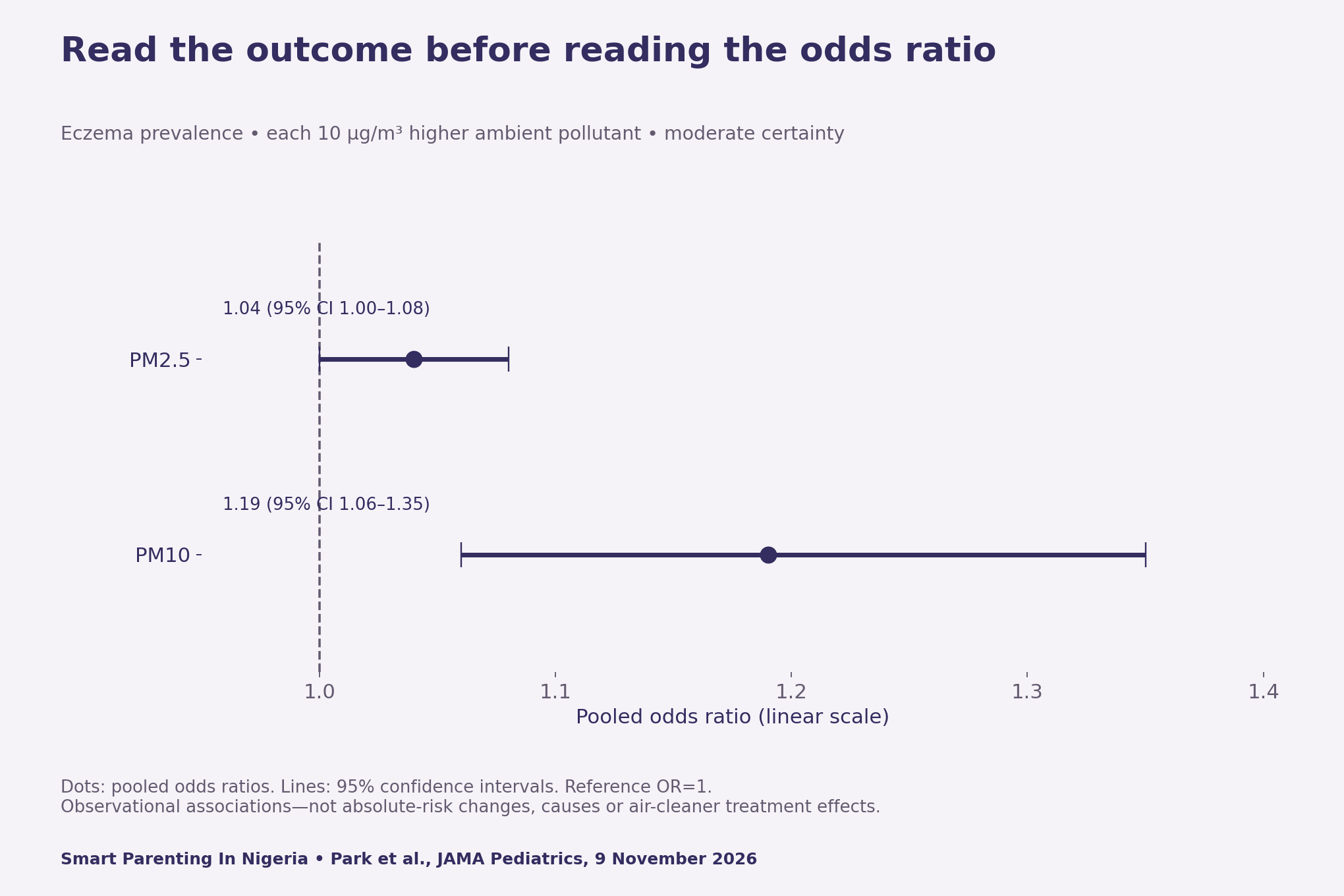
For each 10 µg/m³ increment, the review reports prevalence ORs of 1.04 (95% CI 1.00–1.08) for PM2.5 and 1.19 (1.06–1.35) for PM10, both with moderate certainty. These are ratios of odds for the specified outcome and exposure comparison, not percentage-point changes in a child’s risk.
Keep the interval with the point estimate. It communicates uncertainty that a single large headline number would hide. The PM2.5 interval reaches the reference value at the precision reported. We retain those published limits rather than claiming a precise personal prediction.
Clinic visits are not the same as eczema prevalence
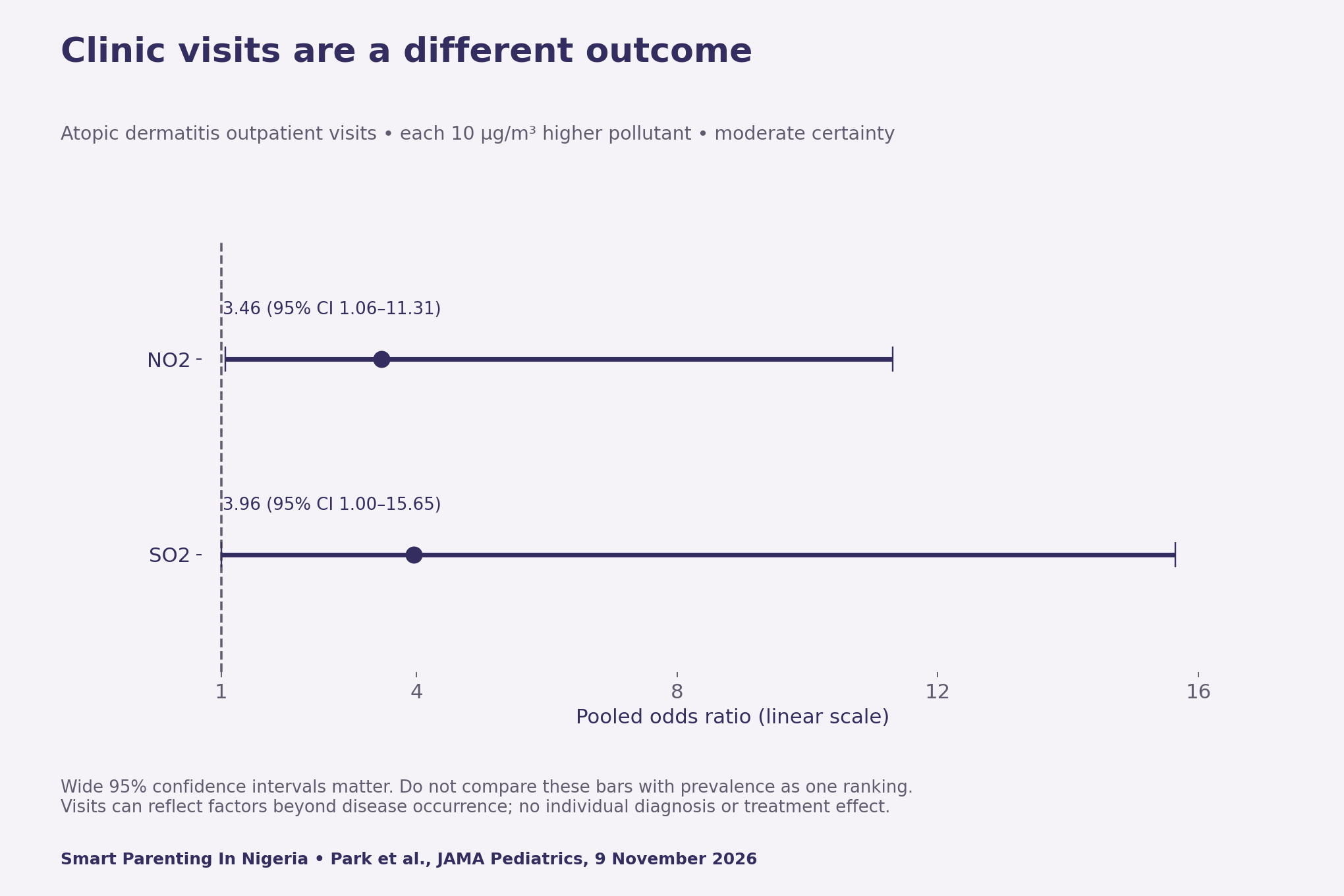
For outpatient visits, the review reports OR 3.46 (95% CI 1.06–11.31) for NO2 and 3.96 (1.00–15.65) for SO2 per 10 µg/m³. Both are moderate-certainty associations. Their wide intervals matter. Findings for incidence and severity were mixed or did not support associations.
A consultation count also asks a different question from whether someone has a condition. Avoid ranking pollutants by placing all four point estimates in one bar chart while ignoring those outcomes and intervals. We use two plots precisely to keep that difference visible.
Use the eczema outcome ladder
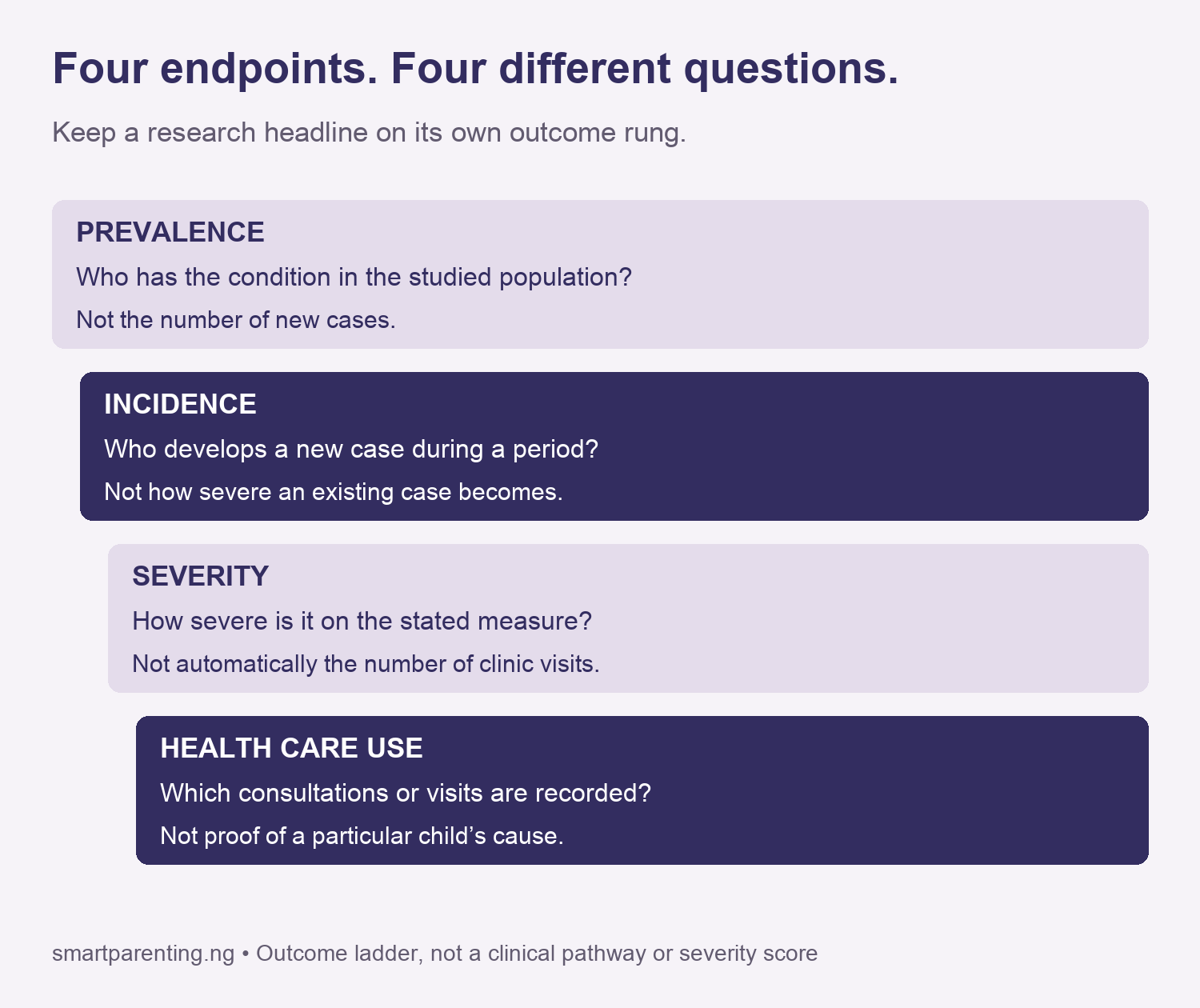
When reading a new article, underline its outcome first. Next, ask whether the evidence behind the headline measured that same outcome. If a marketing claim promises fewer flares but cites a prevalence association, record that mismatch. The source has not automatically tested the promised benefit.
| Claim you encounter | Question to ask | What remains separate |
|---|---|---|
| Pollution caused this child’s eczema | What evidence identifies an individual cause? | A population association alone does not do that. |
| This device prevents flares | Was that device compared on flare outcomes? | Ambient-exposure evidence is not a product trial. |
| An OR is a percentage-point change | What is the outcome and valid baseline? | Odds and absolute risk are different measures. |
| A clinic-visit result proves severity | What did the study actually count? | Health care use and severity are distinct endpoints. |
Prepare a private appointment question list
Use the blank question sheet to organise what you want to discuss alongside the child’s existing care plan. A brief description of an observation and its timing may help explain your question. Keep a suspected environmental link labelled as a question; noticing two things together does not prove that one caused the other.
The worksheet is not a diagnostic diary or exposure test. It has no severity total, pollution threshold or treatment instruction. It does not ask you to stop care while gathering notes. Follow the child’s established professional plan and raise personal concerns with an appropriately qualified clinician.
Keep completed notes privately. There is no need to upload a child’s identity, photograph, school location, health history or completed worksheet to us. Avoid turning an appointment discussion into blame about where a family lives or what it can afford. The purpose is clearer questions, not an individual causal verdict.
Check a product claim on its own evidence
If a product advertisement cites this review, use the separate audit sheet. Record its exact claim and whether the cited research actually tested that product, population and outcome. Unknown remains unknown. This report supplies no purifier recommendation, promised risk reduction or evidence that buying equipment changes a child’s eczema.
Our food-message discussion guide uses a related distinction between a persuasive claim and the evidence for it. That US marketing study supplies no eczema or pollution result. Only the habit of checking the claim transfers.
Download the four evidence-reading tools
- Pollutant, outcome and confidence-interval matrix (CSV)
- Endpoint and odds-ratio dictionary (CSV)
- Blank private clinician question sheet (CSV)
- Blank environmental-product evidence audit (CSV)
Method and limits
We used the accessible primary abstract, transcribed four selected estimates and intervals, and drew original forest plots. Two outcome-specific figures serve the question; extra statistical charts would add no established information. We did not independently reanalyse the underlying studies or convert odds ratios to absolute risks without a valid baseline.
Parenting Made Just for You
Get personalized Parenting Solutions tailored to your child’s needs. Transform your parenting journey with expert guidance in 1-3 days.
Get StartedThe pooled results do not quantify Nigerian exposures or diagnose an individual child. No treatment, feeding, medication or skin-care change is prescribed here. A research summary can make an appointment conversation more precise while leaving clinical decisions with the appropriate professional.
Suggested citation: Smart Parenting In Nigeria (13 November 2026), “Air Pollution and Childhood Eczema: Read the Evidence”, selected-source analysis, outcome-specific charts and private reader tools. Retain the exposure increment, endpoints, intervals and limitations with reused figures.


