






A preschool fears family routine checklist can help a caregiver describe what is happening before an appointment. It should not label a parent as the cause, turn ordinary fear into a diagnosis or prescribe a change in support.
A 12 November exploratory study of parental accommodation examined 93 Australian treatment-seeking families with children aged 3–6. Accommodation means adjustments intended to reduce a child’s distress. The analysis linked greater accommodation with impairment and parenting stress, but did not establish which caused which.
Preschool fears family routine checklist: understand the sample
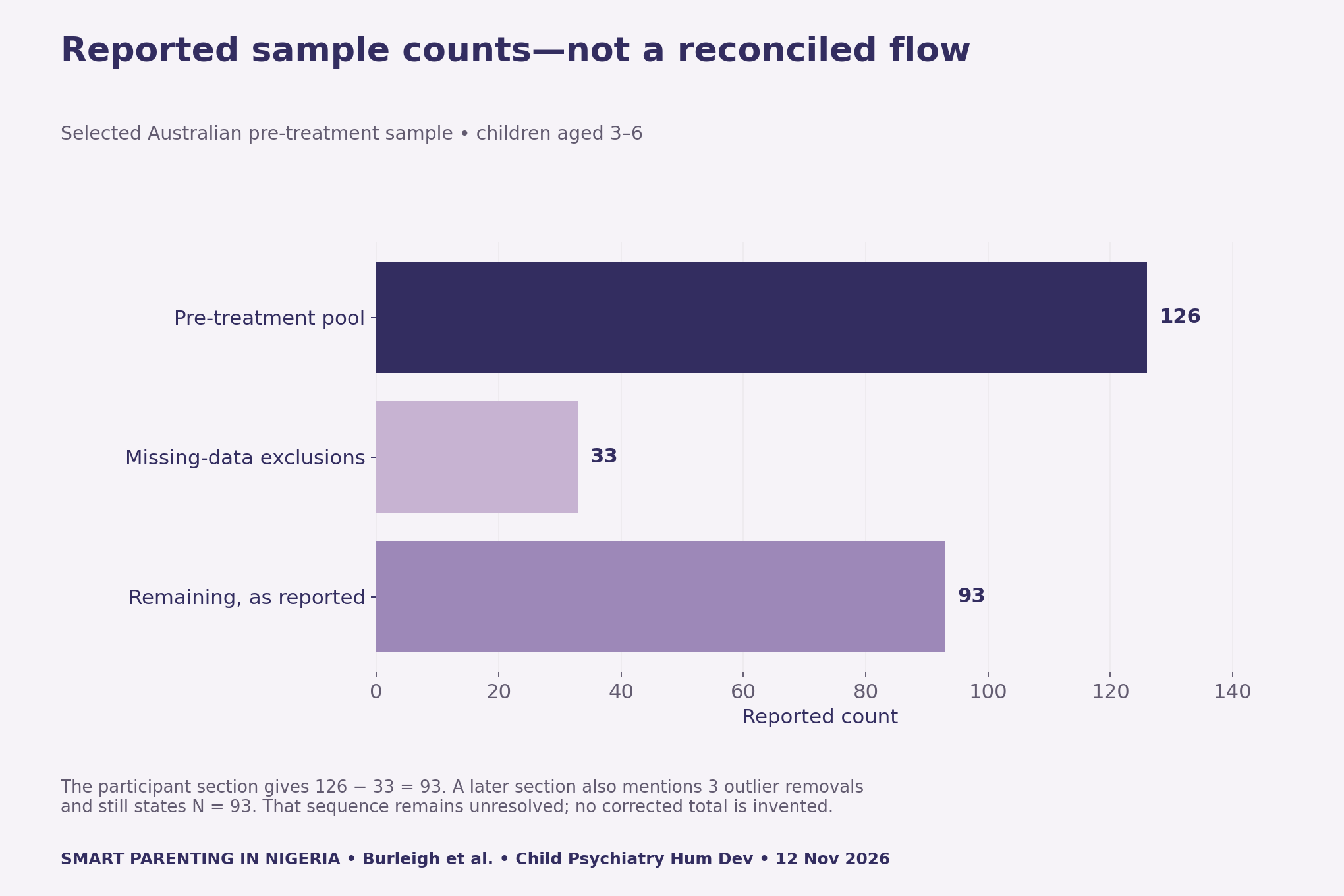
The sample was predominantly affluent, two-parent and represented by mothers. It cannot estimate Nigerian prevalence. The paper used cross-sectional pre-treatment information; it did not test our checklist. Its statistical pathways also worked in reverse, leaving causal direction unresolved.
The count audit matters because a neat-looking chart can hide a reporting problem. Here, the participant section’s subtraction works, but the later outlier sentence does not explain how it fits that sequence. Accordingly, the downloadable audit preserves the statements separately. We have not reconstructed individual records.
Describe a pattern without assigning blame
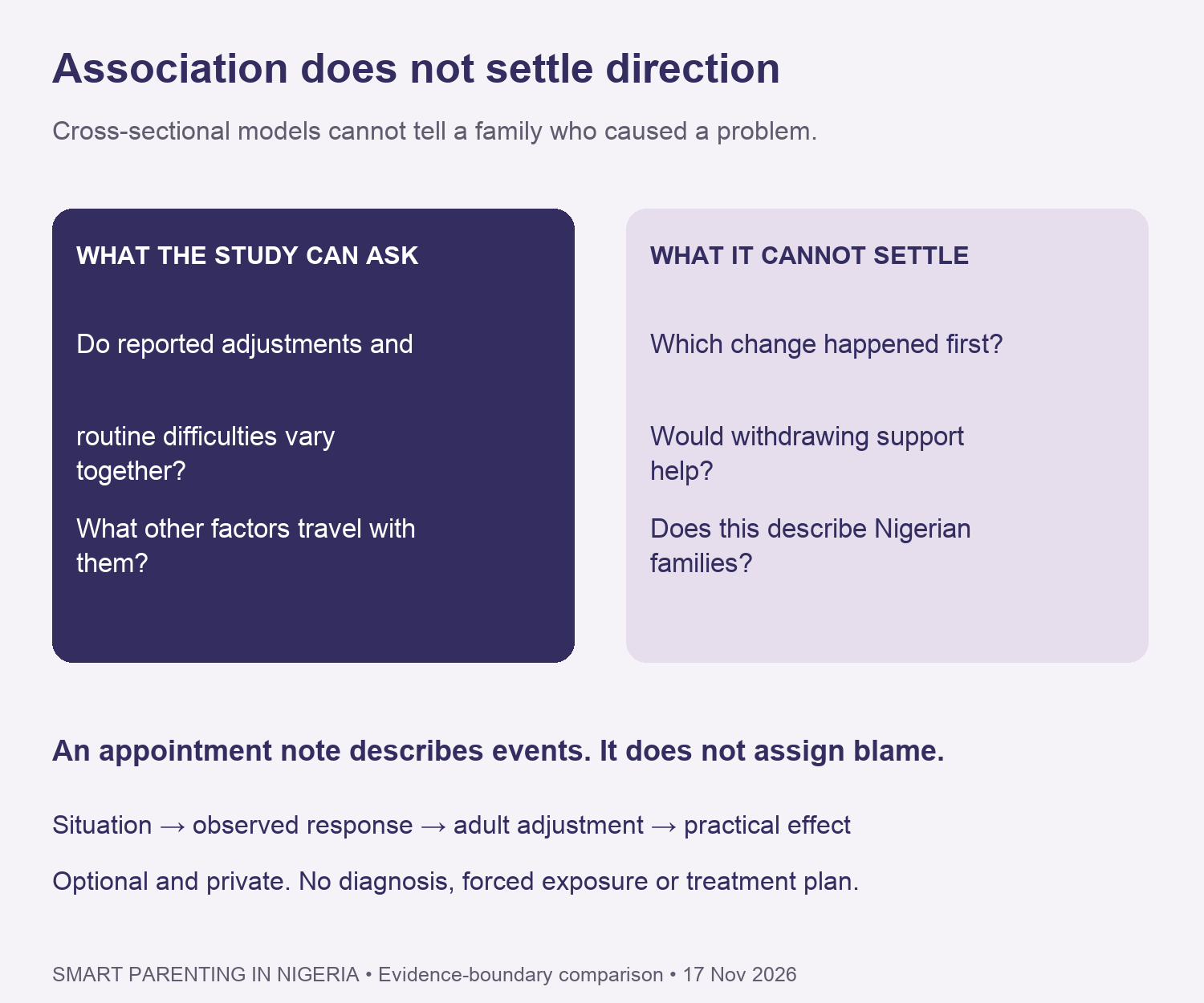
A child expressing fear is not, by itself, a complete account of a family’s difficulties. For an appointment, a factual example can be more useful than a broad judgement such as “we always give in”. Describe the situation and its practical effect without deciding what it proves.
For example, a fictional note might say: “We planned to leave for an activity. Our child cried at the doorway. We changed the plan, and the activity did not happen.” That records an event, an adult adjustment and a consequence. It does not establish a diagnosis or explain why the event occurred.
Likewise, write down what remains uncertain. You may not know whether tiredness, an unfamiliar place or another circumstance mattered. Leave room for the professional’s questions. A worksheet cannot reliably separate those explanations, and a blank field is better than an invented answer.
Prepare a short private note for an appointment
First, choose a small number of concrete examples you want to discuss. Our optional log separates the situation, the observed response, an adult’s adjustment and the effect on the routine. It has no score, diagnostic cutoff or required daily target.
Next, describe what changed in plain words. Avoid labels such as “manipulative”, “weak” or “bad parenting”. If you quote a child, keep only what helps explain the concern and respect their privacy. There is no need to share the completed file with this website.
Also, record your question. You might ask what further information would help, what assessment is appropriate or what support options fit your circumstances. The separate appointment-question file leaves space for answers about follow-up, referrals and costs.
Finally, discuss persistent routine disruption with an appropriately qualified child-health or mental-health professional. Take the note as context, not as proof of a preferred diagnosis. A professional may need a broader history and information beyond what this article can collect.
Keep support decisions separate from the research chart
This article provides no forced-exposure exercise, punishment strategy or medication advice. It does not recommend abruptly withdrawing support. An association in a selected sample cannot tell an individual Nigerian household which response to change or how quickly to change it.
Similarly, do not use the log to rank families or monitor a child for compliance. Keep completed notes private, limit unnecessary identifying information and decide who needs access. An empty template can be shared; a child’s personal history should not become a public discussion thread.
For a related example of separating observation from a family rule, read our family-mood research guide. Different evidence types require different conclusions, even when the topic feels familiar.
Method, boundaries and four CSV resources
We checked the open-access full text on 17 November 2026. The chart reproduces stated sample counts, with the unresolved sequence visible. We collected no new family data, inferred no local prevalence and calculated no treatment benefit.
Parenting Made Just for You
Get personalized Parenting Solutions tailored to your child’s needs. Transform your parenting journey with expert guidance in 1-3 days.
Get StartedThe evidence file records the study’s limits. The two blank resources support appointment preparation only. They are optional and non-diagnostic; no validation or clinical benefit of these editorial tools has been established.
- Reported participant-count audit (CSV)
- Study evidence and boundary register (CSV)
- Blank private routine-disruption log (CSV)
- Private appointment-question sheet (CSV)
Suggested citation: Smart Parenting In Nigeria, “Preschool Fears: Record Routine Disruption Before Changing How You Respond”, 17 November 2026. Source: Burleigh and colleagues, doi:10.1007/s10578-026-02115-2. Original chart, infographic and editorial templates by this publication; no source figure reproduced.


