




Questions about a child’s antibiotic prescription belong with the prescriber or pharmacist who can explain the written plan. This report starts after a clinician has prescribed an antibiotic. It helps a parent clarify instructions and pass them accurately to the next caregiver; it does not choose treatment.
WHO’s World AMR Awareness Week runs from 18–24 November 2026. The campaign is a timely reason to check communication, not a new estimate of Nigerian prescribing. Our original blank handover card keeps clinical answers with the qualified provider. A historical local study shows why item-level wording and denominators also deserve care.
Questions about a child’s antibiotic prescription: the local evidence
Omole and colleagues’2022 study surveyed 270 caregivers of under-fives in Unguwan Dosa, Kaduna metropolis. Table 2 reports 38 always,153 sometimes and 79 never obtaining antibiotics from a pharmacy without a prescription. For stopping a course when the child improved, the counts were 45,98 and 127. Each row totals 270; the chart calculates each count divided by 270.
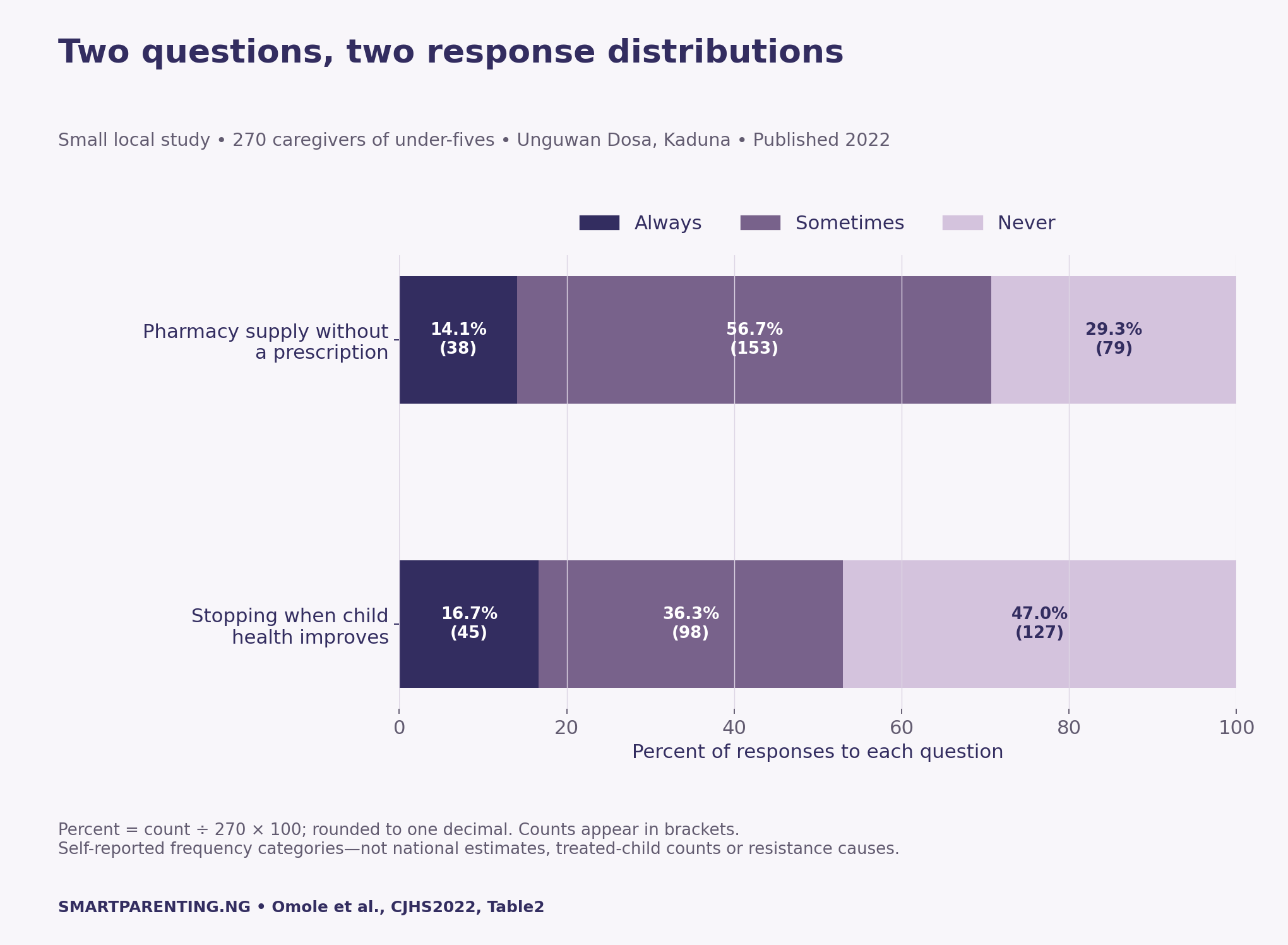
The two rows are separate questions, not groups to add together. The same respondent could answer both. A response labelled “sometimes” is a frequency category, not a count of prescriptions or children treated. The study’s cross-sectional design and self-reporting limit what it can establish. It does not show why resistance occurred or evaluate this card.
Ask for a written plan you can understand
CDC appropriate-use guidance says to take antibiotics exactly as prescribed and avoid sharing or saving them for later. The American Academy of Pediatrics medication-administration policy supports clear written information, checking understanding and communication between caregivers. These sources support a conversation with a qualified provider, rather than replacing that conversation.
Ask the prescriber or pharmacist to explain the label and written instructions in language you understand. Bring up any wording you cannot interpret. Keep the instructions with the medicine so the adult giving it has the current plan. This article deliberately leaves clinical fields blank: there are no sample doses, schedules or treatment durations to copy.
Questions about a child’s antibiotic prescription: read back and check
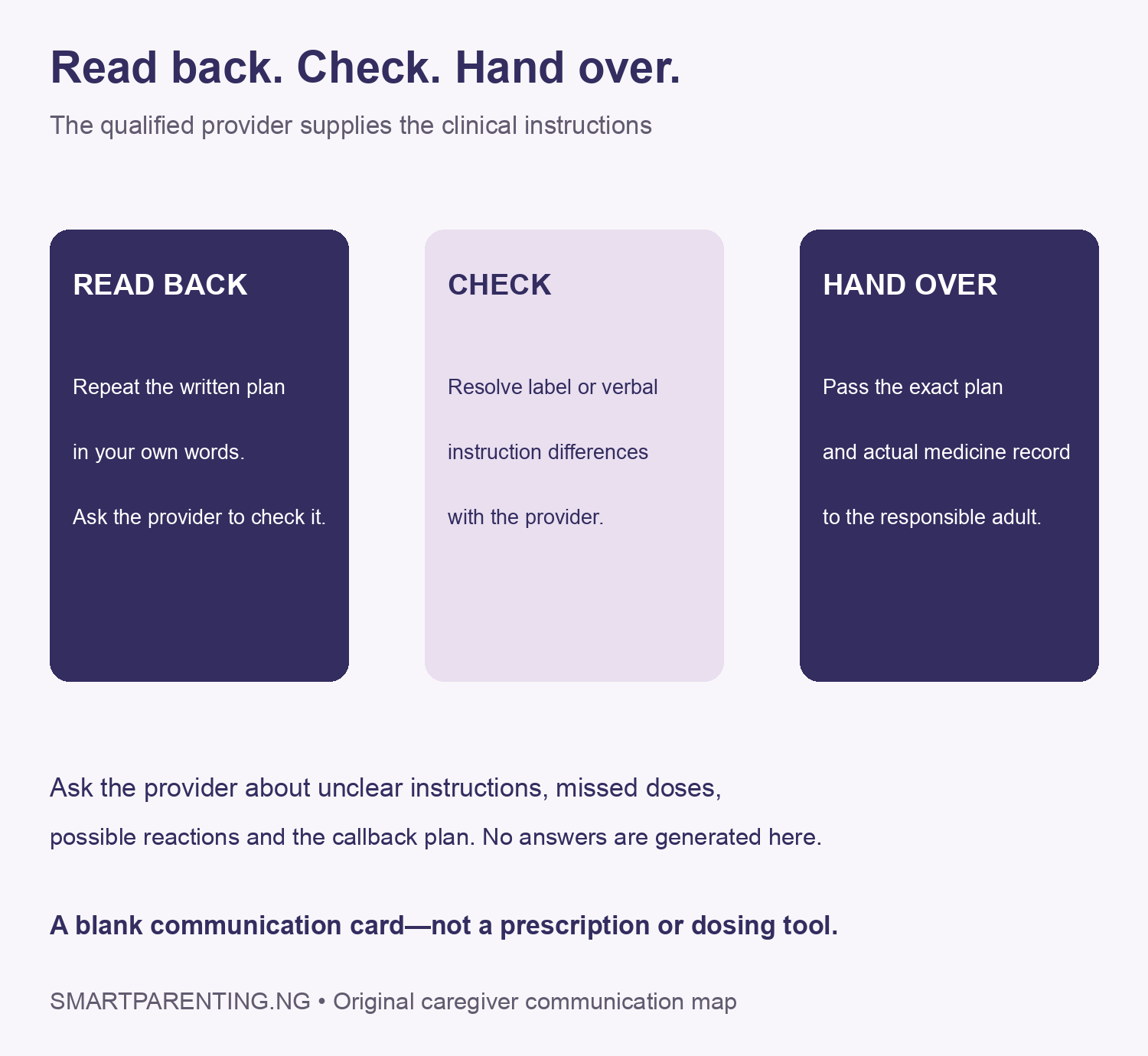
After the provider explains the plan, repeat your understanding and ask them to check it. This gives the provider an opportunity to correct a misunderstanding before the information passes to someone else. Reading back is a communication check; it does not turn a parent into the person deciding the prescription.
If the label and spoken instructions differ, contact the prescriber or pharmacist to reconcile them. Do not improvise an interpretation from an online example. Record the clarified instructions only after the qualified provider supplies them, including how that provider wants you to contact them with further questions.
Put unanswered questions on the card
Useful prompts include: Which part of the label needs explaining? What should I do if a scheduled dose is missed? Which possible reactions and callback instructions apply to this prescription? Ask the qualified provider for the answers. The blank download has a place to record that conversation but supplies no generic clinical response.
Keep an unresolved question visible until the provider clarifies it. A filled space is not evidence that the answer is correct, and a missing answer should not be replaced with a guess. The purpose of the card is to make a communication gap apparent, not to decide how a particular child should be treated.
Questions about a child’s antibiotic prescription: hand over privately
Share the exact current plan with the adult who will actually give the medicine. Include the responsible caregiver’s actual record of what has already been given, rather than relying on an assumption that someone else remembers. Ask the provider how they want that record kept and checked for this prescription.
Do not post a completed card in a group chat or upload a child’s medicine history to an unofficial tool. Our blank template does not request a child’s name, school or identifiers, and we do not collect completed cards. Keep it with the responsible adults and the relevant health professional only as needed for care.
Use this resource within its limits
This guide provides no medicine selection, dose calculation, duration change, stop-or-restart instruction or remote assessment. It is not an emergency algorithm. The child’s qualified provider supplies the individual plan and the instructions for further contact. No antibiotic sales or affiliate links are attached to the resource.
Read related Child Health and Nutrition reporting and our Research & Reports archive. Unlike a guide about deciding when to visit a facility, this tool concerns accurate communication after a prescription already exists.
Methods and downloadable files
We transcribed two specified items from Table 2 and checked that each set of three counts sums to 270. We calculated percentages from the counts rather than copying rounded whole percentages. The chart retains all three response categories and uses a 100% scale for each item. We did not use the abstract’s overall practice grade as the finding.
Parenting Made Just for You
Get personalized Parenting Solutions tailored to your child’s needs. Transform your parenting journey with expert guidance in 1-3 days.
Get StartedPublication in 2022 does not make these observations a 2026 estimate. They concern a small local sample, use self-reported past practices and cannot establish causation. The blank card and communication map are original editorial tools, with no effectiveness result claimed. They require the provider’s actual instructions to be useful.
- Selected Kaduna study item counts (CSV)
- Response percentage calculations (CSV)
- Blank private prescription read-back and handover card (CSV)
- Questions for the provider and resource boundaries (CSV)
Sources: Omole et al., Calabar Journal of Health Sciences 2022, Table 2, doi 10.25259/CJHS_36_2021; WHO AMR Week 2026; CDC appropriate antibiotic use; AAP, Preventing Home Medication Administration Errors 2021. Suggested citation: Smart Parenting In Nigeria, “Your Child’s Antibiotic Prescription: What to Clarify Before You Leave”, research prepared 21 November 2026. Educational communication resource; no individual treatment advice.


