




A discipline agreement for caregivers starts with what the adults will do. When a child moves between parents, relatives or other carers, one private no-harm plan can make the agreed response clear. It should not make the child responsible for reconciling adult disagreements.
On 19 November 2026, UNICEF reported 283 pledges from 94 countries at the close of the Manila conference on ending violence against children. These are commitments, not measured changes in caregiving. A separate November UNICEF brief describes violent discipline at home affecting about two in three children globally. We do not calculate a Nigeria-versus-world gap from those headlines.
Discipline agreement for caregivers: read the Nigerian evidence
Nigeria MICS 2021, Table PR.2.1, reports 90.4% experiencing any violent discipline in the prior month among children aged 1–14. The total base printed in the table is 71,519. It also reports psychological aggression at 84.6%, any physical punishment at 78.0% and severe physical punishment at 29.2%. The survey is historical; these are not 2026 prevalence estimates.
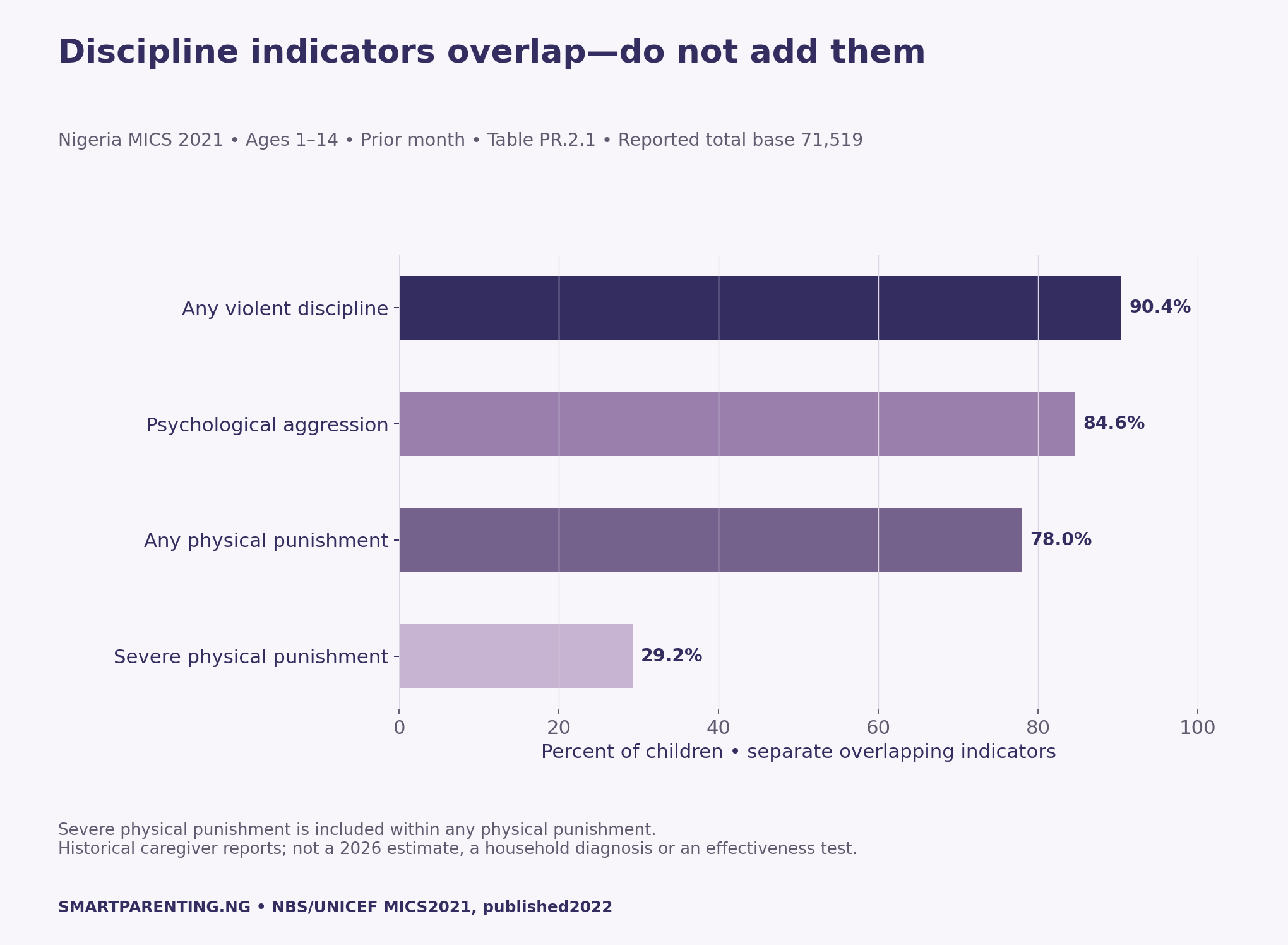
A single child can appear in more than one indicator. Separate bars preserve that relationship better than a pie chart or a stacked total. We also avoid turning rounded percentages into exact numbers of children. The national survey gives context; it cannot diagnose a particular household or test this agreement.
Agree privately on one recurring situation
Choose one ordinary situation where adults need a shared response, such as a frustrating homework session. Talk between caregivers at a calm time. Keep the description focused on the situation rather than assigning the child a label. A written agreement is optional; a clear conversation can serve the same purpose.
State the no-harm boundary before discussing routines. The plan should exclude hitting, threats and humiliating language. It should not replace one harmful act with another or turn nonviolence into a reward the child must earn. Adults own their behaviour even when a routine is difficult.
Discipline agreement for caregivers: make the handover clear
Record the calm response every participating adult agrees to use. Then identify how another suitable adult can take over before the first adult escalates. A handover must maintain safe supervision. It is an adult arrangement, rather than a request for the child to choose sides or carry messages.
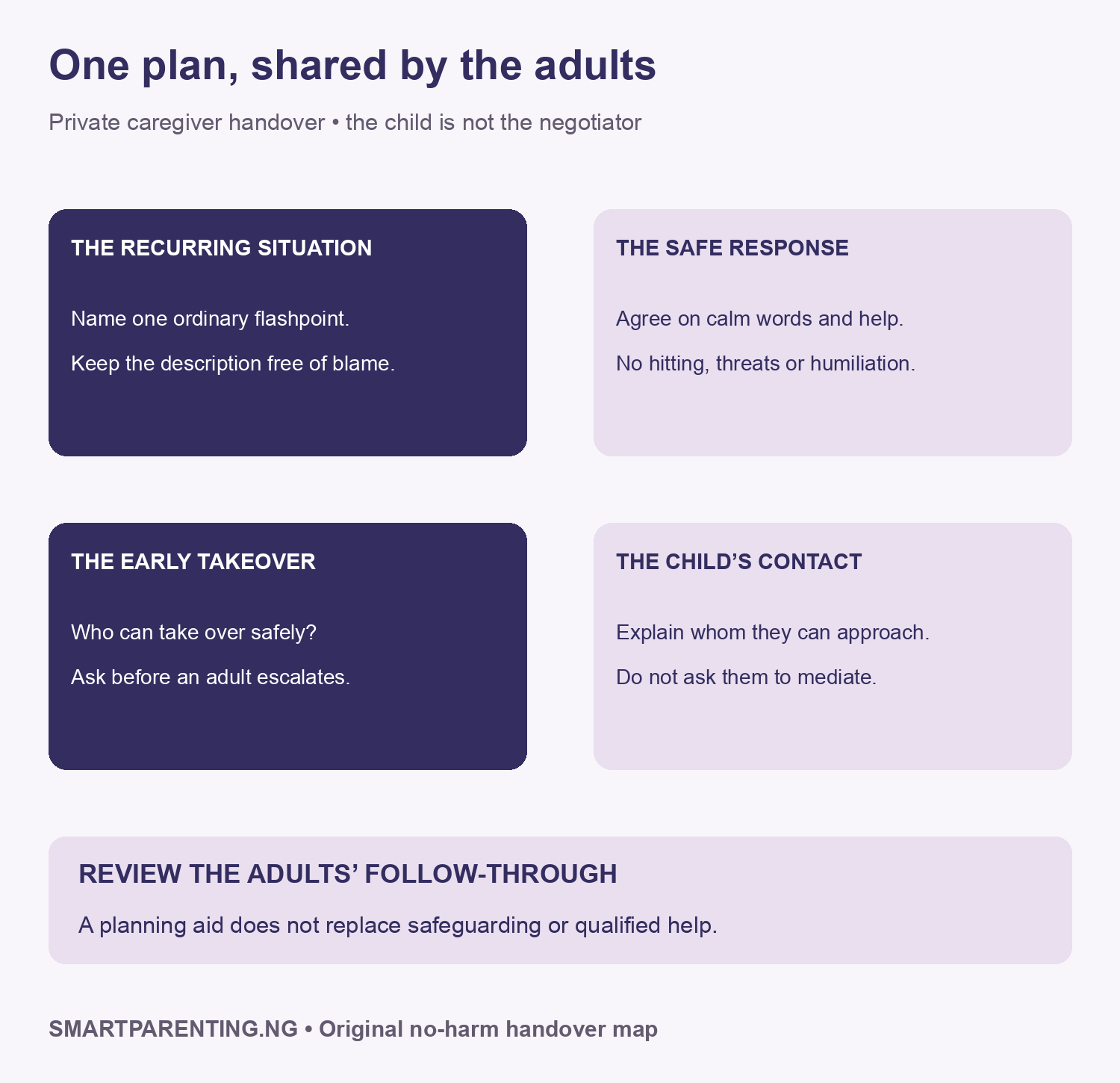
| Plan field | Labelled fictional homework example |
|---|---|
| Situation | Homework has become frustrating. |
| Shared response | Pause the argument and offer calm help later. |
| No-harm boundary | No hitting, threats or humiliation. |
| Early takeover | Ask another calm, available caregiver to take over safely. |
| Child contact | Explain which trusted adult the child can approach. |
| Adult review | Ask whether the adults followed their own plan. |
Give every caregiver the same version
A plan that only one adult knows cannot guide a handover. Share the agreed wording privately with the adults actually providing care. Clarify who will explain a change in the routine. Keep a single current version so one caregiver is not following an older agreement while another has moved on.
Do not invite the child to settle disagreements about the plan. Adults should resolve those differences away from the child, without forced confrontation. If an adult refuses the no-harm boundary or a child is unsafe, this worksheet is not the remedy. Seek appropriate safeguarding or qualified help rather than relying on a signature.
Explain a trusted contact without demanding disclosure
Make clear which trusted adult the child can approach. Use language the child understands, and avoid asking for an account in front of other people. The sheet does not collect children’s experiences, names or identifying details. No child needs to complete it to be entitled to safe care.
The agreement is also not a clinical assessment or an investigation form. Do not use a child’s answers to calculate a risk score from the national survey. Keep any private notes limited to what the responsible adults need for the agreed routine. There is no reason to publish a completed handover online.
Discipline agreement for caregivers: review adult follow-through
At the review, ask whether adults used the agreed response and whether the takeover arrangement was workable. Do not substitute an obedience score for that check. If an adult did not follow the plan, acknowledge that directly and revisit the adult action. Avoid making the child responsible for repairing it.
For broader context, browse our Behavior and Discipline articles and Research & Reports. This resource focuses on the multi-adult handover, rather than offering another list of discipline techniques.
Methods, limits and reusable downloads
We transcribed the national total row of Table PR.2.1, printed page 326, and plotted four indicators on matching 0–100% scales. The source describes experiences in the previous month, reported through the survey. We retain its age range, period and reported base, without adding regional or ethnic rankings.
The original handover map, blank sheet and fictional example have not been tested here. They cannot establish effectiveness or replace safeguarding, clinical support or a qualified professional’s assessment. The 2026 conference and the 2021 survey answer different questions: commitments now and reported experiences then.
Parenting Made Just for You
Get personalized Parenting Solutions tailored to your child’s needs. Transform your parenting journey with expert guidance in 1-3 days.
Get Started- Historical MICS discipline indicators (CSV)
- Blank private caregiver no-harm agreement (CSV)
- Labelled fictional homework handover (CSV)
- Evidence definitions and boundaries (CSV)
Sources: NBS/UNICEF Nigeria MICS2021, Table PR.2.1, report published2022; UNICEF Manila conference close, 19 November2026; UNICEF global context, November2026. Suggested citation: Smart Parenting In Nigeria, “When Caregivers Disagree About Discipline: Make One No-Harm Plan”, research prepared21November2026. No household observations were collected.


