




Home reading support research can be encouraging without promising a particular result for your child. A new review found positive average effects on language and literacy, but the evidence varied substantially across settings. Its large headline numbers are not percentage gains, extra school grades or a guaranteed outcome for a Nigerian family.
This guide separates three questions: what did the research estimate, how uncertain is that estimate, and can a family sustain a chosen routine? The charts explain the evidence. The blank routine log records practical experience. The log does not measure literacy improvement or test the child.
What the home reading support research examined
The Child Development review by Hal Cooper and colleagues appeared on 2 November 2026. It covered 26 studies in 15 low- and middle-income countries, involving 6,264 children in its age-3–7 focus. The reported searches ran from 25 May to 8 July 2025. This is a new synthesis of earlier research, not a 2026 Nigerian assessment.
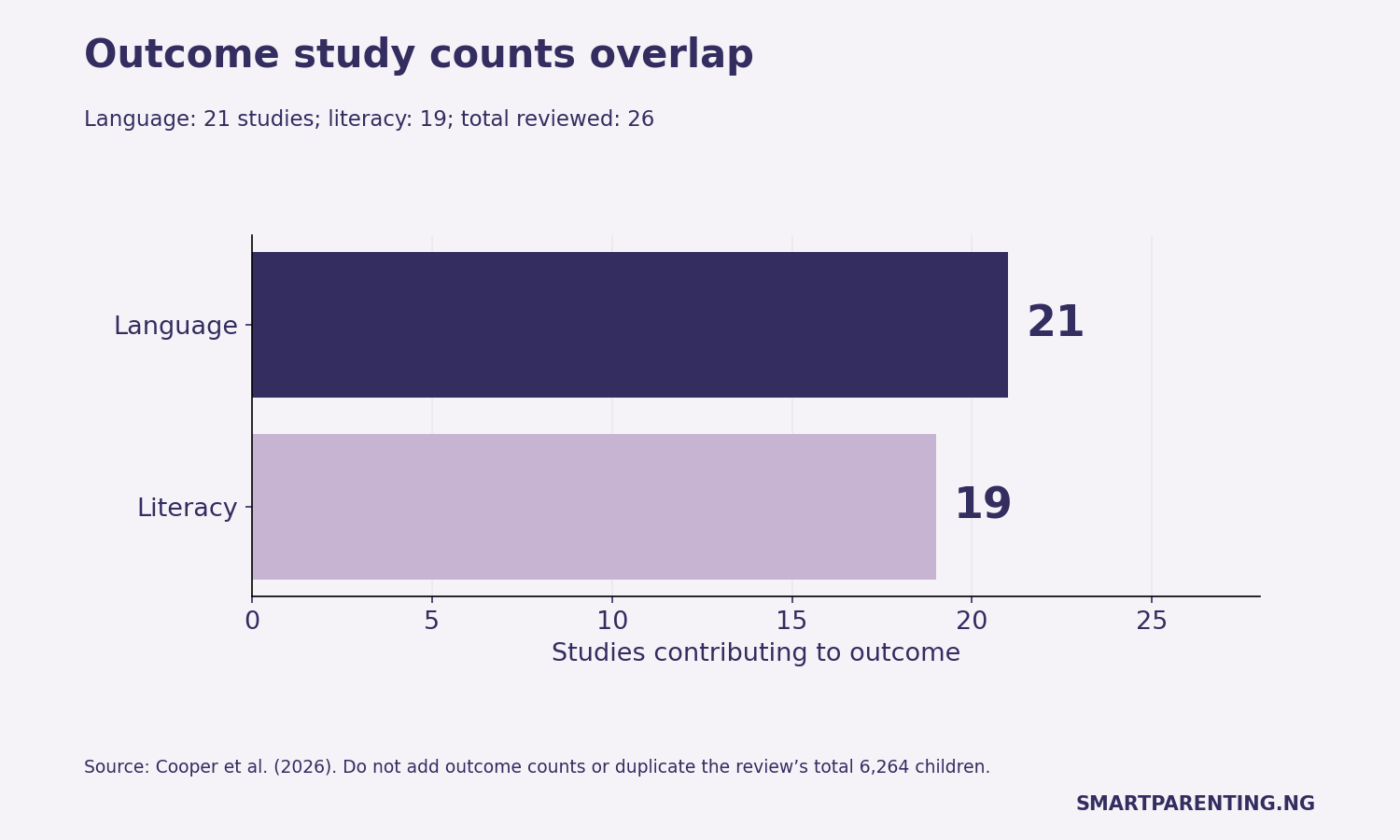
For language, the pooled standardized effect was g = 1.35, with a 95% confidence interval of 0.62–2.09 and prediction interval of −1.63–4.34. For literacy, g = 0.94, the confidence interval was 0.56–1.33 and prediction interval −0.55–2.43. Evidence certainty was very low for language and low for literacy. Language used 21 studies and literacy 19; these outcome sets overlap within the 26-study review.
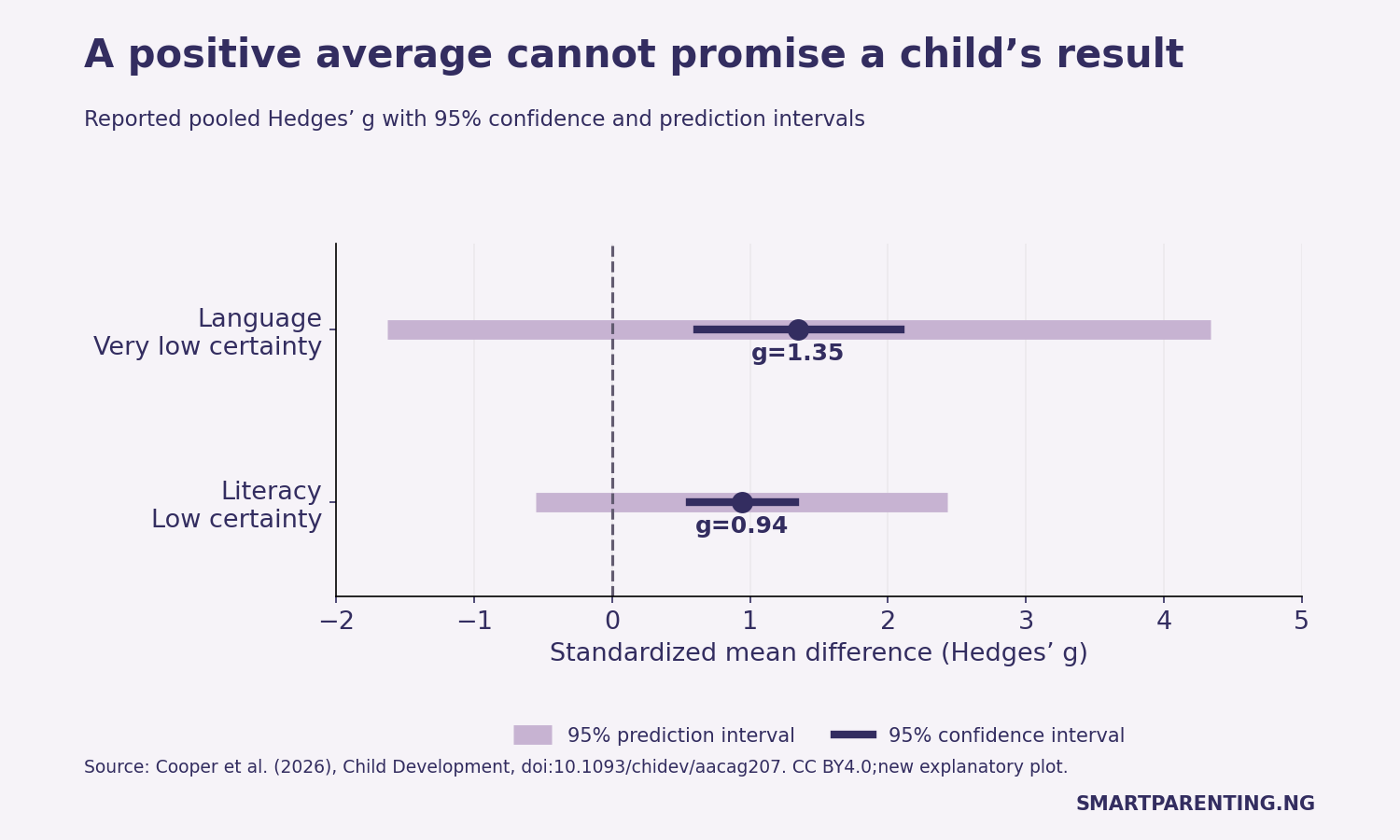
An average result is not a promise to one family
Hedges' g is a standardized comparison between groups. It places outcomes on a common statistical scale rather than expressing an improvement as a percentage. Therefore, g = 1.35 does not mean a 135% improvement. Nor does it mean 1.35 years of learning or a change of that size in a school mark.
A confidence interval shows uncertainty around the pooled average under the review's model. A prediction interval addresses a different question: how much could an effect vary in a comparable setting? A wider prediction interval does not cancel a positive average. It does, however, matter when someone presents that average as a dependable local result.
Both reported prediction intervals include zero and negative values. That leaves room for a null or negative effect in a comparable setting under the model. It does not mean a given child has a specified chance of harm or failure. These are group-level research summaries, not a child's forecast.
The certainty ratings belong beside the impressive numbers. They caution against treating the estimated magnitude as settled. In addition, the review combines programmes and contexts; it does not validate our proposed family log or endorse a book, app or required daily dose.
Outcome study counts are not separate child populations
Figure 2 keeps the language and literacy counts on their own rows. A study can contribute information to more than one outcome. Adding 21 and 19 would therefore not establish 40 independent studies, and splitting the overall child count between those rows would require information not supplied by that total.
For a Nigerian parent, the practical next question is whether a programme's language, materials, support and setting fit the family's circumstances. That requires more detail than a pooled effect alone. Discuss a specific concern or proposed intervention with a teacher who knows the child and the local learning context.
Keep feasibility separate from learning gains
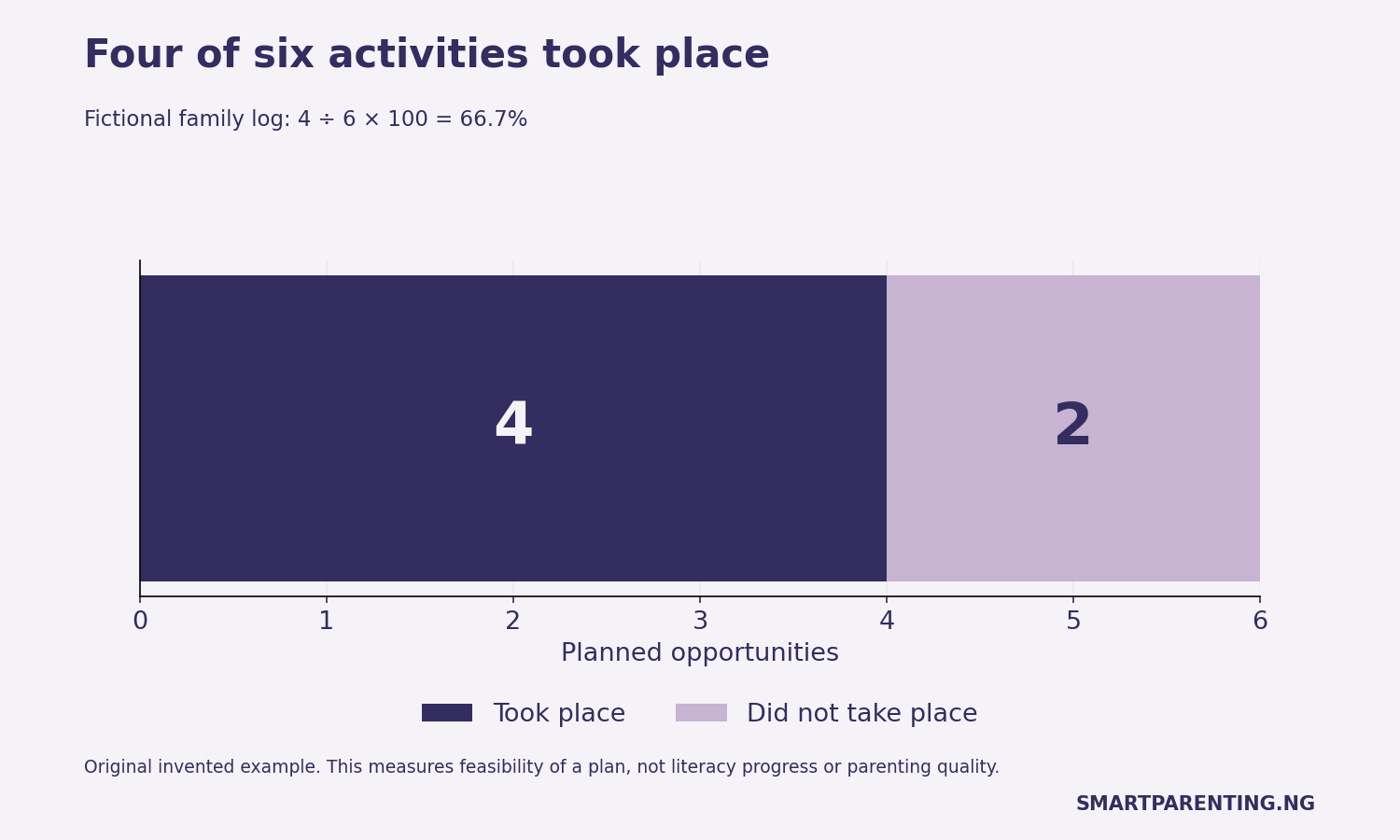
Our fictional example has six planned opportunities for a chosen reading-related activity. Four took place, so the completion fraction is 4 ÷ 6 = 66.7%, rounded to one decimal place. This describes the plan's feasibility. It says nothing about the child's language score, reading level or effort.
In this example, “completed” means the chosen activity took place. It does not mean the child reached a time target or demonstrated a skill. A shorter activity can still count as having happened. Record the child's choice to continue separately, without treating a request to stop as a failure.
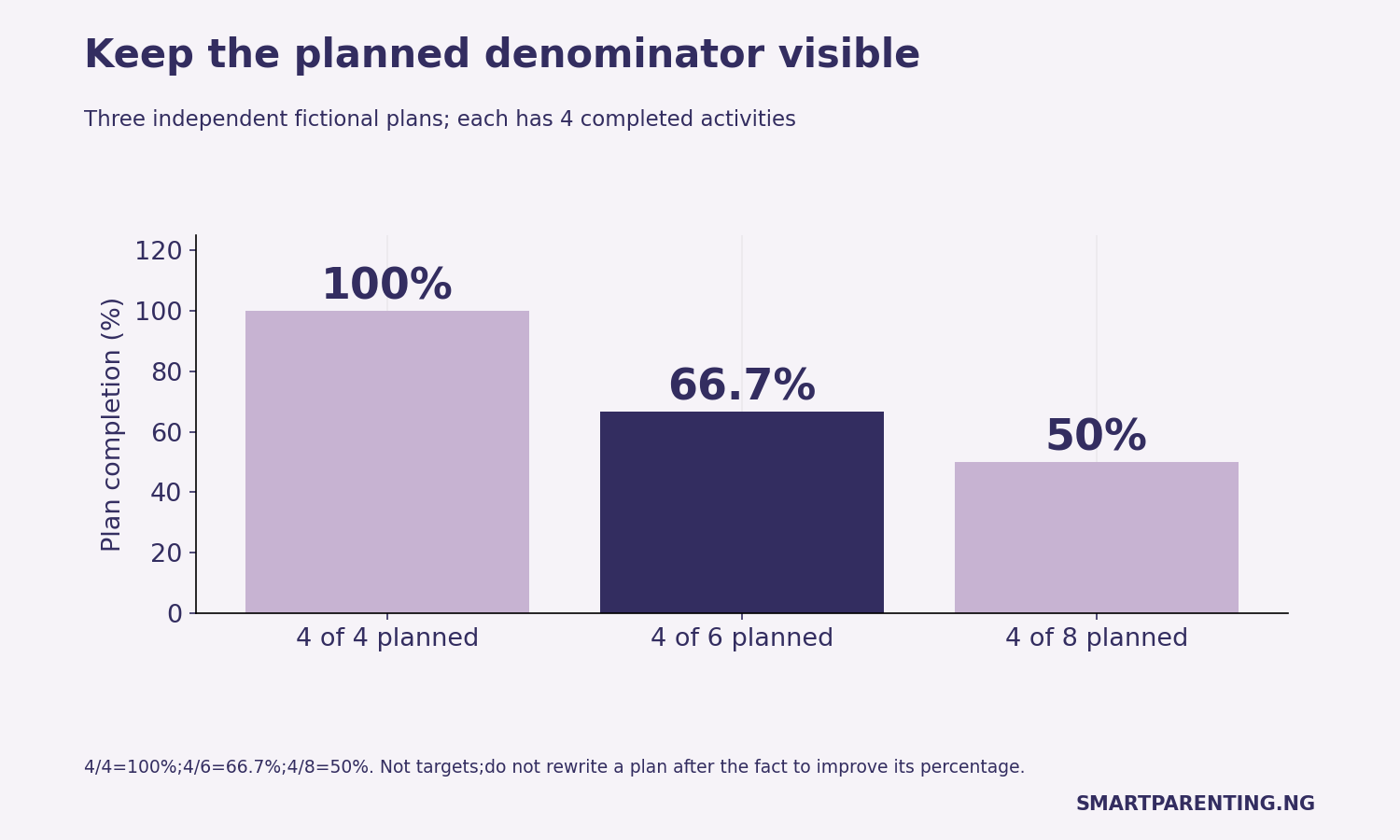
Preserve the denominator. Four completed activities out of four planned is a different fraction from four out of eight. Figure 4 uses three independent fictional plans to explain that distinction. It is not a suggestion to change a plan retrospectively to make the percentage look better.
What a private family routine log can record
The blank sheet has fields for date, chosen activity, language used, planned minutes, actual minutes, whether the activity took place, the child's choice to continue and material cost. It does not ask for names, recordings, school marks or a diagnosis. Keep the completed sheet private.
For an editorial example, a family might record that they looked through a familiar picture book together. The note could say which language they used and whether the child wanted to continue. This is an illustration of recordkeeping, not a research-tested exercise or a prescribed intervention. A local teacher should help judge whether materials and expectations suit the child.
Parenting Made Just for You
Get personalized Parenting Solutions tailored to your child’s needs. Transform your parenting journey with expert guidance in 1-3 days.
Get StartedThe fictional six-opportunity log below has 60 planned minutes and 42 actual minutes across the activities that took place. A 12-minute entry is not automatically better than an 8-minute entry. The numbers help describe what happened; they do not establish an ideal duration or a learning dose.
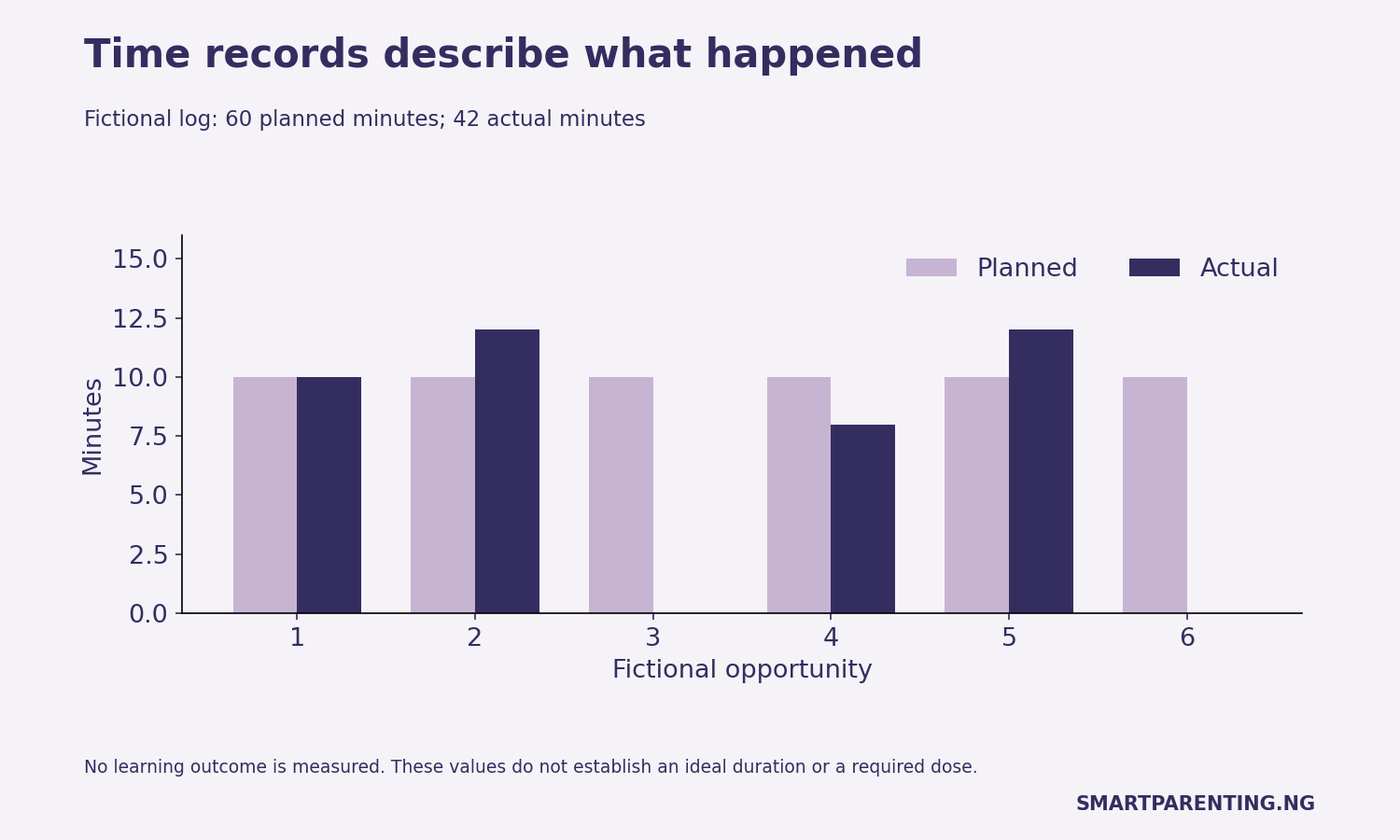
The blank sheet leaves missing values blank. For example, an unknown duration should not become zero. Also record whether a material cost was actually incurred rather than assuming that a family must buy a new book or use a paid app.
Three questions that the log must not combine
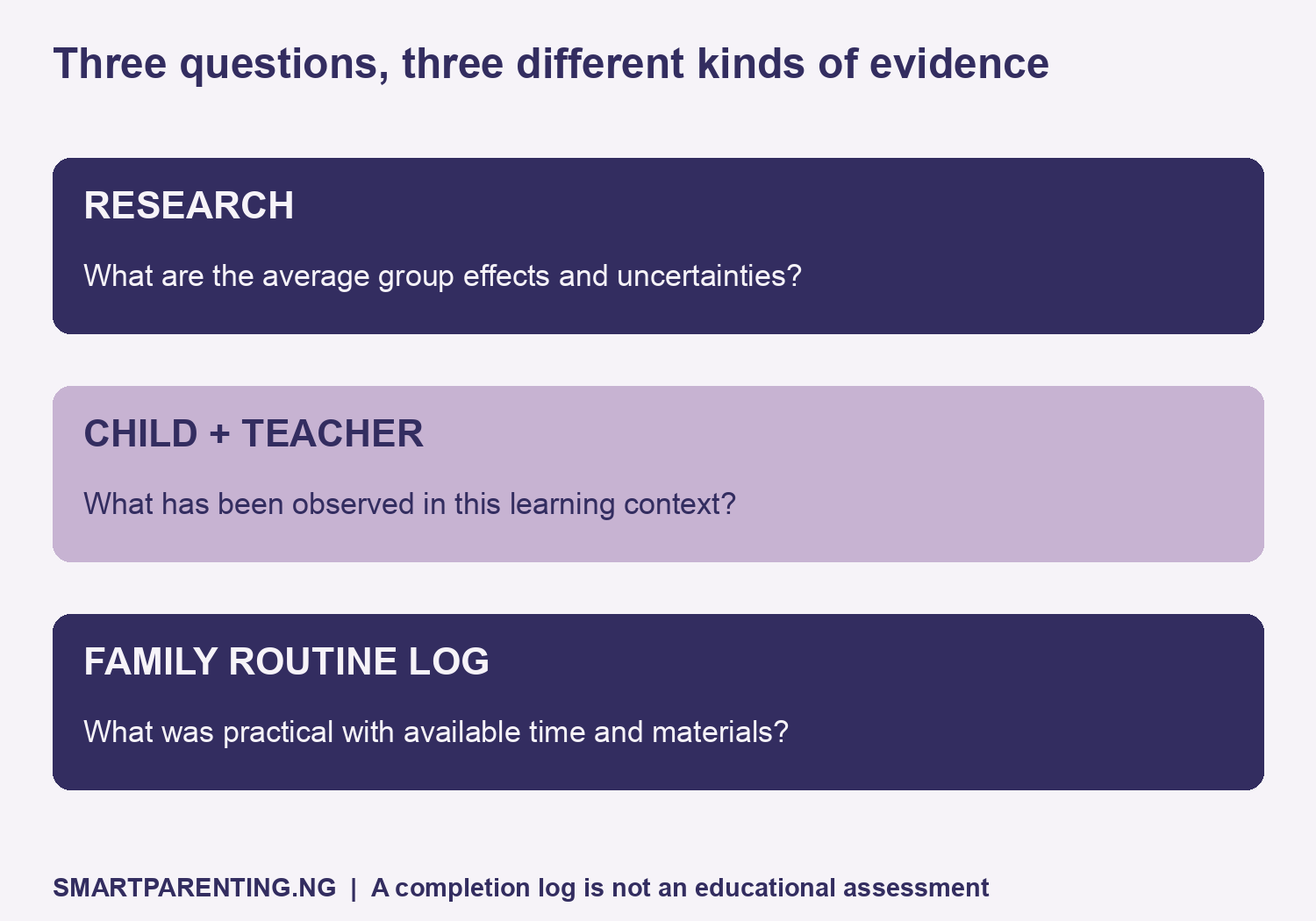
First, the review asks about group effects in studied programmes. Next, a teacher can help discuss the child's learning context and concerns. Finally, the family can record whether a proposed routine fits available time, materials and languages. Keeping those questions separate avoids turning a worksheet into a test.
If progress remains a concern, take specific observations and questions to a teacher. Ask what the school has observed, which materials are appropriate and how follow-up will work. Avoid drawing a conclusion from a single difficult session, or using this log to rank the child against someone else.
Our parenting-programme evidence checklist offers a related framework for asking about evidence and suitability. The Nigeria Learning Passport access guide addresses access and cost questions; access to a resource is a separate matter from proof of a learning effect.
Download the original evidence and routine tools
- Source-linked review evidence sheet (CSV) records each outcome, study count, effect, intervals, certainty and source date.
- Blank private family routine log (CSV) leaves the family's choices and observations open.
- Fictional six-opportunity routine example (CSV) reproduces the completion and timing examples without identifying a child.
- Original denominator examples (CSV) contains the independent arithmetic scenarios in Figure 4.
These are plain CSV files without macros or embedded formulas. To reproduce a completion percentage, divide completed opportunities by planned opportunities and multiply by 100. Retain both counts. If no activities were planned, leave the percentage undefined rather than reporting a zero or dividing by zero.
Home reading support research: methods and limits
We checked the original review on 6 November 2026. Figure 1 redraws reported outcome summaries in a new explanatory layout; it is not a new meta-analysis or a copied study-level forest plot. Figure 2 uses reported outcome counts. The remaining charts use invented routine data and original arithmetic.
The routine log is an editorial planning aid, not a validated literacy intervention, assessment or recommendation for a fixed amount of reading. It cannot establish causality, identify a learning difficulty or show whether a programme works for a particular family. International evidence also needs careful interpretation in Nigerian settings.
Suggested citation: Smart Parenting In Nigeria (6 November 2026), “Home Reading Support Research: What the Review Shows”, explanatory charts and original routine-log examples. Cite Cooper and colleagues' linked review separately for pooled estimates and evidence certainty. The review is available under CC BY 4.0; our outcome summaries credit that source and the routine examples are explicitly fictional.


