




Involving children in family decisions does not end when the child finishes speaking. A parent still needs to explain what changed, what could not change and why. This report offers a private four-box card for closing that loop on one ordinary household choice.
The fresh prompt is UNICEF Nigeria’s 20 November 2026 report from Abuja. Children helped lead discussions and questioned experts at its World Children’s Day event. At home, the practical question is smaller: can your child see what happened to one suggestion? Our card is an original planning aid, not a tested parenting intervention.
Involving children in family decisions: what the research covers
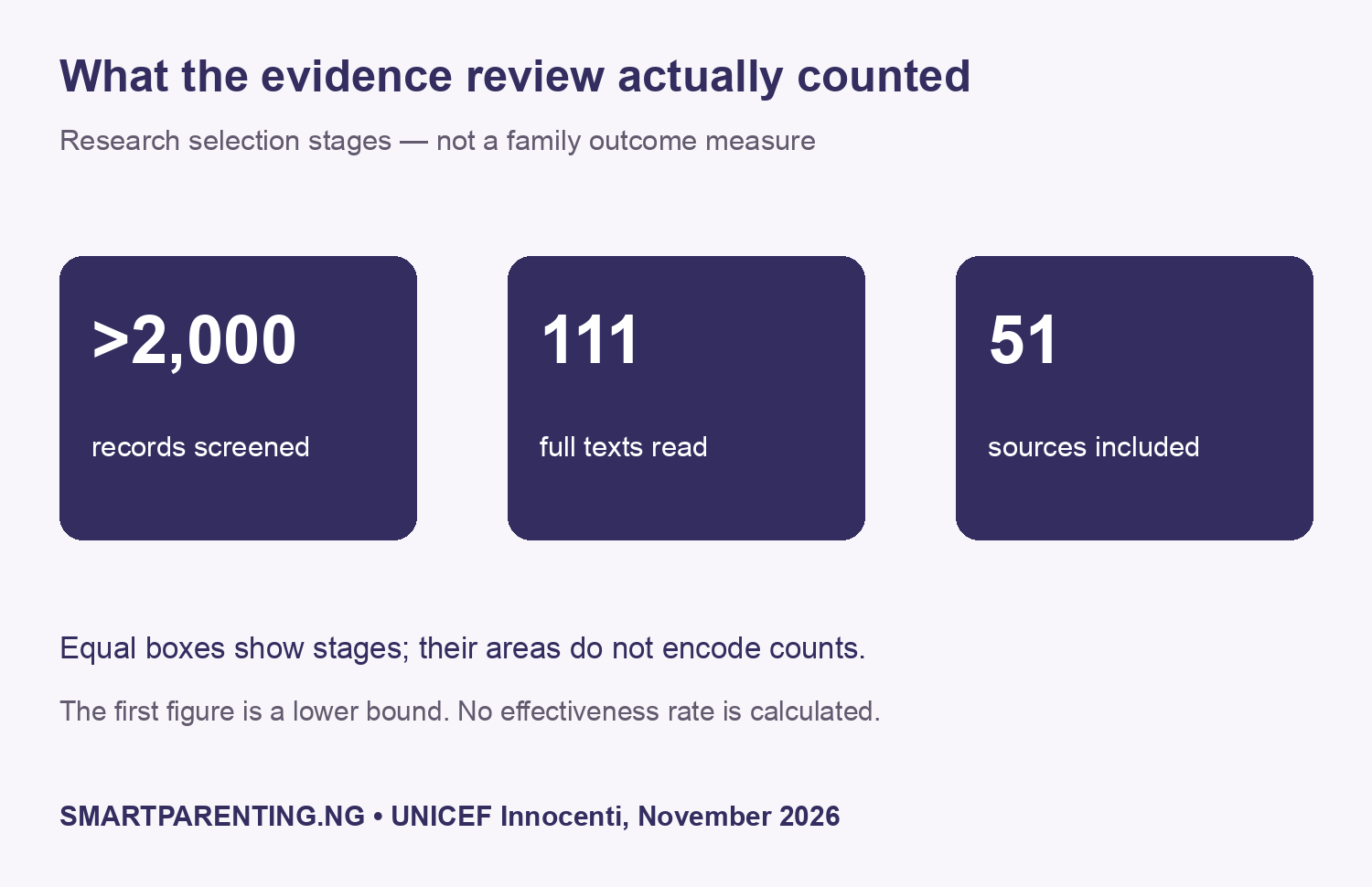
A November 2026 UNICEF Innocenti review examined participation in governance and policymaking. It screened over 2,000 records, read 111 full texts and included 51 sources. Its framework retains space, voice, audience and influence. Feedback to young participants was rarely documented. Some included evidence covers mixed ages extending beyond childhood. These findings do not measure Nigerian household outcomes.
The useful editorial question is therefore about follow-through. An invitation can be sincere yet leave a child unsure what happened next. A short response from the decision-maker makes the outcome visible. It can explain a change, a partial change or a reasoned decision to keep the existing arrangement.
Choose one decision with genuine room to change
Start with a low-stakes routine, such as when a school bag gets packed. Identify the part you can actually reconsider before inviting a suggestion. If pickup time is fixed by a transport arrangement, say that clearly. Do not ask the child to solve a constraint that adults already know cannot move.
Keep the scope manageable. This card is for one everyday decision, rather than a sensitive disclosure, an adult disagreement or a safety assessment. It does not transfer responsibility for adult choices to the child. The adult remains responsible for explaining the boundary and making the decision.
Invite a private, voluntary contribution
Offer a way to contribute that suits the child: speaking, writing or drawing. There is no requirement to fill every box or to take part immediately. An adult can also listen without making a written record. Do not turn the invitation into a test of confidence, fluency or willingness to please.
Choose a calm, private opportunity rather than asking for an answer in front of a group. Ask what the adult should consider about the routine. Then check your understanding in plain language. The purpose is to hear the suggestion accurately, not to collect a polished statement for other people.
Involving children in family decisions: the feedback card
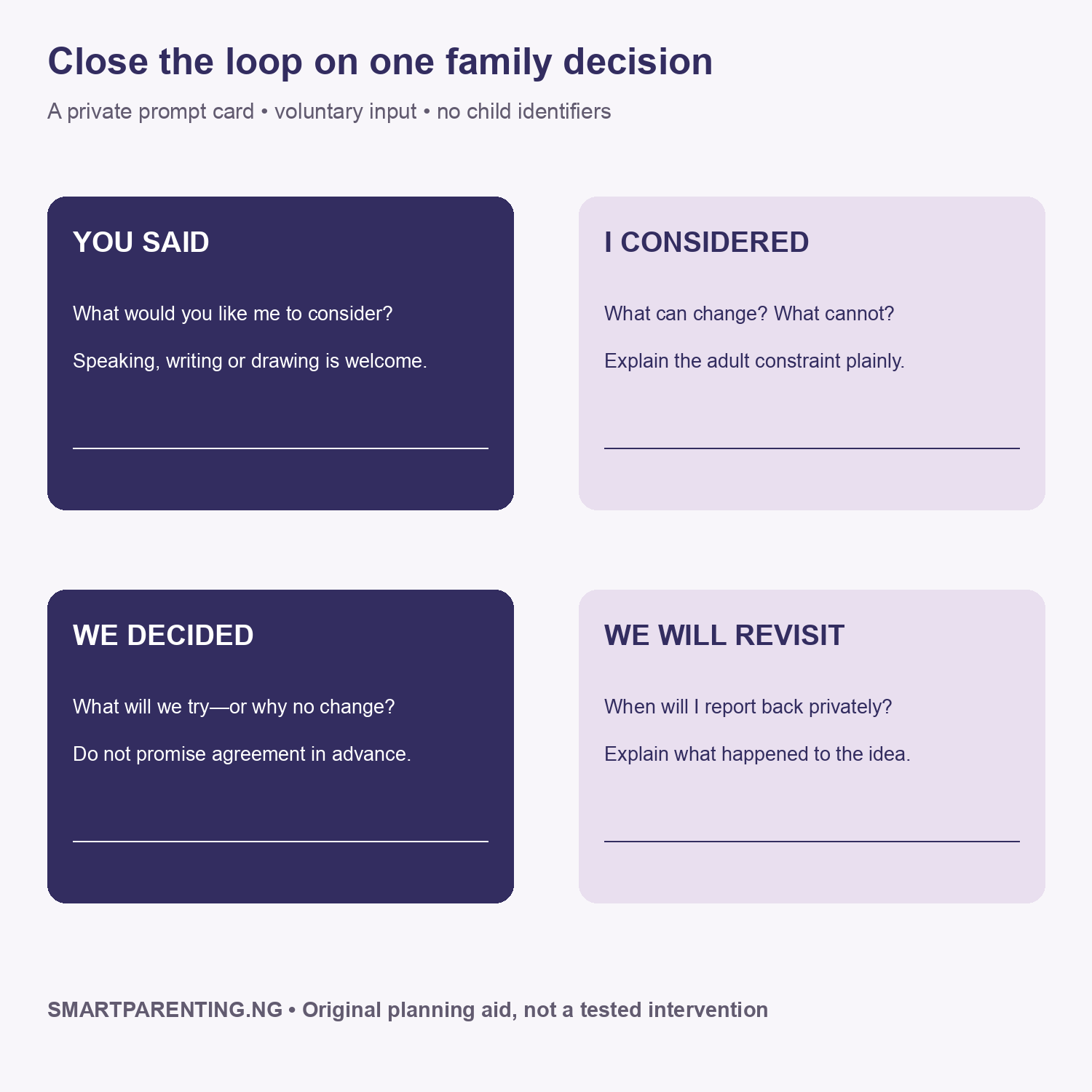
“You said” records the suggestion only if a record is useful and welcome. “I considered” identifies the real constraint and the part that can change. “We decided” states the trial or explains why no change follows. “We’ll revisit” commits the adult to reporting back, without promising a particular result.
Use short, concrete language when reporting back. For example: “The pickup time stays the same. I can move bag packing so it does not interrupt homework. Let us try that and talk again.” This is a fictional script for an ordinary routine, not advice about a specific family.
| Box | Labelled fictional example |
|---|---|
| You said | Bag packing interrupts homework. |
| I considered | The transport pickup cannot move; packing can. |
| We decided | Try packing earlier, away from homework. |
| We will revisit | Ask privately whether the changed timing fits. |
Explain influence without promising agreement
A suggestion can change part of the plan without determining the entire decision. Name that part clearly. If nothing can change, explain the reason and avoid pretending that an unchanged decision is a trial. Giving a reason helps distinguish an adult response from simply letting the conversation disappear.
Do not score the child on whether the trial succeeds. At the next conversation, the adult can ask whether the arrangement fits and explain what they noticed about the routine. If it needs revision, change the plan openly. If it stays, explain why it stays. Keep responsibility with the person making the decision.
Involving children in family decisions: protect privacy
The downloadable sheet has no name, age, school or contact fields. It does not need a child’s identifier to serve its purpose. Keep any completed version offline and share only with the adult who needs it. Educators can share the blank resource without sharing children’s answers. We do not collect completed cards.
For related reading, explore our Parenting Tips and Techniques and Research & Reports archives. This resource concerns the response after an everyday suggestion. It is separate from a school meeting plan or a general guide to respectful communication.
Methods, limitations and reusable downloads
We retained the review’s reported screening counts and preserved the greater-than sign on its first stage. We did not calculate a selection rate from an unknown exact total. The flow diagram shows three equal boxes so its shapes do not imply a precise numerical funnel.
Parenting Made Just for You
Get personalized Parenting Solutions tailored to your child’s needs. Transform your parenting journey with expert guidance in 1-3 days.
Get StartedThe household example and feedback card are original editorial resources. They have not been evaluated as an intervention and carry no claim about behaviour, wellbeing or learning gains. The source review examines institutions and society, uses mixed-age evidence and does not validate this household application. The blank card is optional, not a required record.
- Review selection counts and scope (CSV)
- Labelled fictional feedback example (CSV)
- Blank private family feedback card (CSV)
- Participation concepts and evidence limits (CSV)
Sources: UNICEF Nigeria, 20 November 2026; UNICEF Innocenti, Evidence Review of Adolescent and Youth Participation, November 2026, especially methods pp. 11–13. Suggested citation: Smart Parenting In Nigeria, “How to Show Your Child Their Opinion Was Heard”, research prepared 21 November 2026. No household data were collected.


