



The Nigeria NEDI public education dashboard can help a parent or PTA ask a better question about a school statistic. The first check is what the number counts: schools, learners or another measure. Next check its period, geography, school type and missing entries before using it in a decision.
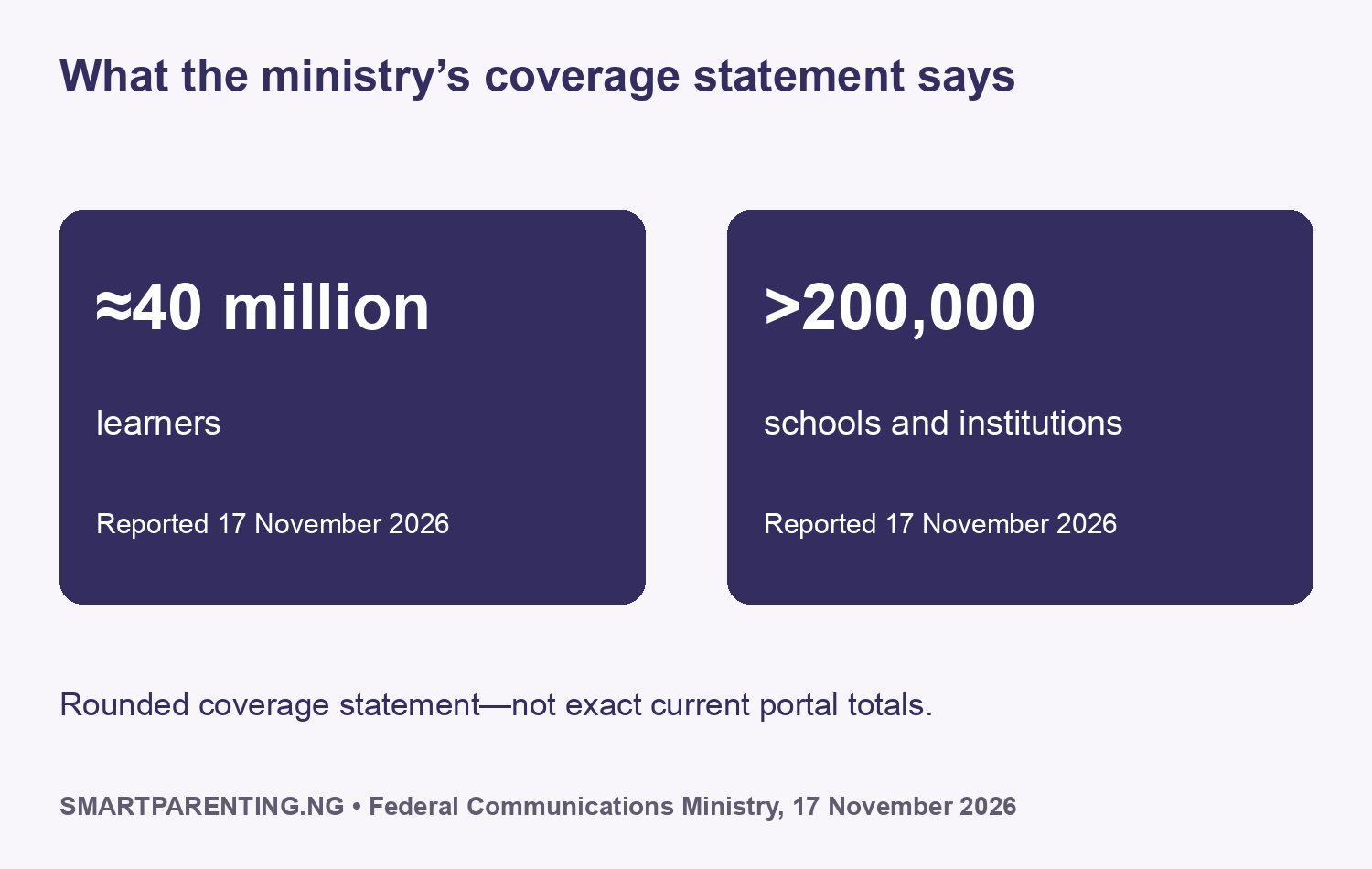
On 17 November 2026, the Communications Ministry announced the National EdTech Strategy alongside AskFME and the NEDI Public Portal. It described database coverage as approximately 40 million learners across more than 200,000 schools and institutions. These rounded statements are not exact current portal totals or a count of every learner and institution in Nigeria.
Nigeria NEDI public education dashboard: separate the tools
The strategy is a policy framework. The public data portal displays selected education indicators. AskFME is an information service. An announcement about all three does not mean that each tool provides the same information or that a chatbot can verify every claim about an individual school.
The Education Ministry’s earlier announcement discussed a 1 July 2026 DNEMIS launch and a public portal. November should therefore not be described as the first public release of all government education data. The earlier source’s page title is inconsistent with its DNEMIS body; we cite the body’s stated event rather than silently repairing its heading.
Record what the public portal actually shows
In our live browser check of the official NEDI portal, the public interface showed a 2024/2025 session and separate primary school-count and learner-count charts. Its school-type legend included Public, Private and Unknown. The footer says data are continuously updated and validated. A saved capture date therefore matters as well as the displayed session.
The charts rendered, but we did not verify a complete exact-value public/private state table for reproducible extraction. Some visible values were abbreviated. We do not invent a state ranking, reconstruct hidden values or claim a verified table export. Instead, the illustration below uses explicitly fictional numbers. The raw-data CSV labels them fictional too.
Nigeria NEDI public education dashboard: unknown is not zero
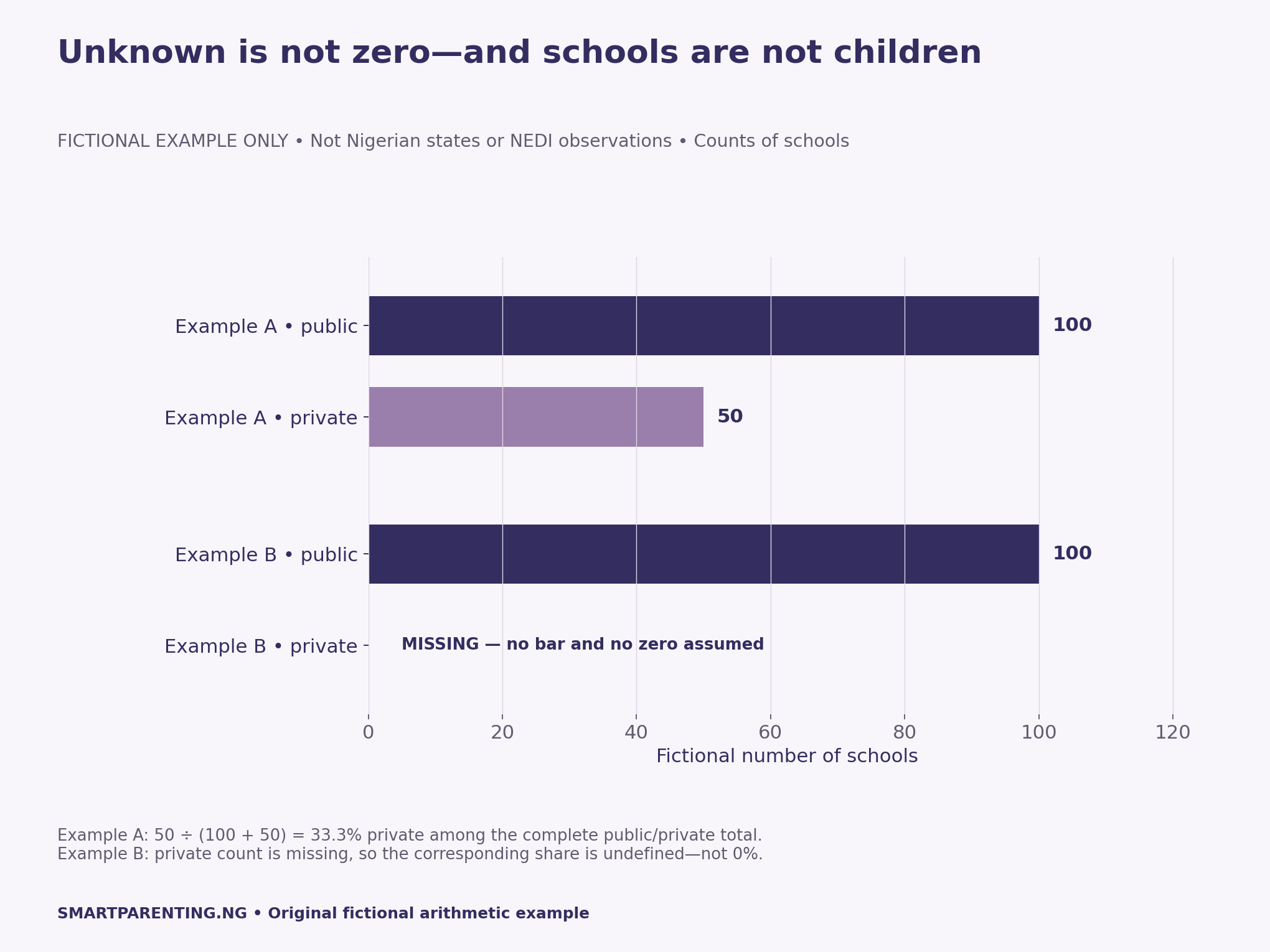
In fictional Example A,50 private schools divided by 150 public-plus-private schools gives 33.3%. Both counts refer to the same invented place and period. In Example B, the private count is blank. A spreadsheet that turns that blank into zero would produce a misleading result. Leave the share undefined until compatible information exists.
A real chart with an Unknown school-type category needs another check. Even when public and private counts are present, their sum may not cover every recorded school. State clearly whether a calculated share uses known public-plus-private schools or a wider total. Do not erase the unknown category to make the calculation easier.
Keep school counts separate from learner counts
A school is an institution; a learner is a person captured by the stated measure. More recorded schools does not automatically mean more children, better provision or greater safety. A chart about one level cannot settle a question about another level. Keep the unit in the heading and with every calculation.
The same care applies to coverage claims. A rounded ministry statement and a live filtered indicator can differ in timing, scope or definition. That difference is a reason to check the metadata, rather than to subtract the figures and label the result missing children. This article makes no such calculation.
Nigeria NEDI public education dashboard: use an evidence ledger
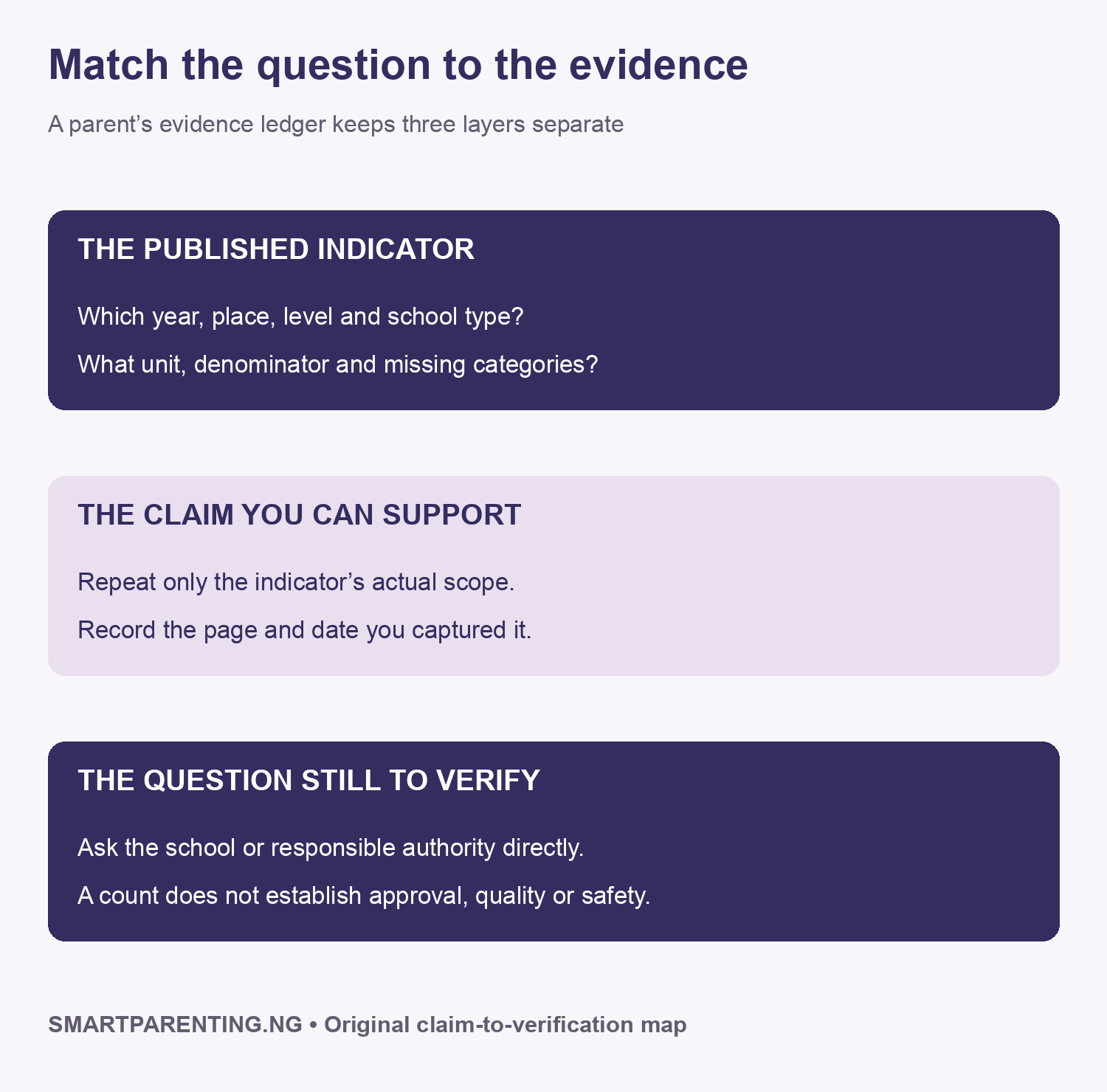
Write the claim first. Next record the official page and indicator, coverage year or session, capture date, level, geography and school type. Add the unit, denominator and any unknown or missing category. Finish with the authority that can answer the remaining question and what still needs clarification.
For a school-specific issue, confirm the relevant details directly with the school and responsible authority. An aggregate count cannot establish a school’s approval, admission terms, quality or safety. We provide no school recommendation or accreditation decision. We also do not promise a school-lookup feature, downloadable fields or a permanent sequence of interface clicks.
Protect children’s records while checking a statistic
A public aggregate question should not require sharing a child’s NIN, school record or other identifier with an unofficial website or chatbot. Our ledger is for public claims and source definitions. It does not request child identifiers, collect completed worksheets or offer access to individual learner records.
For a different education task, read our Nigeria Learning Passport free-data guide. Browse related Education and Research & Reports coverage. This resource concerns interpreting a statistic, rather than choosing a learning app or ranking schools.
Methods, limitations and downloadable files
We checked ministry announcements and the visible official portal in the browser. We retained its displayed session, school-type legend and update notice, but did not certify a complete exact-value state table. The ministry cards preserve their rounded wording. The fictional chart isolates a missing-data mistake with transparent arithmetic and no claim about actual states.
Parenting Made Just for You
Get personalized Parenting Solutions tailored to your child’s needs. Transform your parenting journey with expert guidance in 1-3 days.
Get StartedThe portal may change as submissions are processed. Retain the date and filters for any later capture, and verify a complete compatible table before reproducing real shares. Our blank ledger and dictionary support that check; they do not validate data quality or resolve school-level questions on their own.
- Ministry coverage statements and scope (CSV)
- Explicitly fictional missing-data example (CSV)
- Blank parent and PTA evidence ledger (CSV)
- Indicator definitions and verification limits (CSV)
Sources: Communications Ministry,17 November 2026; Education Ministry DNEMIS announcement; NEDI public portal; DNEMIS public landing page. Suggested citation: Smart Parenting In Nigeria, “Nigeria’s NEDI Education Dashboard: What Parents Can Verify”, research prepared 21 November 2026. Original charts distinguish ministry statements from fictional examples.


