



Preterm baby follow-up after NICU discharge needs a written handoff, especially when the next appointment is at another facility. Ask the neonatal team who will receive the referral, whether an appointment is booked and what to do if access falls through. This guide helps record that conversation; the team supplies the clinical plan.
The Nigeria Society of Neonatal Medicine’s 15 November 2026 message emphasises continuing follow-up. WHO’s 2026 campaign also focuses on care during admission and after discharge, and confirms 15 November as the observance date from 2026. Our original blank card addresses the administrative handoff, rather than setting a universal care schedule.
Preterm baby follow-up after NICU discharge: keep the figures in scope
Fajolu and colleagues analysed births in 54 Nigerian referral-level hospitals between 1 September 2019 and 31 August 2020. Among 62,383 live births,9,547 were preterm. The analysis extracted births at or after 28 weeks of gestation. Subtracting 9,547 leaves 52,836 other live births. These are facility birth data, not a count of families who completed outpatient follow-up.
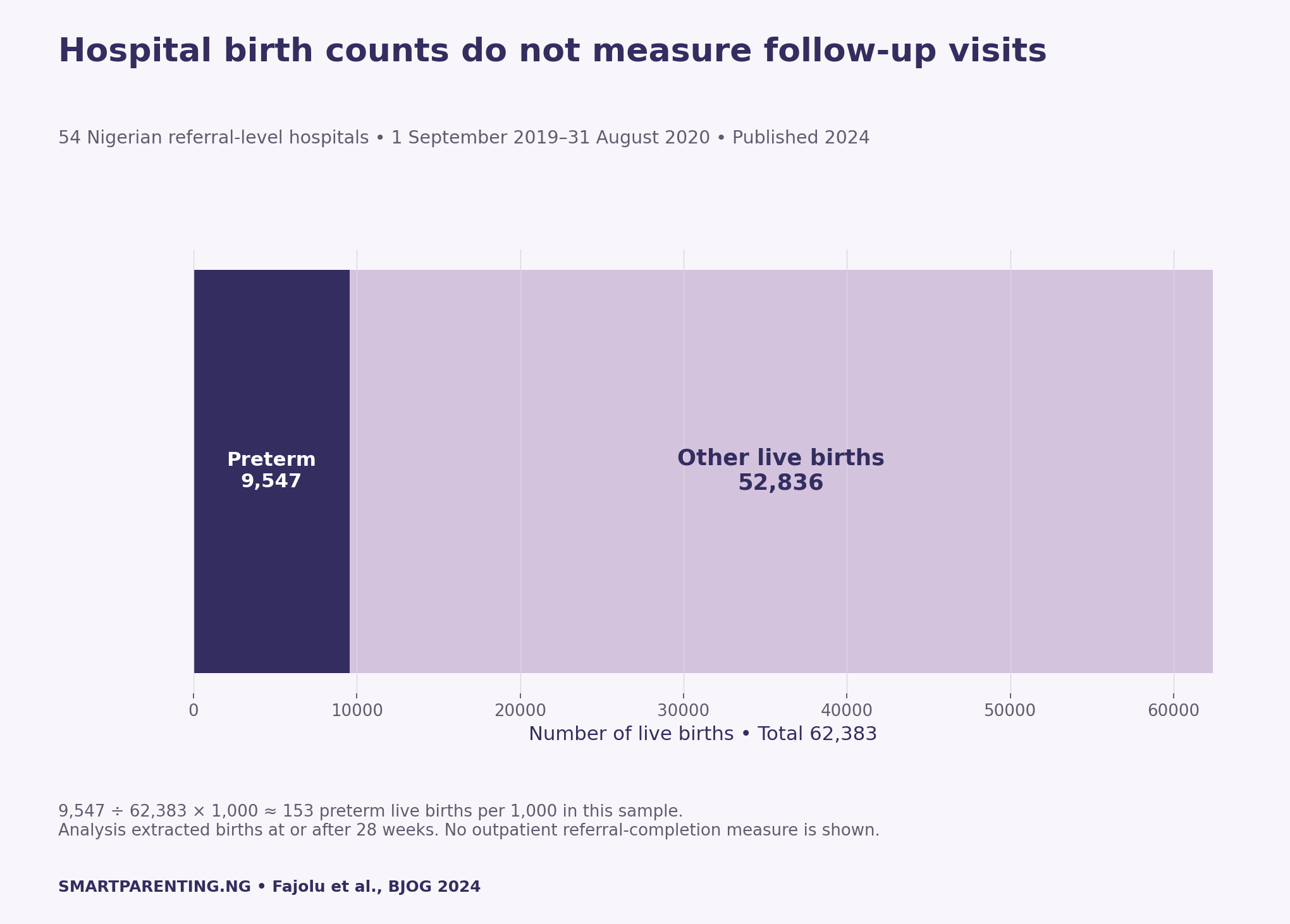
A statistic about births cannot answer whether a receiving service got a referral. That second question needs a different record: the service, the referral status and its confirmation. The chart is context for careful reporting, not a measurement of the success of this handoff card or a prediction for an individual baby.
Keep the national model separate
Ohuma and colleagues’2023 analysis separately estimated 774,100 preterm live births in Nigeria in 2020, with a 95% credible interval of 426,300–1,366,200. That is a historical national model. It is not the same population, unit or method as the selected hospital birth count, and it is not a 2026 count.
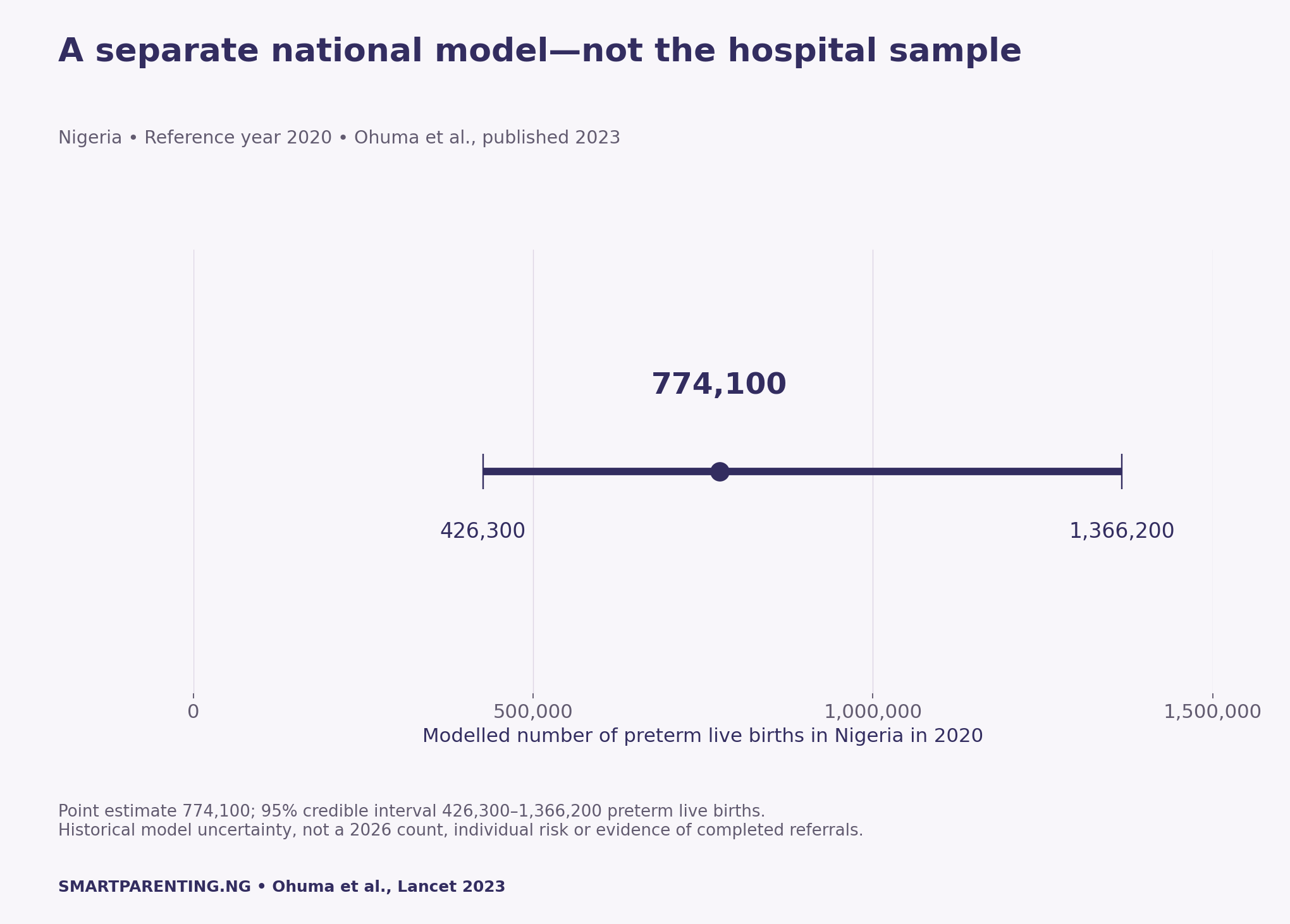
The wide interval belongs with the estimate. Removing it would make the number appear more precise than the model reports. We do not place this national count beside the facility percentage on a common comparison scale or calculate a trend between them. Neither source reports the handoff outcome this resource asks families to clarify.
Preterm baby follow-up after NICU discharge: before you leave
Ask the neonatal team to put the plan in writing. Check the receiving service, its location, contact details and the documents it needs. Ask who is responsible for arranging the next appointment and communicating with the other facility. Keep the team’s actual wording rather than filling a gap from a general online example.
The blank card has room for the written plan’s reference and the service’s instructions. It does not prescribe what assessments, feeding support or medicines a baby needs. It also does not decide when the next visit should happen. The responsible clinical team supplies those details for the individual child.
Ask whether the appointment is recommended or booked
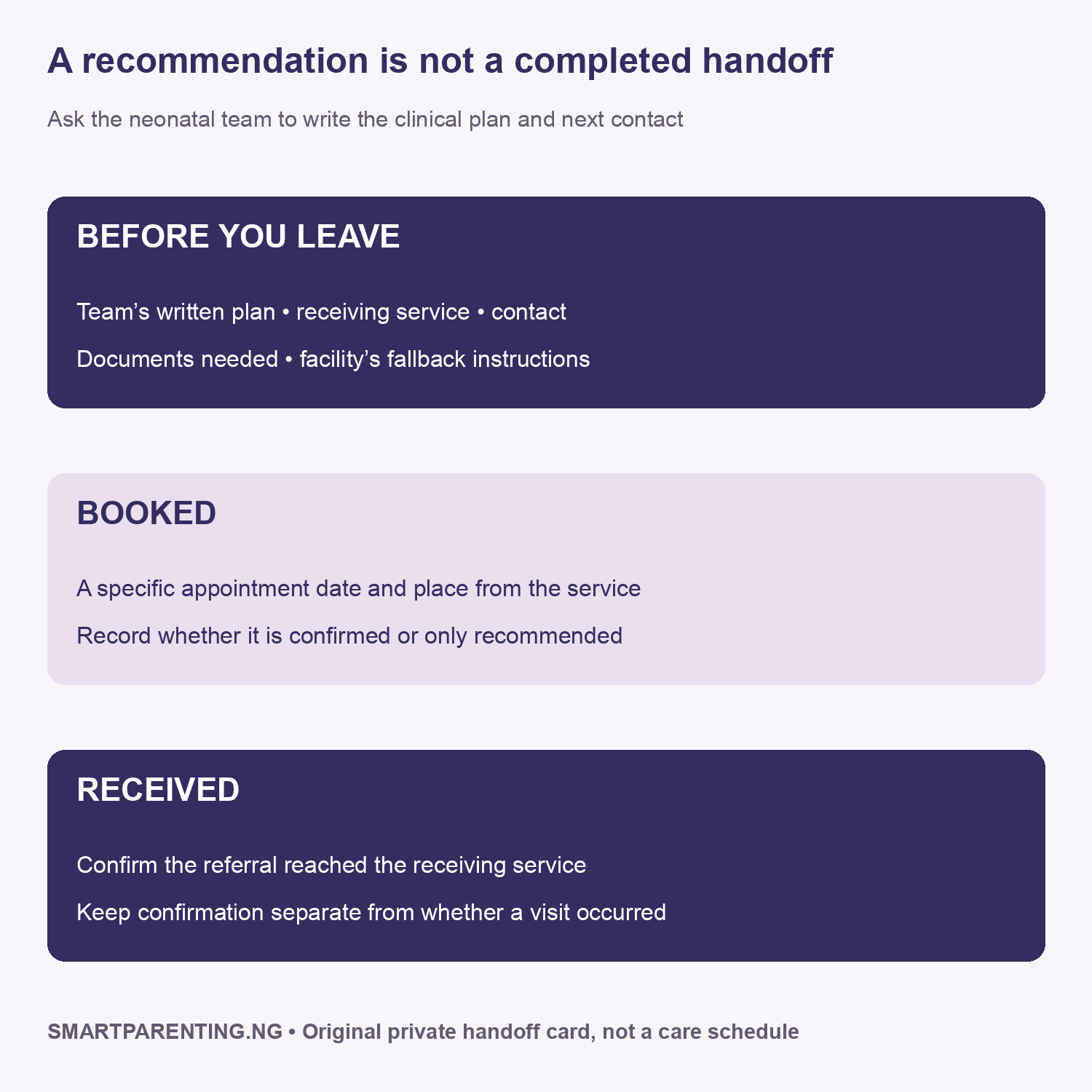
“Attend another service” and “your appointment is booked” are different statements. Ask the team which applies. If a booking exists, record the date, place and contact supplied by the service. If it is only recommended, ask who will arrange it and how the family should confirm the next step.
Do not turn an unanswered booking question into an assumed date. A visible blank is more useful than a made-up appointment. Ask the facility what contact route and fallback it wants the family to use if arranging access fails. This resource supplies no universal interval or automatic escalation rule.
Confirm receipt without overstating completion
When the referral goes to another facility, ask how the receiving service’s receipt will be confirmed. Record the confirmation the service actually provides. Keep that distinct from whether an appointment has been booked, whether the family attended and whether the clinical follow-up took place. Each question needs its own evidence.
The status labels on our card describe the handoff only. They are not a quality score for a parent or a clinical outcome score for a baby. If information is missing, take the question back to the responsible team rather than treating a complete-looking form as a completed referral.
Preterm baby follow-up after NICU discharge: keep the card private
Use the card with the relevant caregivers and health professionals. The download does not request a baby’s name or identifiers, and we do not collect completed versions. Keep the actual clinical documents and any necessary identifying information within the care team’s appropriate process, rather than posting them publicly.
This is an administrative communication aid. It gives no developmental timetable, feeding or lactation recommendation, medication instruction, remote diagnosis or emergency triage algorithm. The facility’s clinical plan and contact instructions remain the reference for the family. Ask the neonatal team to check the written handoff before leaving.
Methods, boundaries and downloadable files
We retained the hospital study’s live-birth denominator, verified its collection period and calculated the remainder by subtraction. The rate calculation is 9,547÷62,383×1,000, or about 153.0. We did not substitute a smaller denominator from a different special-care admission analysis. The national model’s point and 95% credible interval stay in a separate file and chart.
Parenting Made Just for You
Get personalized Parenting Solutions tailored to your child’s needs. Transform your parenting journey with expert guidance in 1-3 days.
Get StartedBoth research sources concern historical births, not referral completion. The original blank card has no demonstrated effectiveness result. It supports recording a team-supplied plan and confirming administrative status without generating care advice. For related coverage, browse Babies and our Research & Reports archive.
- Hospital birth counts, period and calculations (CSV)
- Separate Nigeria 2020 model and credible interval (CSV)
- Blank private neonatal follow-up handoff card (CSV)
- Handoff status and evidence dictionary (CSV)
Sources: Fajolu et al., BJOG 2024, doi 10.1111/1471-0528.17869; Ohuma et al., Lancet 2023, doi 10.1016/S 0140-6736(23)00878-4; NISONM World Prematurity Day 2026 message; WHO campaign 2026. Suggested citation: Smart Parenting In Nigeria, “After NICU Discharge: Get Your Preterm Baby’s Follow-Up Handoff in Writing”, research prepared 21 November 2026. No individual care plan is generated.


