




Research on daycare and parental burnout can raise expectations about what childcare will change. A booked place may create room for paid work, travel or other caring duties. It may leave much less discretionary time than the booking suggests.
This guide separates a research finding from a practical scheduling exercise. Our private seven-day timetable is an editorial planning aid. It does not diagnose burnout, measure parenting quality or promise relief from distress.
Daycare and parental burnout: what the new study found
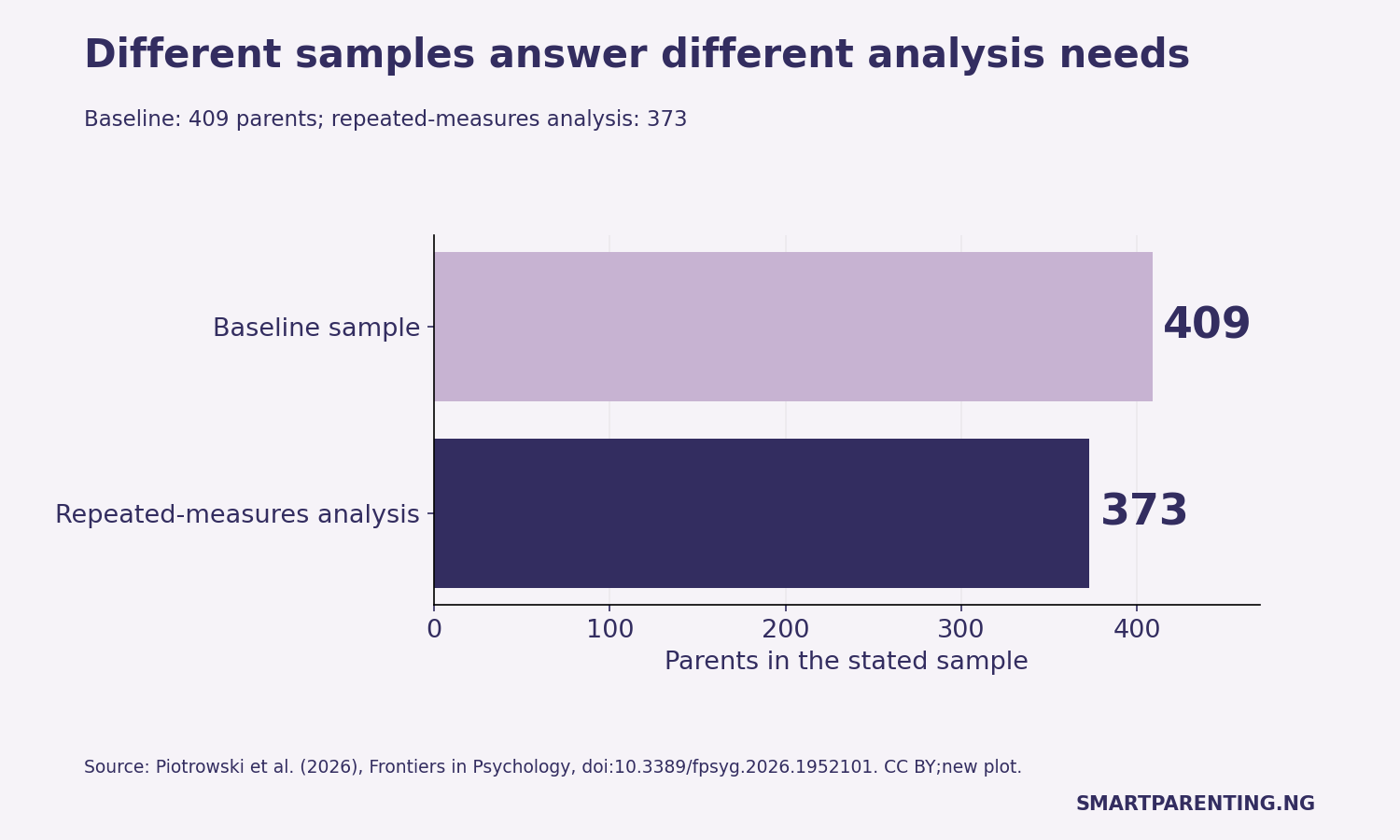
A Polish study by Piotrowski and colleagues, published on 2 November 2026, followed 409 parents across four waves from May 2023 to January 2025. Its repeated-measures analysis included 373 parents.
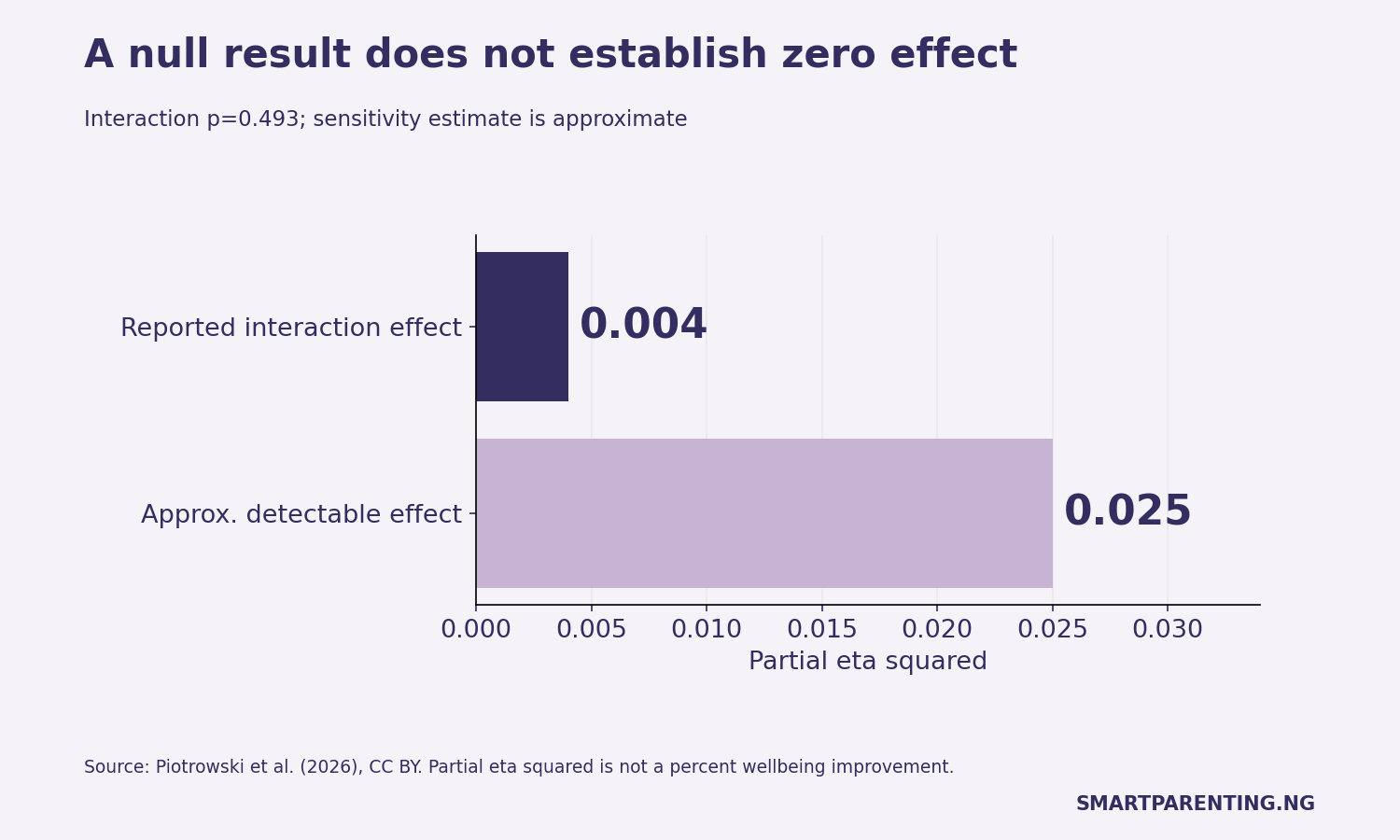
The time-by-childcare-group interaction was not statistically significant: p = 0.493, partial eta-squared = 0.004. The sensitivity analysis suggested effects below about 0.025 might escape reliable detection. A non-significant result does not prove there is no effect.
The observational, non-probability sample leaned towards educated, financially stable parents. Six-month intervals could miss short transitions. It cannot establish what daycare causes or prevents for a Nigerian family. Nor does the result decide whether a particular childcare arrangement is worthwhile.
Start with actual coverage
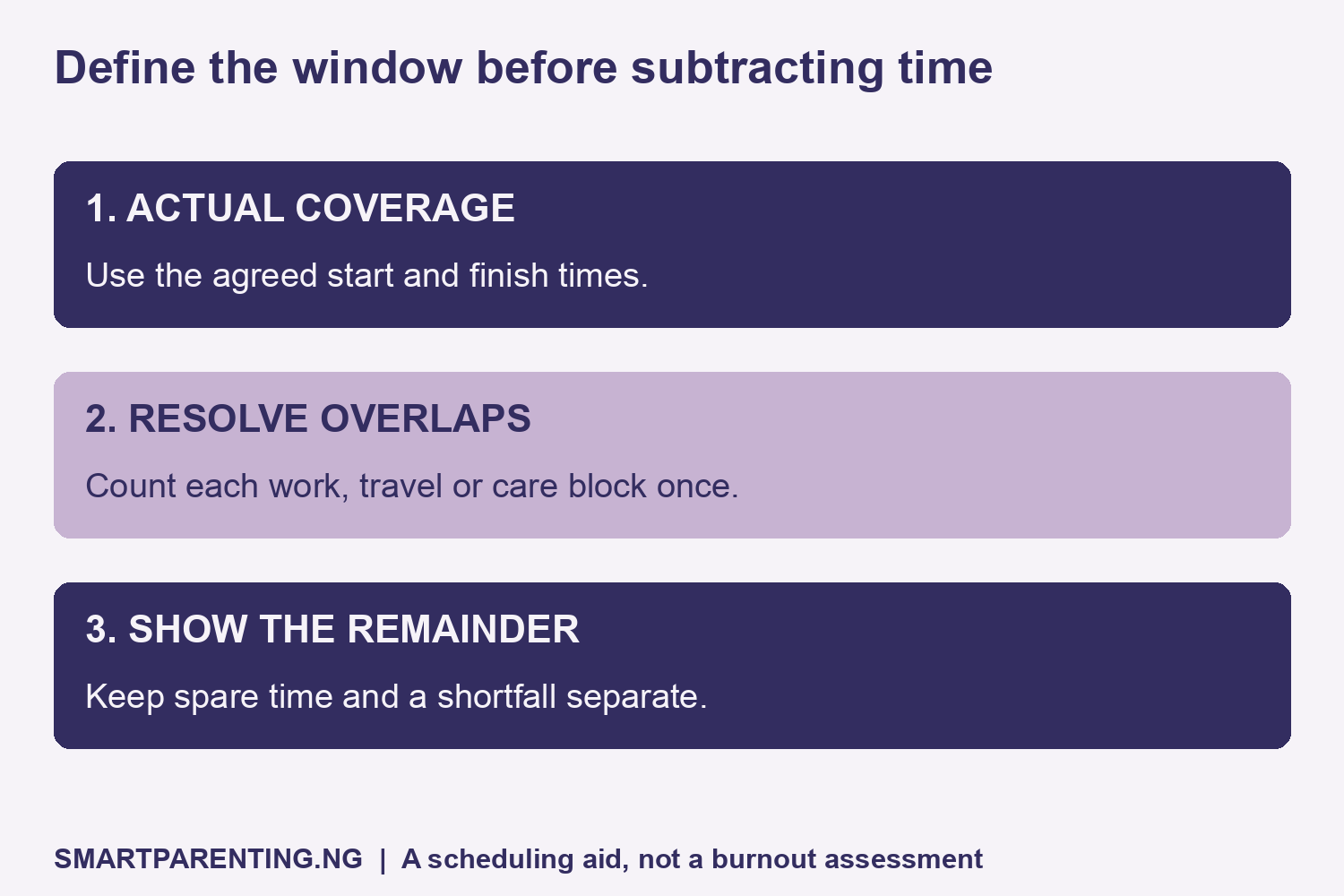
Write down when another caregiver or provider actually takes responsibility. First, distinguish opening hours from your child’s agreed attendance. Then check drop-off, collection and any settling-in arrangement. A brochure’s full-day availability may differ from your family’s booking.
Next, place your own commitments on the same calendar. Work, travel and care for another child can occupy the time that daycare releases. These are different uses of time, even when all are necessary. Do not label the whole booking as rest.
Keep the first version simple. Use start and end times, one activity per row, and a separate person column. Mark estimates clearly until you have actual timings. If two activities overlap, resolve that clash before adding hours.
A fictional 25-hour week
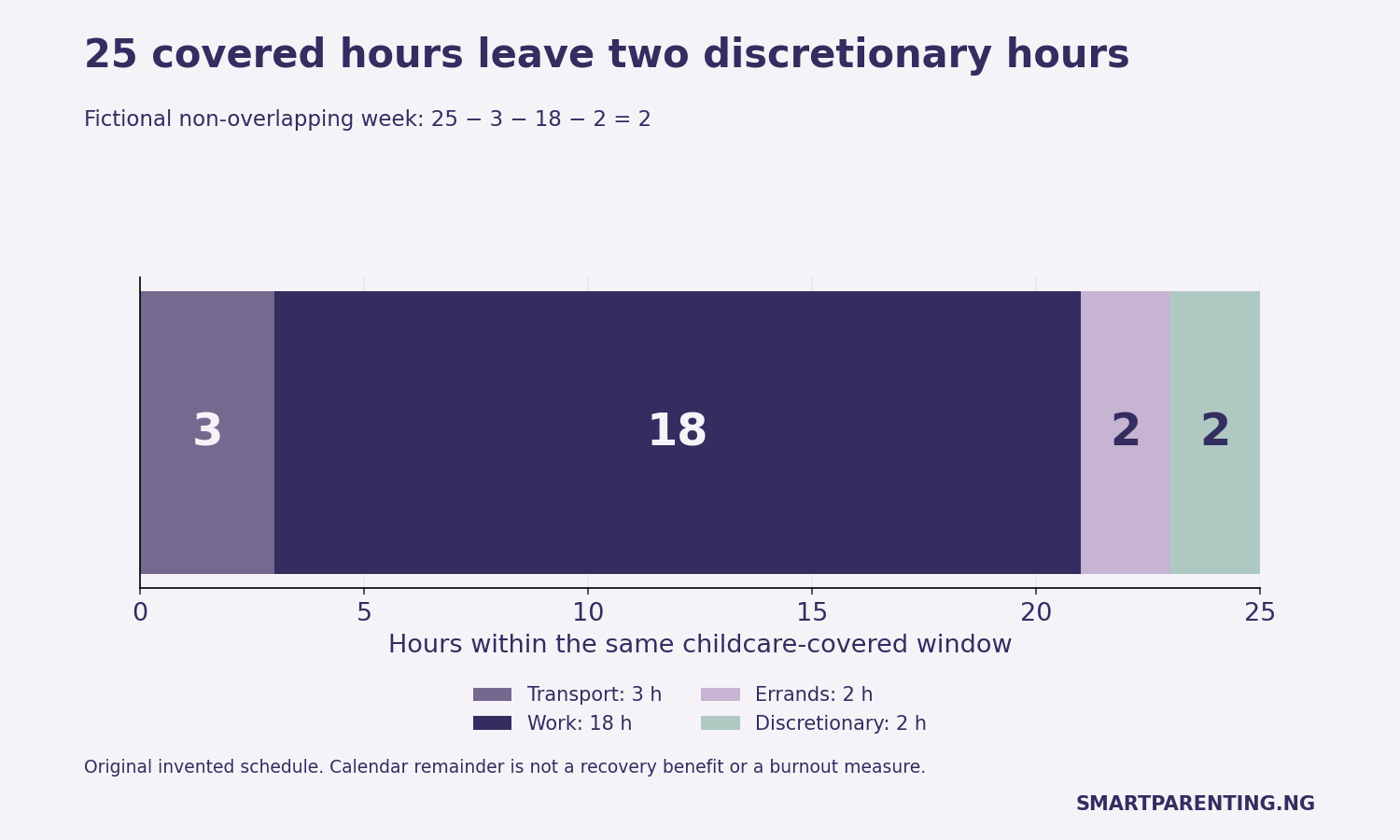
Our worked example starts with five covered hours on each weekday. Across the week, that gives 25 hours. Within that window, the fictional parent has three hours of transport, 18 hours of work and two hours of errands. These blocks do not overlap.
Therefore, 25 − 3 − 18 − 2 = 2 discretionary hours. That is a calendar remainder, not a measured recovery benefit. Someone may use it for rest, another task or something else. The timetable cannot predict how they will feel.
| Fictional weekly item | Hours | Meaning |
|---|---|---|
| Actual childcare coverage | 25 | The window available for this calculation |
| Transport | 3 | Travel within that window |
| Work | 18 | Work within that window |
| Errands | 2 | Other allocated time |
| Discretionary remainder | 2 | Unallocated hours, not guaranteed recovery |
Although the arithmetic is simple, the boundary matters. Do not subtract a commute that already sits outside the covered window. Likewise, do not count the same hour as both work and an errand. The CSV includes a window note so that the calculation remains auditable.
See where the week gets tight
A weekly total can hide a difficult day. In the fictional daily example, Monday and Wednesday each leave half an hour, while Friday leaves one hour. Tuesday and Thursday have no discretionary remainder. Together, those days still sum to two hours.
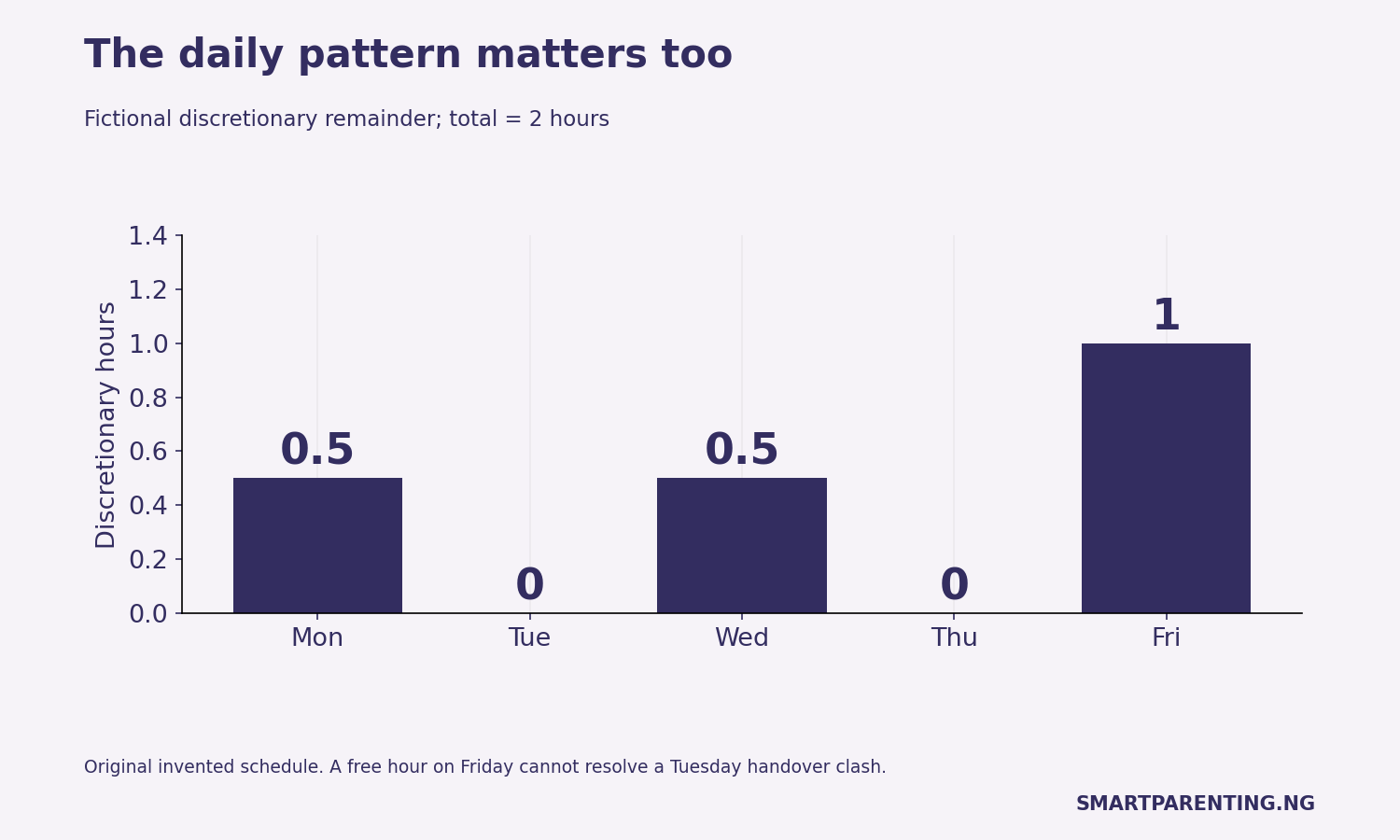
For this reason, check the sequence as well as the total. A free hour on Friday cannot solve a Tuesday collection clash. Record who handles each handover and whether that person has actually agreed. Avoid treating an available relative as an automatic or unpaid backup.
Test a closure without inventing negative rest
Now suppose the same fictional week loses three covered hours. Coverage falls from 25 to 22 hours while transport, work and errands still total 23. The result is a one-hour scheduling shortfall. It is not minus one hour of rest.
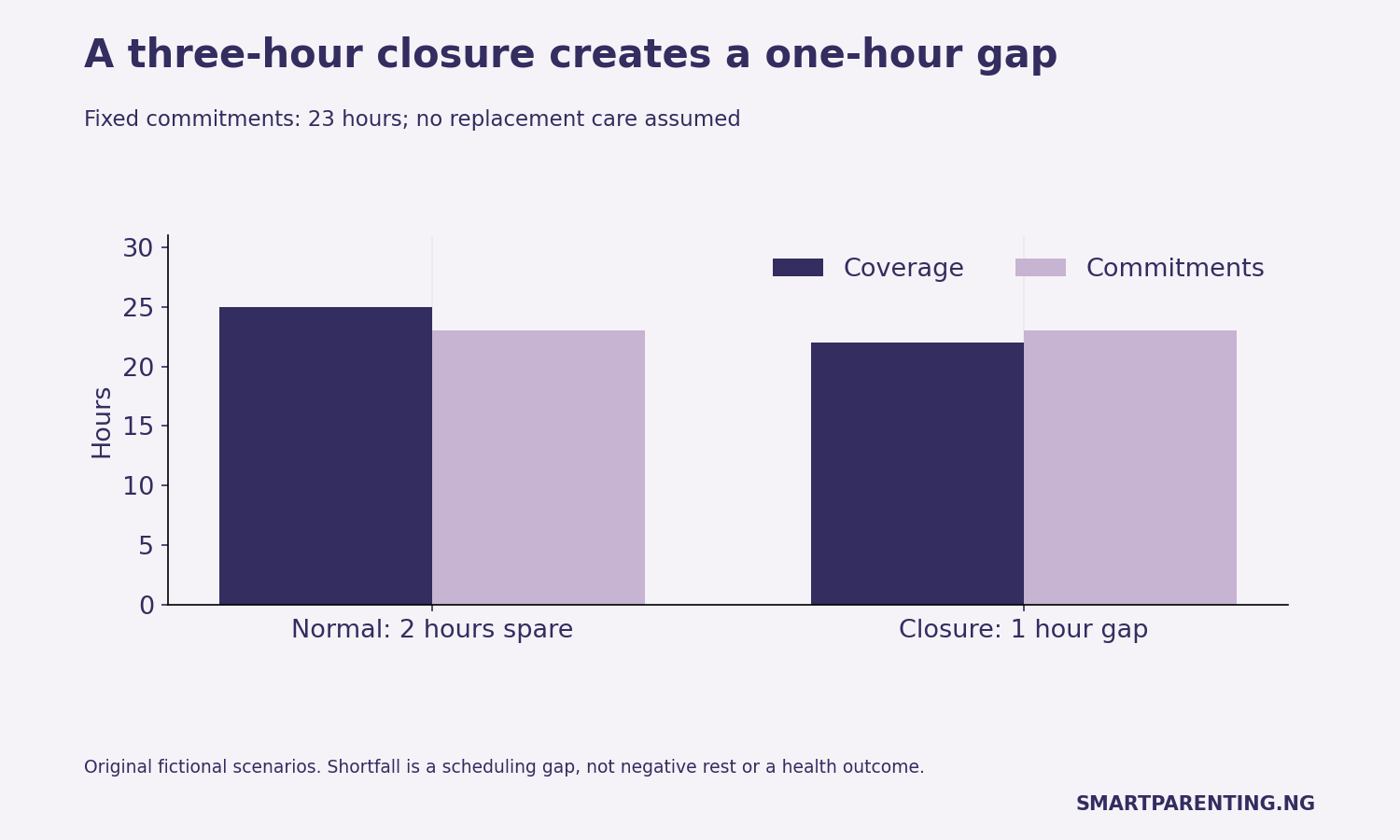
A shortfall identifies something to discuss. Options might include a different agreed handover, a changed work block or an affordable replacement arrangement. Their availability depends on the family; this tool does not assume any option exists. Also, a change can bring its own travel or fee costs.
Parenting Made Just for You
Get personalized Parenting Solutions tailored to your child’s needs. Transform your parenting journey with expert guidance in 1-3 days.
Get StartedRecord an agreed backup separately from a possible one. Write down who has agreed, which hours they cover and any payment or conditions. If no arrangement exists, leave the gap visible. An honest blank is more useful than an assumed solution.
Keep money and hours in separate columns
Include weekly childcare fees and transport costs, using naira for your own entries. However, do not treat the fictional time example as a Nigerian price quote. No current provider prices or wage assumptions underpin these calculations.
List deposits, settling-in charges or late-collection fees only when they apply to the actual booking. Ask the provider for its written terms. Then note which amounts are recurring and which are one-off. The blank sheet lets a family record costs without forcing a comparison between providers.
Download the private planning files
- Study figures and limitations (CSV): source-linked sample counts and reported statistics.
- Blank seven-day coverage timetable (CSV): local start/end times, duties, fees and agreed backup.
- Fictional non-overlapping week (CSV): the daily blocks behind the 25-hour example.
- Closure and coverage scenarios (CSV): visible spare hours or scheduling gaps.
Use the blank file privately. It asks for no health history, and the website requires no upload. Avoid names or identifying details in copies you share outside the people arranging care. No row is a score of whether someone is coping well.
A schedule cannot answer a health question
If distress persists or concerns you, discuss it with an appropriately qualified professional. Do not use the study’s group result as a personal prognosis. Similarly, a full timetable cannot establish why someone feels exhausted or which support would help them.
For another example of keeping routine records separate from outcomes, see our home reading support research guide. Both resources explain what a family log can record and where its meaning stops.
Methods and limits
We checked the full study on 6 November 2026. All time budgets are invented editorial scenarios. Their hours refer to the same childcare-covered window, and each block appears once. Calculations use coverage minus allocated transport, work and errands; a negative remainder becomes a separately labelled shortfall.
The five charts and explanatory diagram are original layouts. We credit the study under CC BY and reproduce no source figure or psychological questionnaire. The tool offers logistics prompts, not psychological treatment, provider endorsement or a validated burnout screen.


