




A selective eating school handover should make an existing support plan easier to understand. For example, it can record agreed food preferences, sensory or communication support, a named contact and a review date. However, it should not turn a new research concept into a treatment or pressure a child to eat.
This guide helps Nigerian families prepare a private, consented note for the adults already involved in care. Two charts explain selected findings from a new Brazilian study. A handover-map infographic and four CSV tools keep the research, practical communication and clinical decisions separate.
What informs this selective eating school handover
The Journal of Autism and Developmental Disorders paper, published 10 November 2026, studied 128 families through a service-based quantitative sample. Interviews involved 35 caregivers representing 37 children aged 3–14. Survey collection was May–October 2025; interviews followed November 2025–January 2026. Therefore, keep these units separate rather than adding the samples.
The authors propose “food chronocare” as a provisional way to interpret care coordination. However, researchers have not validated it as a treatment or assessment tool. The study does not establish Nigerian prevalence or prove that using our handover improves eating, sleep or school participation.
Read the 94-of-128 finding carefully
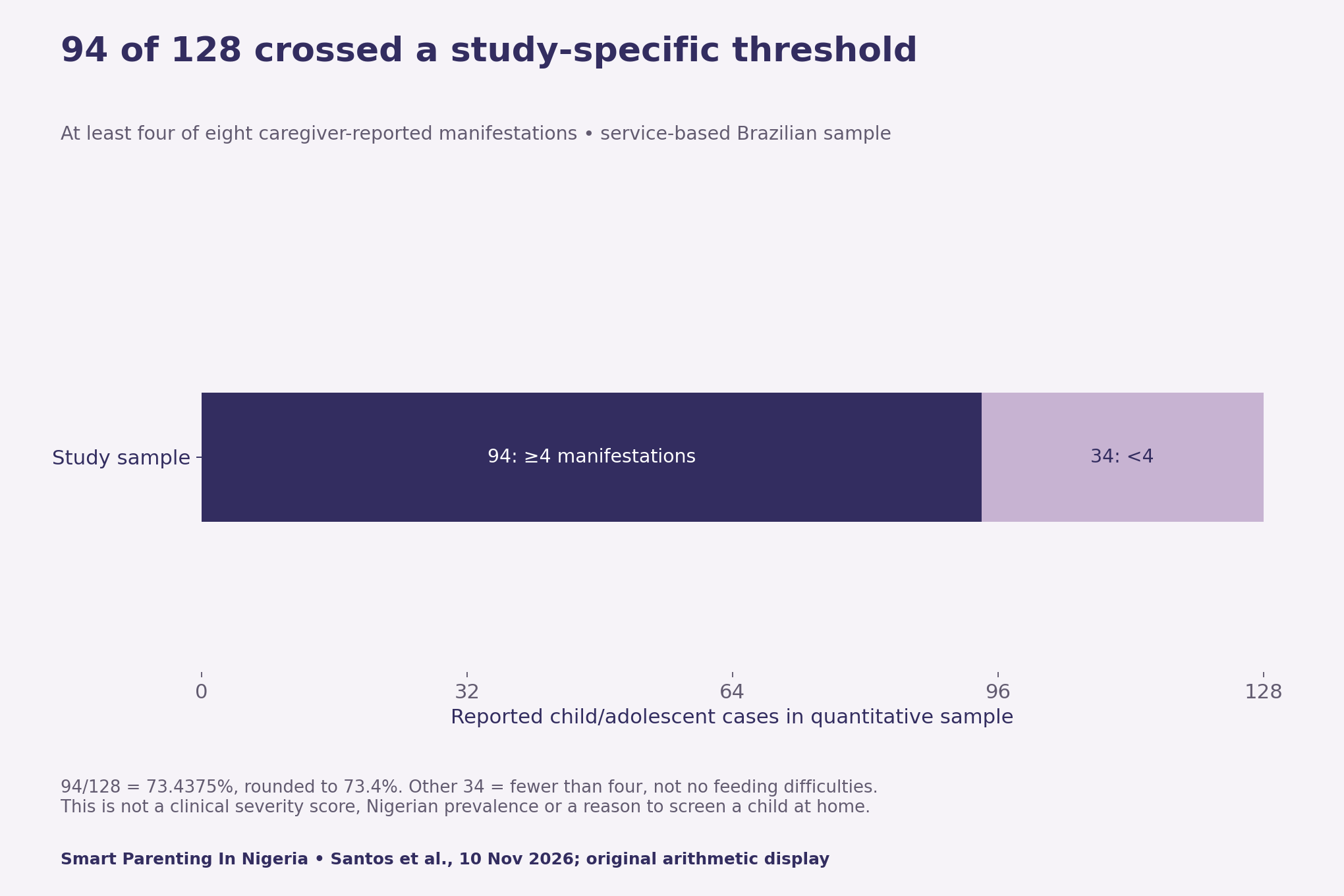
Ninety-four of 128 met the study’s threshold of at least four of eight reported manifestations: 73.4%, rounded. In contrast, the other 34 is our arithmetic complement, not a symptom-free group. The descriptive checklist should not be repurposed as a home diagnosis, severity grade or school eligibility test.
If you reuse this figure, retain the denominator and threshold beside it. A percentage detached from those details could imply a population estimate or a universal clinical cut-off. Neither interpretation belongs in a family handover. Instead, the note concerns one agreed support arrangement, not a comparison with study participants.
Associations do not tell caregivers to remove support
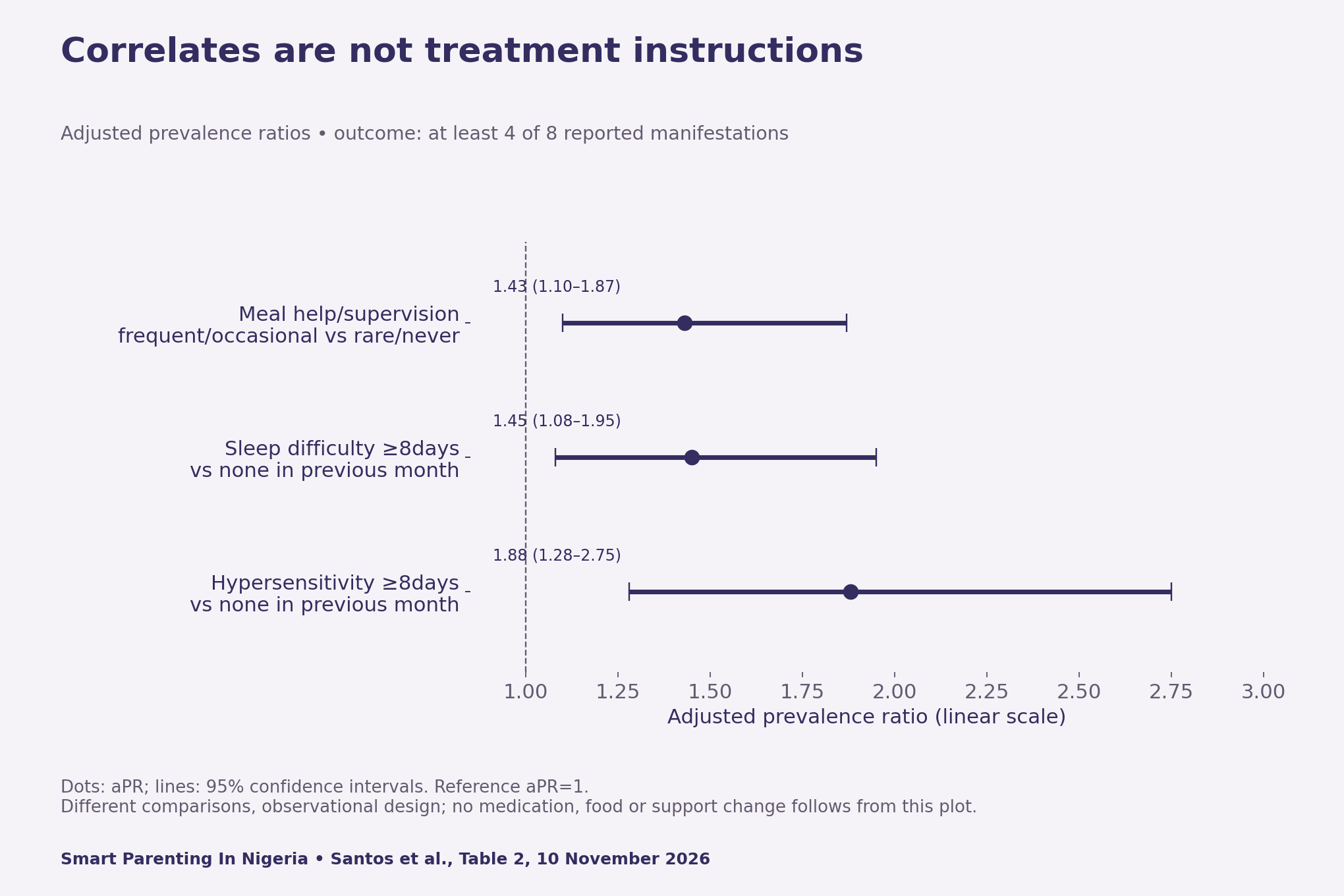
Selected adjusted prevalence ratios were 1.43 (95% CI 1.10–1.87) for meal help/supervision, 1.45 (1.08–1.95) for sleep difficulties on at least eight days, and 1.88 (1.28–2.75) for hypersensitivity on at least eight days. These associations cannot show that withdrawing support or changing medication helps.
The practical boundary is straightforward: a chart cannot authorise a new instruction for a child. Therefore, keep prescribed care with the responsible professional. Use the handover to communicate what the adults already agreed and to flag questions, rather than using a population association to justify an untested change.
Build a selective eating school handover around agreement
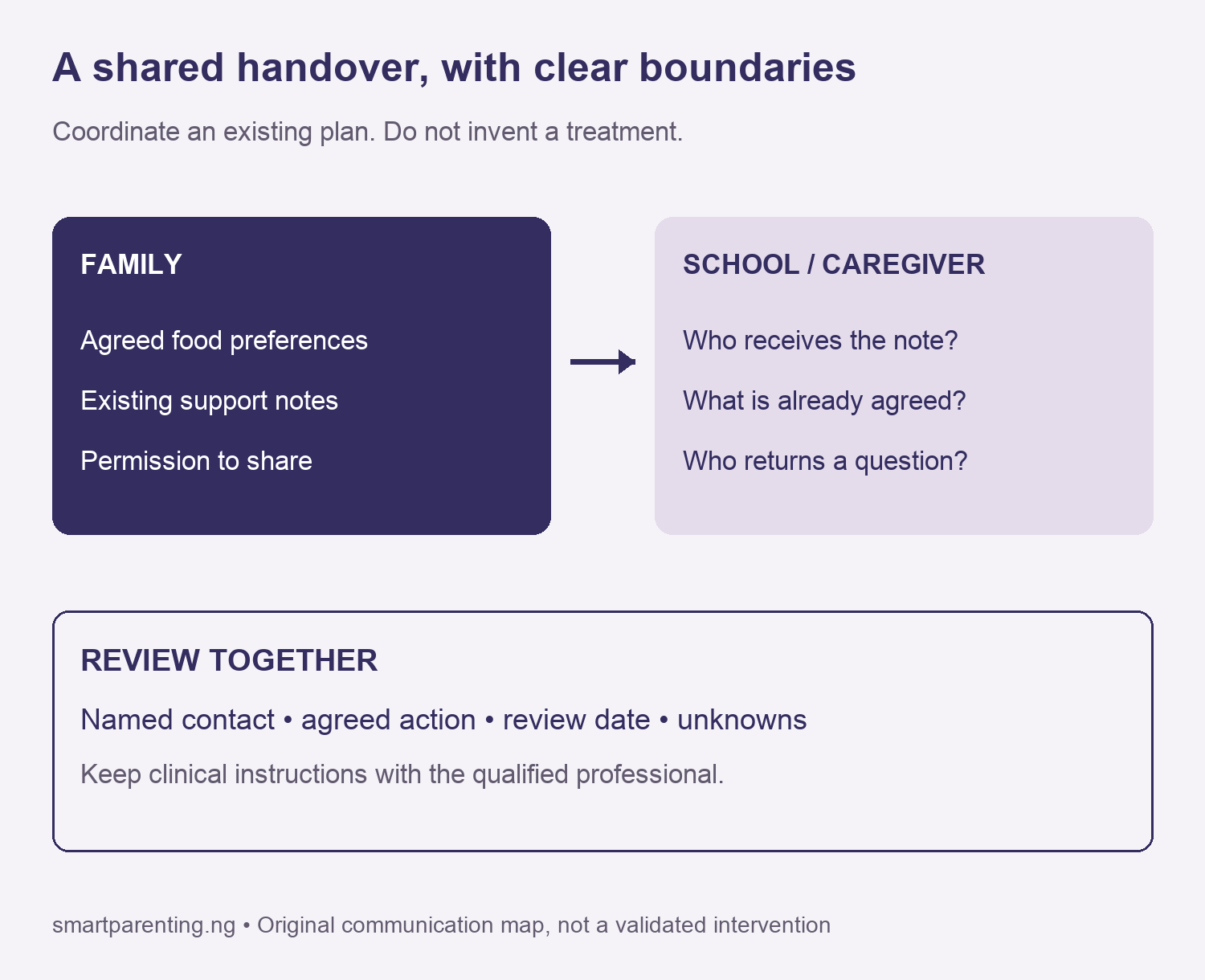
First decide the purpose and recipient. For example, a note for an agreed school contact does not need every detail of a child’s history. Therefore, include only what that person needs for the existing arrangement. Ask how the family’s permission and the school’s normal information-handling process will be respected.
Next, record agreed preferences in neutral language. Leave space for sensory or communication support that is already part of the plan. Avoid moral labels such as difficult, good food or bad parent. As a result, a clear description should help the next adult understand the arrangement without judging the child or caregiver.
Then identify who receives a question and when the note will be reviewed. A named role can be enough in a shared copy; keep private contact details in the appropriate secure channel. However, if responsibility is unclear, record it as a question to settle with the adults involved.
Keep a question separate from a new instruction
| Appropriate handover field | Keep it factual | Do not turn it into |
|---|---|---|
| Already agreed food preference | Record the existing description | A new restriction or nutrition prescription |
| Existing sensory/communication support | Name the agreed arrangement | A coercive eating target |
| Uncertainty reported by school | Write the question and contact | A diagnosis or medication adjustment |
| Review date | Agree who checks the note | A score for judging the family |
For example, “Which agreed contact should clarify this note?” is a coordination question. It does not tell a teacher to change a meal, withhold an accepted food or alter a medicine. If the child needs a clinical instruction, obtain it through the child’s established qualified professional and the school’s normal process.
Do not use the worksheet to introduce food restriction, forced tasting, supplement treatment or a medication timetable. It contains no calorie target, food challenge, diagnostic checklist or severity total. Instead, the blank format deliberately leaves such decisions outside its scope.
Use the private action and question log
The second blank tool records a short observation, the question it raises, an agreed contact and the review status. Write unknown when information is missing. For example, a useful record can say that clarification is needed; it does not need a completed answer in every cell.
Keep any action tied to the existing authorised plan. Before sharing a revised copy, agree which version is current and who should receive it. This simple version check can prevent an old note from being mistaken for a new instruction. No family record needs to be uploaded to this website.
Parenting Made Just for You
Get personalized Parenting Solutions tailored to your child’s needs. Transform your parenting journey with expert guidance in 1-3 days.
Get StartedOur private bedtime log guide also separates observations from advice. Its sleep study is not evidence about selective eating or an autism intervention. Only the record-keeping principle transfers: name the measure, preserve uncertainty and keep personal decisions with the appropriate adults and professionals.
Download four research and handover tools
- Study counts and denominator table (CSV)
- Selected adjusted associations and intervals (CSV)
- Blank consented food-support handover (CSV)
- Blank handover action and question log (CSV)
Method and limits
We transcribed selected aggregate counts and estimates, calculated 34 as 128 minus 94, and created two original charts. The infographic and blank tools are our communication designs. We accessed no participant microdata. Also, we did not test the worksheets as an intervention.
A service-based Brazilian sample does not describe all autistic children, children with ADHD or Nigerian families. The phases represent different caregivers and children. Therefore, keep completed notes private and limited to their purpose. Do not publish a child’s health history, identifying details or completed handover with a social post.
Suggested citation: Smart Parenting In Nigeria (13 November 2026), “Selective Eating: A Clearer School Handover”, selected-source analysis, denominator-aware charts and original communication tools. Retain the study limits and non-clinical boundaries with reused figures.


