






A school toilet locked or broken before a repair needs more than a new “fixed” label afterward. Ask staff what pupils can now use during the school day. The useful answer identifies an open, working and private facility, explains whether your child can use it, and confirms handwashing arrangements separately.
This guide is for a family whose child is already enrolled and wants to understand a reported repair. It provides an original staff-confirmation card and four CSV tools. It is not a school ranking, a general complaints tracker or an engineering inspection. Keep children’s identities and private toilet use out of any shared record.
What the November sanitation announcements establish
On 19 November 2026, the Federal Ministry of Water Resources and Sanitation announced a revised open-defecation-free executive order and renewed the national sanitation commitment. Separately, Voice of Nigeria attributed a proposed FCT school-sanitation intervention plan to the Environment Ministry. These are different announcements from different institutional contexts.
Neither announcement proves that a named school toilet has been repaired. A proposed programme also does not establish a completed nationwide school rollout. For your family’s decision, ask the school to describe the facility now available, the checks staff made and any work that remains. Keep a plan, a repair claim and a confirmed usable arrangement as separate records.
What Nigeria’s school sanitation estimates measure
The WHO/UNICEF JMP 2026 schools report, Annex 3, pages 68–69, lists Nigeria’s modelled 2025 sanitation estimates as 43% basic service, 14% limited service and 43% no service. These are percentages of schools. They are not percentages or counts of pupils, nor a description of the toilet your child uses.
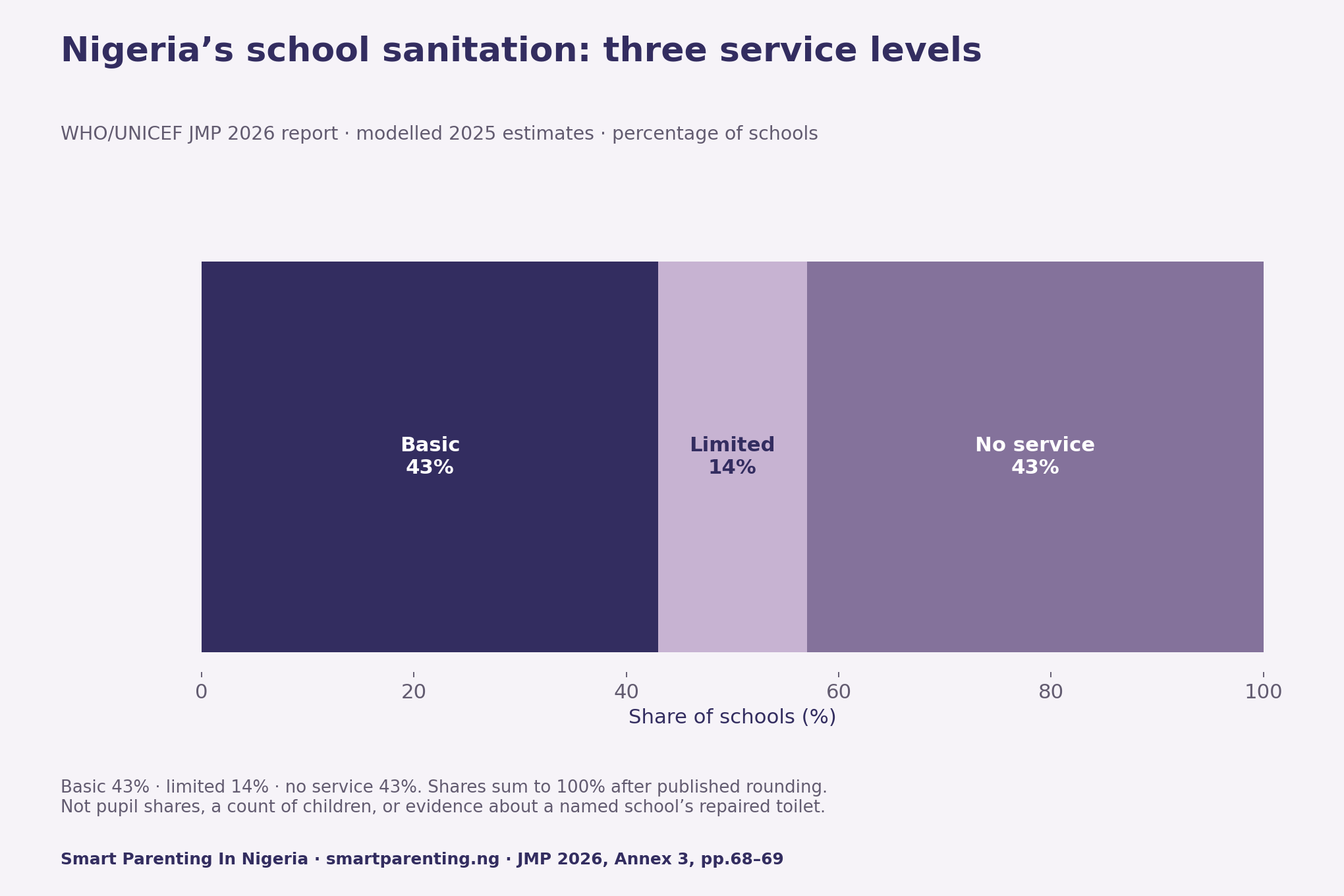
One national bar is enough to present those three shares. Adding a fictional pupil total would change the unit and imply evidence we do not have. The repair-confirmation card below addresses a separate task: getting a clear answer about the actual arrangement at your child’s school after staff say work is complete.
School toilet locked or broken: what does usable mean?
The JMP school-service definitions distinguish the building from its usability. A usable toilet is physically accessible to pupils, functional and private. Access requires an unlocked door or a key available when needed. Functionality includes water for flush or pour-flush toilets; privacy includes a closable door with an inside lock and no major structural gaps.
Basic sanitation normally requires improved, single-sex and usable facilities. Improved facilities that are unusable or not single-sex are limited service. There is a pre-primary exception: usable facilities may qualify as basic without being single-sex. Do not apply the general single-sex rule to pre-primary settings without that qualification.
Disability-inclusive access and handwashing need separate questions. A basic sanitation percentage does not establish either. JMP basic hygiene concerns a handwashing facility with soap and water. This distinction prevents a repaired cubicle from being treated as proof that every related service works or that the route fits an individual child’s needs.
Ask staff for a specific after-repair answer
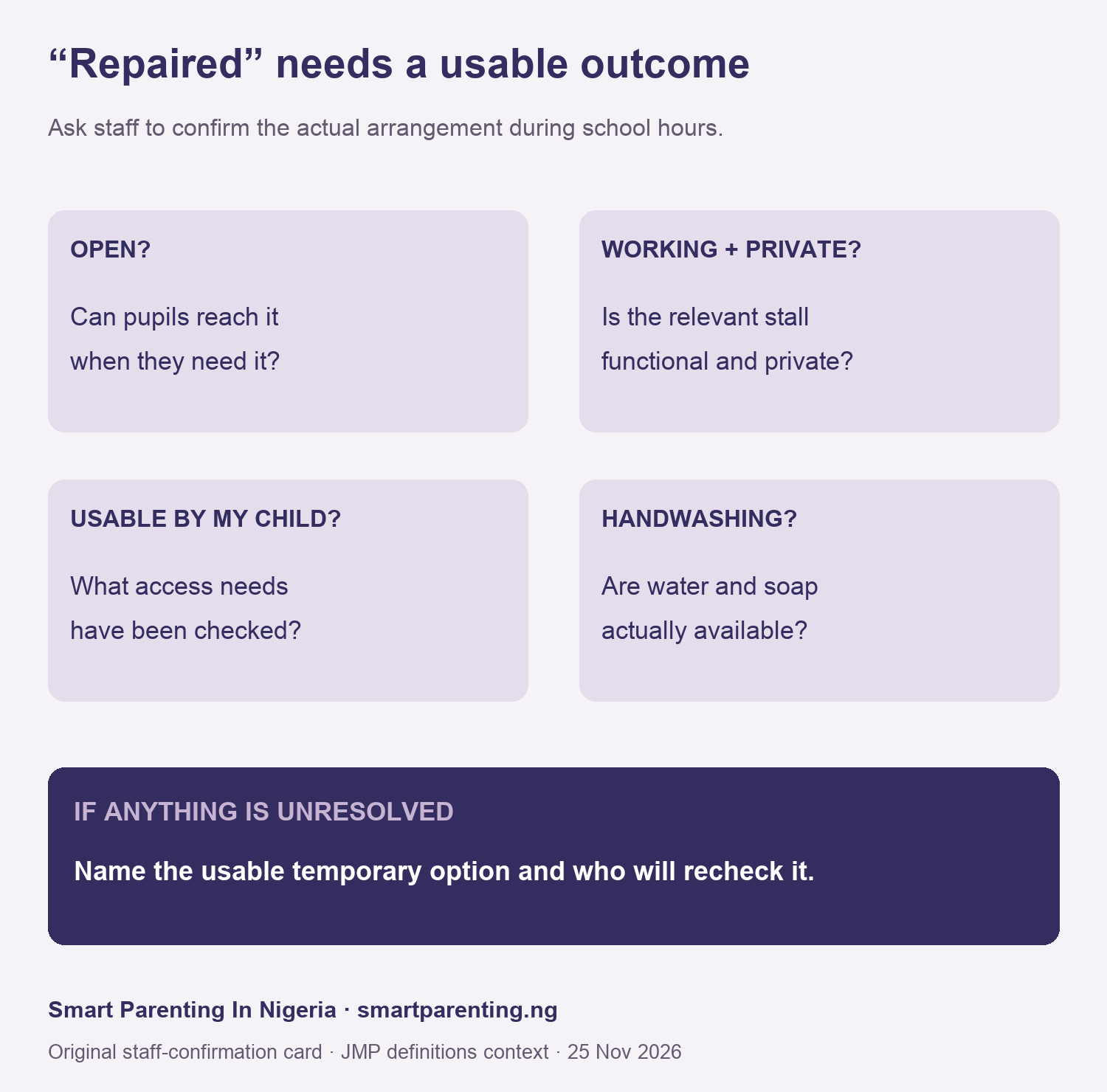
Start with the school-day arrangement. Which facility is available to pupils, and when can they reach it? If a key is used, ask which staff role makes it available and what happens if that person is absent. “There is a toilet” is less informative than an answer about the route pupils can actually use during class hours.
Next, ask what staff checked in the relevant stall. Keep the answer about functionality and privacy, rather than asking a child to inspect, photograph or prove the problem. Record an unresolved item plainly. Do not substitute a photo of new tiles, a paint job or a handover ceremony for confirmation of an available facility.
Check your child’s access and handwashing separately
Ask staff about the entrance, steps, route, door, space or support arrangement that matters for your child. Explain the practical need privately and share only necessary information. The answer should describe the arrangement, not require your child to demonstrate a difficulty in front of others. If staff cannot confirm it, leave that item unresolved.
For handwashing, ask where pupils wash their hands and whether water and soap are available during the school day. Record this separately from the toilet repair. A functioning tap in a photograph may not show that supplies are available when pupils need them. Ask which staff role monitors the arrangement and how a missing supply is addressed.
If the repair is incomplete, name the temporary option
Ask where the usable alternative is, when pupils can access it and how the school explains the arrangement. A reply that work will finish soon does not answer what is available today. Record the responsible staff role and the next check date, rather than assigning a child the job of monitoring the repair.
Keep the discussion focused on a practical, appropriate arrangement through the school’s normal contact route. If there is an urgent safety concern, raise it with the responsible school authority promptly. This general guide cannot decide a particular facility’s safety, legal compliance or engineering condition. Suitable professional assessment may be needed where those questions remain.
Parenting Made Just for You
Get personalized Parenting Solutions tailored to your child’s needs. Transform your parenting journey with expert guidance in 1-3 days.
Get StartedMethods, privacy and free confirmation tools
We transcribed the Nigeria row from the JMP annex, checked the service definitions and separated the two November announcements from claims of completed work. The original card records staff answers, unknowns and an interim arrangement. It does not certify a school, calculate a pupil count or claim that a repair has happened.
Use the blank file privately. It does not ask for children’s names, medical histories, photographs or details of toilet use. If you share a summary with a PTA, keep it at facility and staff-role level. Four tools make the evidence trail reusable without turning a family follow-up into a public register of children.
- JMP Nigeria school-sanitation estimates and source (CSV)
- Blank after-repair staff-confirmation card (CSV)
- Service definitions and measure boundaries (CSV)
- Announcement scope and completion-evidence register (CSV)
Browse Education and Research & Reports for related evidence-led reading. For a separate family outing, see our first library visit guide. Suggested citation: Smart Parenting In Nigeria, “School Toilet Locked or Broken? Verify the Repair”, 25 November 2026.


