





Teens helping a friend in a controlling relationship need a clear boundary: support the friend, then involve a safe adult. A parent can rehearse that idea through a short, voluntary fictional conversation. The aim is to make a supportive reply and adult help easier to name, without asking a child to investigate or solve a real case.
Ask whether your teen wants to try a two-minute made-up scenario. They may decline or stop. Keep real names, messages and experiences out of the exercise. This article is a conversation aid, not a test, counselling service or evidence that a prompt prevents harm.
What the Ebonyi research can and cannot tell parents
A BMC Public Health study published on 24 November 2026 sampled 300 senior-secondary students in rural Ebonyi. Using the authors’ descriptive threshold, 184 of 276 valid respondents fell in the lower knowledge category. Separately, 181 of 287 fell in the higher self-reported prevention-practice category. The publication was an early accepted version when checked.
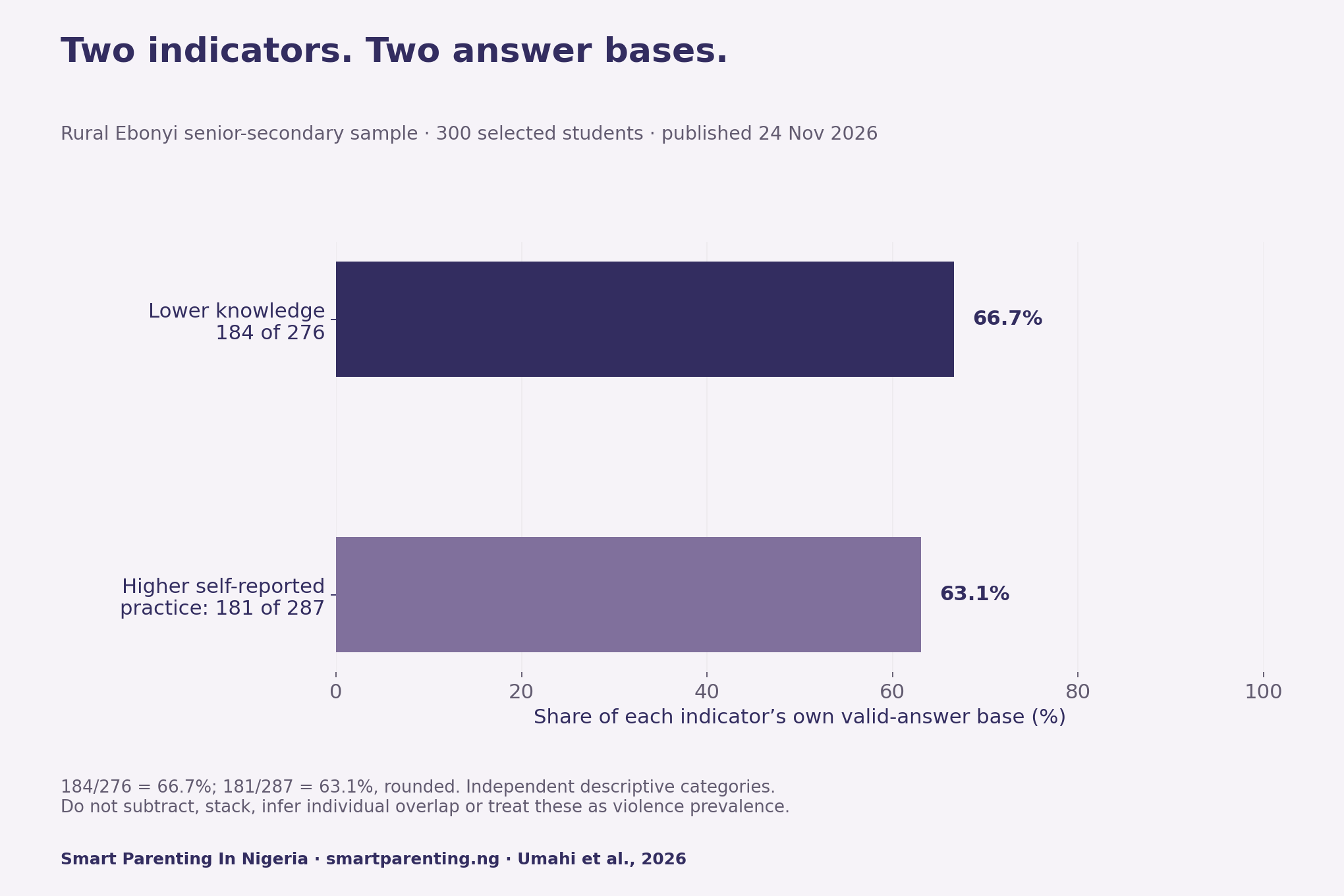
The calculations are 184 ÷ 276 × 100 = 66.7% and 181 ÷ 287 × 100 = 63.1%, rounded to one decimal. Do not subtract them to create a “gap” for an individual. The summary does not identify which students belonged to both categories. Nor can a cross-sectional questionnaire establish that knowledge caused a later response.
The useful lesson for a family conversation is to discuss a concrete response rather than assume that knowing a definition means knowing who can help. This is our editorial application of the evidence limits. It is not a finding that our exercise has been tested in the study or that the percentages apply to all Nigerian teenagers.
Teens helping a friend: try a fictional conversation
UNICEF’s Helping Adolescents Thrive facilitator guide, written for work with 15- to 19-year-olds, discusses relationship boundaries, voluntary scenario practice and seeking support. Its later modules distinguish supporting a friend from being left alone with an unsafe situation. Our short parent conversation is original; it does not reproduce the guide’s role-play script or constitute the full programme.
Use a simple invented situation: a friend says their partner gets angry whenever they spend time with other people. Ask what your teen could say to the friend. A calm answer can acknowledge that the friend deserves respect and does not have to handle the concern alone. Avoid turning the answer into a lecture about why the friend stayed.
Next, ask who could help without leaving the friend alone with it. Make the role concrete, such as a safe parent, a suitable school safeguarding adult or a qualified professional. An adult is not automatically safe just because of their title. Ask who the backup would be if the first person dismissed the concern.
Name what your teen should not take on
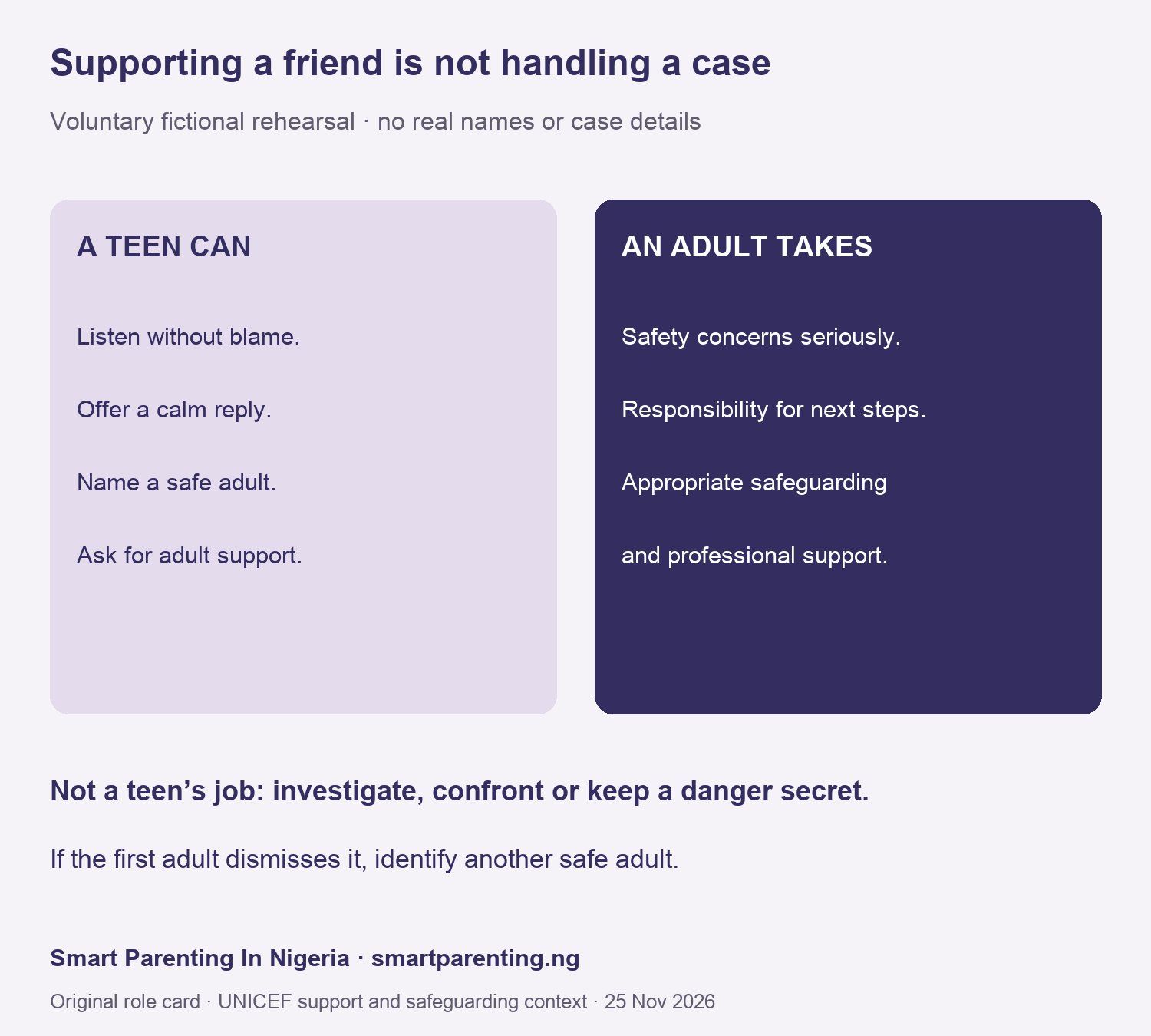
Ask what should stay outside a friend’s role. They should not confront the controlling partner, gather evidence, mediate the relationship or promise to keep a dangerous situation secret. The exercise should leave the teen with a route to adult help, not a duty to rescue someone alone.
UNICEF’s I Support My Friends resources place peer support within close adult supervision and child safeguarding. That context matters: a helpful conversation between friends cannot replace an adult’s responsibility. You can reinforce that asking for support is compatible with caring about a friend, rather than a betrayal of that friendship.
If a real concern comes up, stop the rehearsal
If your teen describes something real, stop treating the conversation as an activity. Listen calmly, avoid blame and do not press for unnecessary details. Do not promise secrecy. Explain that safety concerns may need appropriate help and involve a safe, responsible adult or qualified safeguarding professional. If there is immediate danger, seek urgent local assistance rather than continue the worksheet.
A parent should take responsibility for arranging suitable support and following up. Do not leave the next steps entirely with the teen or their friend. Where an adult is implicated or unsafe, seek another appropriate safeguarding route. This general card cannot assess a particular situation or provide case-specific legal or clinical advice.
Methods, limits and private planning tools
We checked the two published indicator bases, calculated each percentage separately and made an original two-role infographic. The fictional prompts do not request actual experiences, screenshots or identifying details. The blank planning file uses adult roles, with no names required, and should remain private if you add personal information.
One substantive chart reflects the available evidence. There is no individual risk score, prevalence estimate or claim that the conversation changes outcomes. Keep the focus on a nonjudgmental reply, concrete safe adult support and the boundary between practice and a real disclosure.
- Separate study indicators and answer bases (CSV)
- Original voluntary fictional conversation prompts (CSV)
- Blank private safe-adult and backup-role plan (CSV)
- Evidence and role-boundary register (CSV)
Browse Parenting Challenges and Research & Reports for related evidence-led reading. Suggested citation: Smart Parenting In Nigeria, “Teens Helping a Friend in a Controlling Relationship”, 25 November 2026.
Parenting Made Just for You
Get personalized Parenting Solutions tailored to your child’s needs. Transform your parenting journey with expert guidance in 1-3 days.
Get Started


