






A breastfeeding demonstration at antenatal care can give you a chance to ask for practical help, rather than leaving with information you are unsure how to use. Ask a qualified maternity worker which demonstration is appropriate for your appointment, how they can check your understanding, and where you can receive individual counselling.
This guide offers a conversation card, not feeding techniques or a regimen. You can use the questions in your own words and choose what you feel comfortable discussing. A group health talk and an individual counselling appointment may offer different opportunities, so it helps to ask what is available.
What the new Ibadan study actually measured
A study by Folasire and colleagues published on 24 November 2026 examined an education tool among healthcare personnel in five purposively selected primary healthcare centres in Ibadan. Of 48 questionnaire respondents, 45 fell in the study’s high-acceptability category. Six key-informant interviews explored practicality. The publication was an early accepted version when checked.
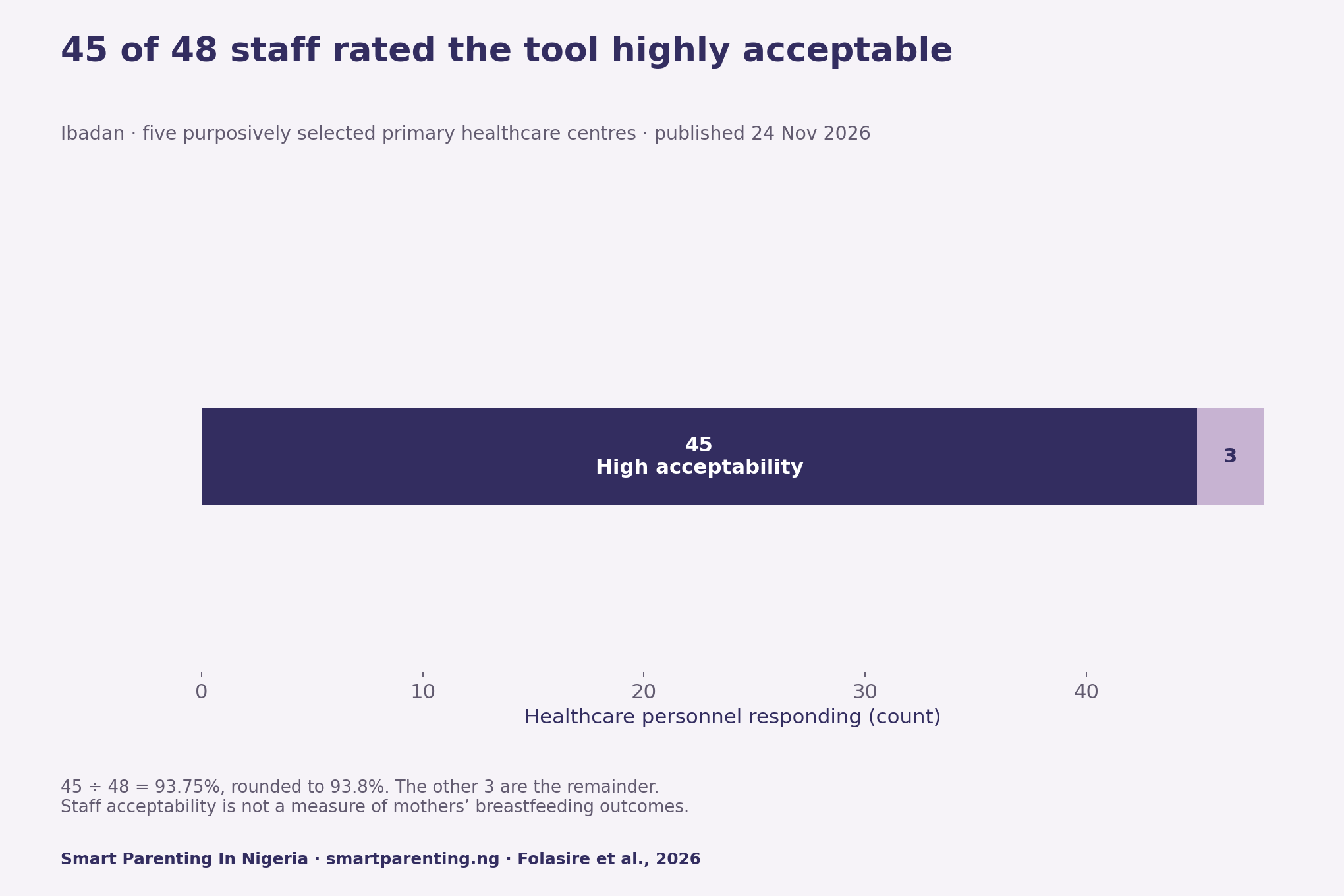
Dividing 45 by 48 gives 93.75%, which rounds to the reported 93.8%. The remaining three responses represent 6.25%. We label them as the remainder, not as rejection, because that would add a meaning the summary does not establish. The chart is an original visualisation of reported counts; it does not reproduce the authors’ education tool.
The research did not compare mothers’ breastfeeding outcomes across interventions or prove that a specific demonstration improves an individual outcome. Nor does a five-centre sample show what every Nigerian clinic currently provides. Its practical value here is to frame a careful appointment question, while keeping those limits visible.
Ask for a breastfeeding demonstration at antenatal care
WHO and UNICEF’s counselling implementation guidance covers support before and after birth and the development of skills and confidence. That broader guidance supports asking for appropriate practical help. It does not guarantee a particular service at your local appointment, or replace advice tailored to you.
A useful opening is to explain what you want to understand. You might say that a group talk explained the benefits, but you would like a worker to show an appropriate practical step. Ask what can be covered today and whether a separate counselling contact is needed. Let the qualified worker decide what demonstration is suitable.
Use the card without turning the appointment into a test
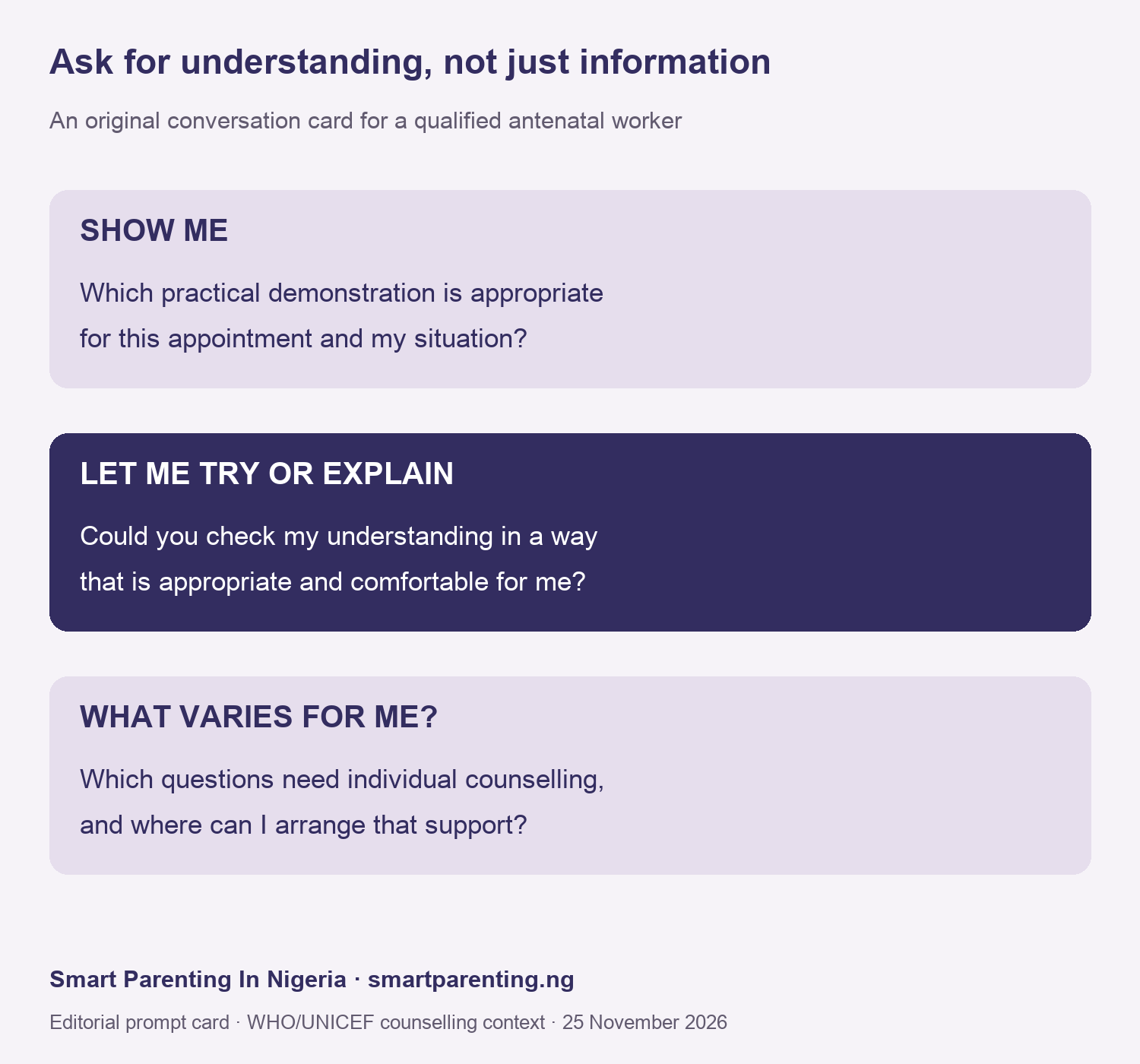
“Show me” asks for practical explanation. It is different from assuming that a leaflet or a general talk answered every question. If the appointment cannot include a demonstration, ask who provides that support and how to arrange it. Record the service or next contact rather than expecting the worker to fit everything into one session.
“Let me try or explain” asks the worker to check understanding in an appropriate way. You do not need to perform for an audience or pretend that everything is clear. Ask for another explanation if needed. The card does not score you, certify a skill or ask you to practise a technique without qualified guidance.
“What varies for my situation?” leaves room for individual counselling. You may prefer a private conversation instead of raising personal questions in a group. Ask whether a birth companion may join if you want one and the service allows it. Your preferences and comfort belong in that discussion.
Leave with a clear next contact
If only a group talk is offered, ask where individual counselling is available. Note the location or service, how to arrange a contact, and which question you still want clarified. A planned follow-up is more useful than an unverified assumption that the same service is available everywhere.
Keep your working notes private. The blank CSV asks for appointment questions and support arrangements; it does not require a medical history or a baby’s personal identifiers. You can leave any field blank. Do not post personal care details when sharing the conversation card with a parent group.
Methods, limits and free appointment tools
We checked the study’s reported staff counts and calculated the remainder and percentages. We read the WHO/UNICEF counselling guidance and created a separate editorial prompt card. One substantive chart fits the available sample; adding outcome charts would imply evidence the study did not collect.
The article provides no positioning instructions, feeding schedule, formula judgment or individual treatment advice. Ask a qualified maternity professional about your circumstances. The prompt card is not the study’s copyrighted tool and has not been tested as an intervention. We make no claim that using it changes a health outcome.
- Study staff counts, percentages and boundaries (CSV)
- Original antenatal conversation prompts (CSV)
- Blank appointment questions and next-contact notes (CSV)
- Evidence and claim-boundary register (CSV)
For related reading, browse Pregnancy and our Research & Reports archive. Suggested citation: Smart Parenting In Nigeria, “Breastfeeding Demonstration at Antenatal Care: What to Ask”, 25 November 2026. The source study concerns staff in selected Ibadan centres, not a national outcome survey.
Parenting Made Just for You
Get personalized Parenting Solutions tailored to your child’s needs. Transform your parenting journey with expert guidance in 1-3 days.
Get Started


