





A National Library of Nigeria children’s section can be a useful lead for a family outing. However, check the branch’s current arrangements before spending money on transport. Confirm the location, children’s access and visit hours directly. Then separate reading on site from permission to borrow books and take them home.
Your first visit can have a small goal: let your child choose one book to look at together on site. There is no need to make borrowing the measure of success. This guide provides an original trip card, one historical-data chart and four downloadable CSV tools to help you plan an outing that fits your family.
The Abuja headquarters announcement is not a public opening
In a release dated 21 November 2026, the National Library of Nigeria welcomed the resumption of work on its headquarters building. The recommencement event took place on 19 November. That is a construction milestone; it is not confirmation that families can now visit the project as an operating children’s library.
Keep the planned headquarters separate from an existing branch when checking an address. A news photograph or completion promise cannot tell you whether a children’s room is open on your intended day. Ask about the branch you actually plan to visit, rather than assume the headquarters news describes its services.
Find a National Library of Nigeria children’s section to check
The NLN state-branch directory lists a Children section at its existing FCT branch in Area 2, Garki, Abuja. It gives the location as Reference and User Services, Mokwa Street. This is a documentary lead checked on 25 November 2026. We have not contacted branch staff to confirm current access, hours or lending.
The institution also documented the Lagos Green Library in April 2024 as a space for children and young adults. Its historical article is a reason to ask about that service today, not a current operating guarantee. Confirm the age range, collection and arrangements for your intended visit directly with the branch.
If neither lead is local, use the official directory to identify a closer branch. Do not infer that every branch has an active children’s section. Ask what is currently offered for your child’s age, whether a suitable adult must accompany them and whether a staff member can explain the reading area’s rules on arrival.
What the book-availability data adds—and what it does not
Nigeria MICS 2021, Table TC.10.2, printed page 262, reports that 4.3% of under-fives lived in households with at least three children’s books for the child. The urban estimate was 9.2%; the rural estimate was 1.4%. These are historical survey estimates about books at home.
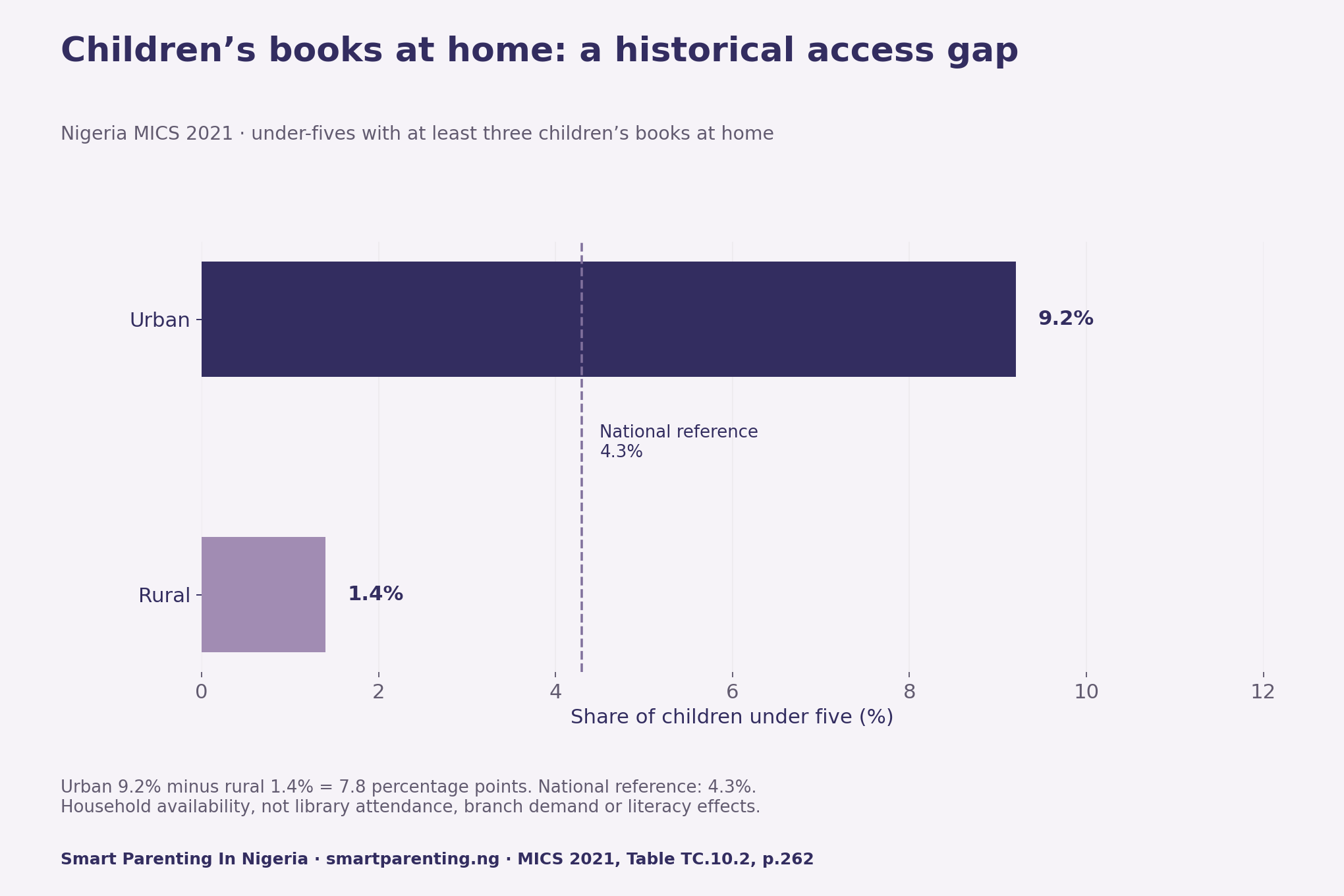
The arithmetic is 9.2 − 1.4 = 7.8 percentage points. Keep “percentage points” in the label because this subtracts two percentages. Do not report it as a 7.8% increase. Nor should you average 9.2 and 1.4 to recreate the national figure, which reflects the survey’s national estimation rather than equal weighting of those two groups.
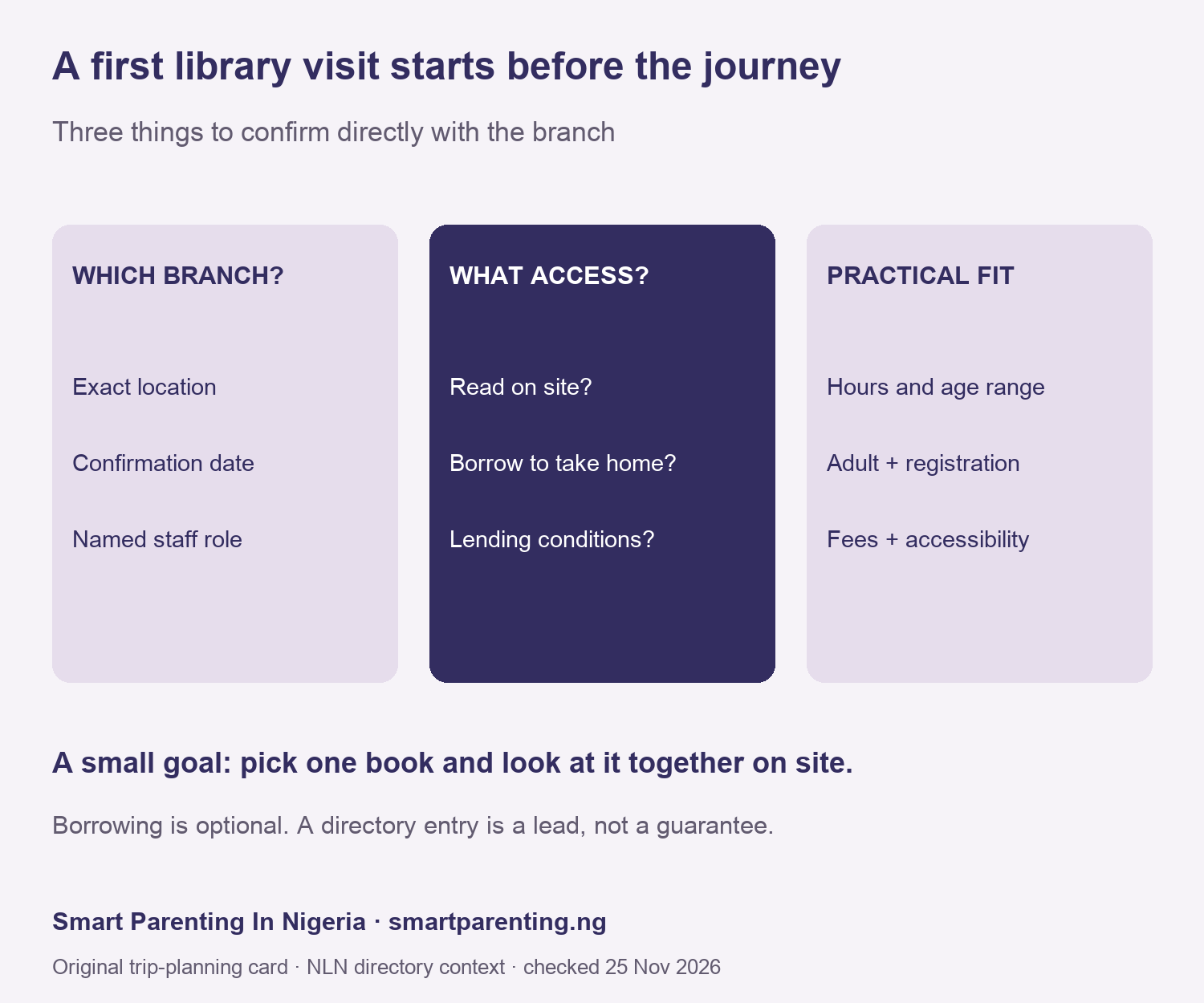
The figures give context for thinking about access to children’s books. They do not measure library attendance, demand at a particular branch or the effect of a visit on literacy. They also do not predict what any child owns or enjoys. The practical trip card below is our editorial planning tool, not a tested intervention from the survey.
Confirm three parts of the visit before travelling
First, record the exact branch and the date you received confirmation. Note the staff contact’s role rather than collecting unnecessary personal information. Ask whether children can use the relevant room on the specific day and during the hours you intend to arrive. If the answer is uncertain, keep it marked unconfirmed and recheck before setting off.
Second, ask two separate access questions. Can your child sit and read books on site? Can books be borrowed to take home? If lending is available, ask about membership, the responsible adult, any documents, return dates and applicable charges. A reading-room service does not automatically establish take-home borrowing rights.
Third, check practical fit: age range, available material, adult accompaniment, registration and fees if any. Ask about the entrance, stairs, toilets, seating or another accessibility need that matters to your family. A general statement that a branch is accessible is less useful than an answer about the route and room your child will use.
Keep the first visit simple
Once staff confirm access, agree a small, flexible activity with your child. You might look at one picture book together, ask what they notice or let them choose a page. Follow the branch’s handling and quiet-area rules. This is a suggested family activity, not a promise of a measurable reading outcome.
If there is no suitable collection or the room is unavailable, ask staff about a workable alternative before travelling. You can postpone rather than turn an unconfirmed outing into a wasted fare. Avoid telling a child they will definitely borrow a book until the lending conditions are clear. The aim is a realistic visit, not a checklist score.
Parenting Made Just for You
Get personalized Parenting Solutions tailored to your child’s needs. Transform your parenting journey with expert guidance in 1-3 days.
Get StartedDownload the branch-verification and planning files
We checked the official branch documentation, separated the construction news from access claims and transcribed the three MICS estimates from the source table. One chart suits the limited historical dataset; the trip infographic explains a different planning task. We make no nationwide claim about free borrowing, weekend opening or active children’s sections.
- MICS 2021 books-at-home estimates and source table (CSV)
- Official branch leads and confirmation limits (CSV)
- Blank first-visit confirmation and trip card (CSV)
- Calculation and interpretation boundaries (CSV)
For related family activities, browse Activities and Entertainment and Research & Reports. Suggested citation: Smart Parenting In Nigeria, “National Library of Nigeria Children’s Section: Plan a Visit”, 25 November 2026.


