




Why Listening Matters in the Classroom
Listening helps children learn, participate, follow directions, and communicate respectfully.
It also helps children understand teachers’ messages and respond appropriately during classroom activities.
Through attentive listening, children become more prepared for daily school experiences.
Supporting Learning
First, listening helps children understand what teachers explain.
Careful attention helps children follow directions and focus on learning tasks.
Additionally, listening allows children to recognize important details during classroom instruction.
Children can use what they hear to respond appropriately and continue learning.
Encouraging Classroom Participation
Listening helps children understand questions, discussions, and opportunities to contribute.
When children listen carefully, they can share relevant thoughts with greater confidence.
Moreover, attentive listening helps children notice when teachers invite responses.
It also supports respectful participation during group conversations.
Promoting Classroom Safety
Teachers may share directions that help children act safely in the classroom.
Therefore, children need to listen when teachers explain safety expectations.
Listening helps children recognize instructions before beginning activities or changing tasks.
It also helps children respond promptly when teachers provide important guidance.
Parenting Made Just for You
Get personalized Parenting Solutions tailored to your child’s needs. Transform your parenting journey with expert guidance in 1-3 days.
Get StartedBuilding Respectful Communication
Listening shows teachers that children value their words and attention.
Furthermore, attentive listening supports polite exchanges between children and teachers.
Children learn to wait, hear complete messages, and respond thoughtfully.
This practice encourages respectful communication throughout the classroom.
Connecting Listening With Daily School Experiences
Listening influences how children learn, participate, follow directions, and communicate.
Consequently, strong listening habits support several parts of the classroom experience.
Children can become more prepared to engage when they focus on teachers’ messages.
Build Listening Habits at Home
Home practice can help children develop steady listening habits.
Begin with short conversations that encourage focused attention.
Then, gradually invite your child to listen for longer periods.
Encourage Comfortable Eye Contact
Invite your child to look toward the speaker during conversations.
Explain that eye contact shows attention without requiring a fixed stare.
However, allow natural breaks so your child remains comfortable.
Gently remind your child to reconnect visually when attention drifts.
Unveil the Perfect Name that Tells Your Family's Story
Let us help you find a name that embodies your family's values, traditions, and dreams. Our personalized consultation weaves cultural insights to create a name that's uniquely yours.
Get StartedSupport an Attentive Posture
Show your child how posture can support careful listening.
Encourage your child to face the speaker and keep the body still.
Place both feet comfortably and keep hands calm during conversations.
Also, reduce nearby distractions before giving important directions.
A quieter setting makes attentive posture easier to maintain.
Practice Patience During Conversations
Teach your child to wait while another person finishes speaking.
Use brief pauses to practice waiting before responding.
For example, pause after speaking and let your child answer naturally.
Remind your child that patience gives everyone time to express thoughts.
Additionally, praise calm waiting when your child demonstrates it.
Teach Respectful Turn-Taking
Help your child notice when another person has finished speaking.
Encourage your child to raise a hand or wait for an opening.
Practice taking turns during ordinary family conversations.
Keep each turn clear so your child can follow the exchange.
When interruptions happen, respond calmly and guide your child back.
Reduce Interruptions Without Discouraging Questions
Tell your child to remember questions while listening.
Your child can hold the question briefly until the speaker finishes.
Offer a simple reminder, such as “Please wait for your turn.”
Afterward, invite your child to ask the saved question.
This approach protects curiosity while encouraging respectful listening.
Use Consistent Home Routines
Choose regular moments for practicing listening skills.
For instance, use conversations that involve sharing directions or thoughts.
Keep expectations consistent across different family discussions.
Meanwhile, demonstrate the same listening habits when your child speaks.
Children can notice and follow respectful behavior they see at home.
Offer Specific Encouragement
Recognize the exact behavior your child displayed.
You might mention eye contact, quiet hands, patience, or turn-taking.
Specific feedback helps your child understand which habit to repeat.
Finally, correct gently and return attention to the listening practice.
Building Direction-Following Skills
Teach your child to listen carefully whenever a teacher gives spoken instructions.
First, encourage your child to pause and focus on the complete message.
Next, help your child identify what the teacher wants them to do.
Then, encourage your child to remember the order of each required action.
Identifying Key Points
Children can listen for action words that explain the expected task.
They can also notice details about materials, order, or completion.
Meanwhile, encourage your child to separate essential directions from additional information.
Afterward, ask your child to describe the main instruction in their own words.
Breaking Directions Into Steps
When instructions contain several actions, your child can divide them into smaller steps.
First, they can identify the starting action.
Next, they can recall what follows that action.
Finally, they can check whether they remembered the complete direction.
This process helps your child approach spoken instructions in an organized way.
Repeating Directions When Necessary
Teach your child to repeat directions when part of the message remains unclear.
Your child can calmly ask the teacher to repeat the instruction.
They can also repeat the direction aloud to confirm their understanding.
For example, your child might restate the requested action using their own words.
Then, the teacher can clarify any misunderstood details.
Checking Understanding Before Starting
Encourage your child to review the direction mentally before beginning.
They can ask themselves what they must do first.
They can also consider whether they understand every part of the instruction.
If uncertainty remains, your child should seek clarification before continuing.
Practising Spoken Instructions
Give your child opportunities to listen to short instructions during everyday activities.
Gradually, present directions that include more than one action.
After each instruction, ask your child to explain the key points.
Then, invite your child to repeat any direction that needs clarification.
With practice, your child can strengthen careful listening and accurate direction-following.
Learn More: Preparing Your Child To Share And Take Turns
Handling Distractions
First, help your child notice what pulls attention away from the teacher.
Distractions may come from nearby activity, personal thoughts, or surrounding sounds.
Then, encourage your child to return attention to the teacher’s words.
Use calm reminders that direct attention without causing embarrassment.
Additionally, discuss which distractions your child can manage independently.
Channeling Restlessness
Restlessness can make sustained listening feel difficult.
Therefore, help your child recognize early signs of physical discomfort.
Encourage quiet adjustments that support attention without disturbing others.
For example, your child might shift position carefully when needed.
Also, remind your child to listen while managing movement respectfully.
Managing Excitement
Excitement can cause children to speak quickly or respond before listening fully.
Teach your child to pause and let the teacher finish speaking.
Next, encourage your child to hold thoughts briefly before responding.
A quiet pause creates space for complete directions and thoughtful answers.
Meanwhile, praise your child for waiting and listening through exciting moments.
Responding to Difficult Feelings
Frustration, worry, or disappointment can interrupt classroom listening.
Help your child name the feeling without letting it control the response.
Then, encourage one calm action that supports renewed attention.
Your child might focus on the next spoken point.
Alternatively, your child might ask for clarification after listening.
Creating a Personal Reset Plan
A simple reset plan can prepare your child for challenging moments.
Keep the plan brief and easy to remember.
Include noticing the challenge, pausing, and returning attention.
Practice the steps during calm conversations at home.
Over time, your child can adjust the plan to match personal needs.
Learn More: How To Reduce Crying And Clinging At School Drop-Off
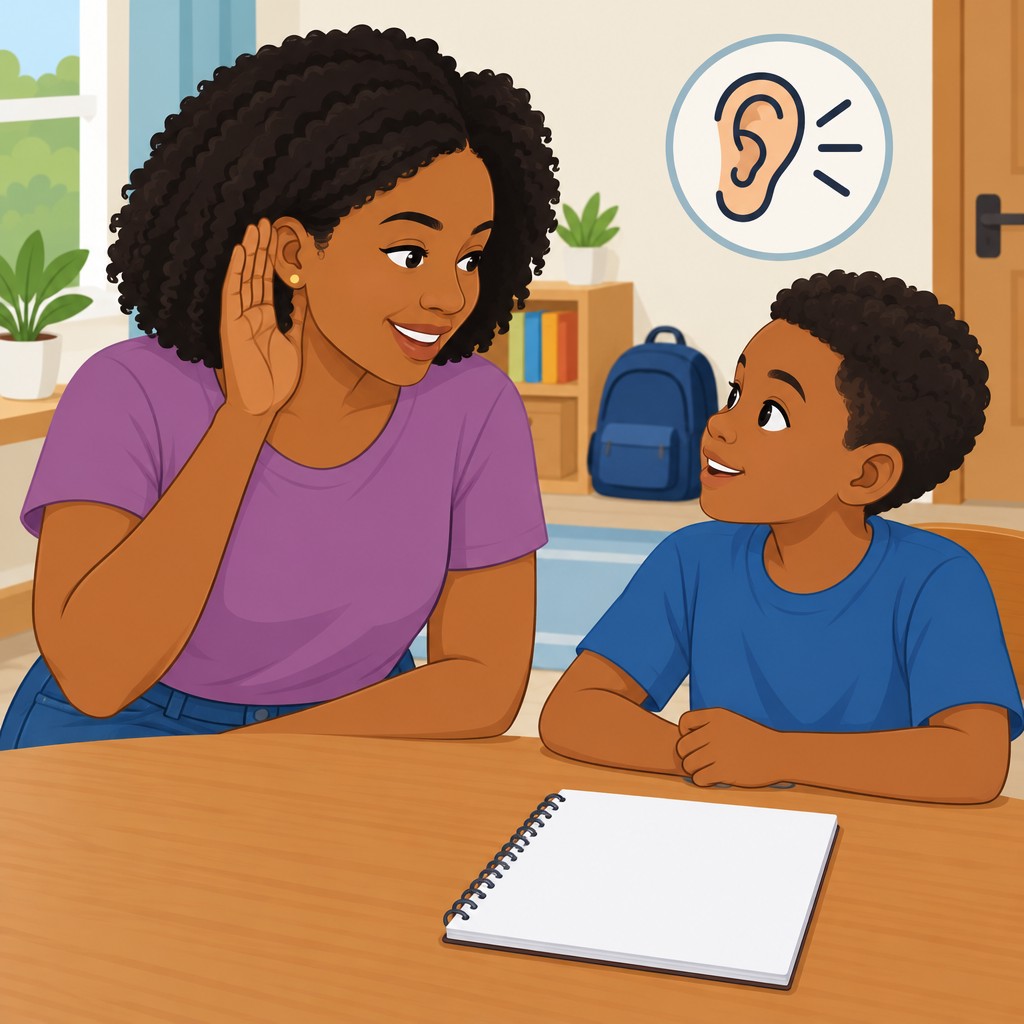
Strengthening Listening Through Conversation
Age-appropriate conversations help children practice listening in a comfortable setting.
Begin with topics that match your child’s understanding and interests.
Then, share one idea at a time during each conversation.
Pause occasionally so your child can process the information.
Ask your child to explain the idea using their own words.
This response shows how well your child understood the conversation.
Using Stories to Build Understanding
Stories give children opportunities to follow ideas from beginning to end.
Choose stories that match your child’s age and current comprehension.
Before reading, invite your child to consider what might happen.
During the story, ask questions about important details.
Afterward, ask your child to describe the events in order.
Encourage your child to identify the main idea without supplying the answer.
Furthermore, ask your child to explain why certain events happened.
Asking Questions That Strengthen Attention
Use questions that require more than a brief response.
Ask your child to describe, explain, compare, or recall information.
For example, ask what happened first and what happened afterward.
Next, ask which details seemed most important.
Allow enough time for your child to think before answering.
Then, restate the response when your child needs clarification.
Supporting Memory Through Retelling
Retelling helps children practice holding information and expressing it clearly.
Ask your child to summarize a conversation or story later.
Encourage your child to recall details without immediately providing prompts.
If needed, offer a gentle question that guides the memory.
For instance, ask what happened before a remembered event.
Gradually invite your child to include more relevant details.
Adjusting Practice Over Time
Keep conversations and stories suitable for your child’s current abilities.
As understanding develops, introduce longer ideas and more detailed questions.
However, maintain clear language and manageable discussions.
Notice which questions help your child explain ideas most successfully.
Finally, use those question types regularly during everyday conversations.
Explore Further: What To Do If Your Child Refuses School
Seeking Clarification Respectfully
Sometimes, a child may not understand a teacher’s explanation.
Therefore, teach your child to request clarification calmly and respectfully.
Your child can use questions to address confusion.
Recognizing When Help Is Needed
Encourage your child to notice confusion instead of guessing silently.
Your child can identify unclear words, directions, questions, or explanations.
Additionally, your child can recognize when an answer remains uncertain.
Choosing Respectful Words
Teach your child to use polite language when asking for clarification.
A respectful request can explain that the child needs additional understanding.
Encourage your child to avoid blaming, interrupting, or dismissing the teacher’s explanation.
Polite wording helps your child communicate confusion without sounding disrespectful.
Waiting for an Appropriate Moment
Teach your child to follow the teacher’s expectations for asking questions.
Your child may raise a hand, wait briefly, or use an agreed classroom signal.
However, your child should respond immediately when clarification affects safety or instructions.
Encourage your child to remain attentive while waiting for assistance.
Explaining the Confusion Clearly
Guide your child to describe which part of the explanation caused confusion.
A specific question helps the teacher understand what requires clarification.
For example, your child can mention an unfamiliar term or unclear direction.
Encourage your child to ask one question at a time when possible.
Listening After Receiving Clarification
After the teacher responds, your child should listen carefully to the explanation.
Then, your child can restate the direction or idea in personal words.
This response allows the teacher to correct any remaining misunderstanding.
Your child can ask another polite question if confusion continues.
Practicing Respectful Clarification
Practice short clarification conversations during ordinary discussions at home.
Ask your child to identify confusion and form a respectful request.
Then, respond as the teacher might and invite your child to listen.
Afterward, discuss the words, timing, and tone your child used.
Encouraging Confident Participation
Remind your child that asking for clarification supports understanding.
Also, explain that respectful questions show active involvement in learning.
Encourage your child to seek help without embarrassment or frustration.
With practice, your child can communicate confusion clearly and respectfully.
Gain More Insights: How To Build Discipline Before School Begins
Responding Calmly to Correction
Teach your child to view correction as guidance rather than a personal attack.
Teachers may correct behavior, schoolwork, or classroom choices.
Encourage your child to listen fully before responding.
Meanwhile, remind your child that defensiveness can interrupt useful feedback.
Pausing Before Responding
Teach your child to pause when a teacher offers correction.
During that pause, your child can breathe and focus on the message.
Then, your child can consider what the teacher wants them to understand.
This brief pause creates space for a respectful response.
Separating Feelings From Actions
A child may feel embarrassed, frustrated, or disappointed after receiving feedback.
However, feelings do not require disrespectful words or actions.
Help your child name the feeling without rejecting guidance.
Afterward, guide your child toward a calm and appropriate response.
Practicing Respectful Responses
Give your child simple language for acknowledging correction.
For example, your child might say, “I understand,” or “I will try again.”
Your child might also say, “Thank you for explaining that.”
These responses help your child accept guidance without arguing.
With practice, respectful words can support calmer classroom interactions.
Receiving Feedback About Work
Teach your child to focus on specific feedback.
Encourage your child to identify what needs changing.
Next, your child can decide which action should follow.
For instance, the action might involve revising, checking, or restarting work.
If feedback remains unclear, remind your child to request further explanation.
Handling Classroom Guidance
Teachers may guide students toward appropriate classroom choices.
Prepare your child to stop, listen, and adjust their behavior.
Encourage your child to avoid arguing about correction immediately.
Instead, your child can respond respectfully and follow the guidance.
Later, your child can discuss lingering concerns calmly.
Building Reflection After Correction
Afterward, ask your child what the teacher communicated.
Then, ask what response your child chose.
Encourage your child to consider whether that response showed respect.
Next, discuss another response your child could use later.
Creating a Personal Response Plan
Help your child choose a short plan for future corrections.
The plan might include pausing, listening, acknowledging, and adjusting.
Write the steps in language your child understands.
Before situations requiring guidance, review the plan together.
Encouraging Continued Effort
Remind your child that responding appropriately requires practice.
Recognize your child’s effort to listen without becoming defensive.
Also, encourage your child to keep practicing after difficult moments.
With continued guidance, your child can strengthen respectful responses to feedback.
Partnering With Teachers
Regular communication helps parents and teachers address listening difficulties with shared understanding.
It also helps adults compare observations from home and school.
Meanwhile, shared planning keeps support focused on the child’s listening needs.
Share Relevant Observations
Tell the teacher when your child experiences ongoing difficulty listening during the school day.
Describe patterns clearly without assigning blame or assuming the cause.
Also, share information about strategies that support listening at home.
This exchange gives both adults a fuller view of the child’s needs.
Ask Focused Questions
Ask the teacher which situations create the greatest listening challenges.
Ask whether difficulties appear during specific activities, transitions, or classroom interactions.
Then, ask what changes the teacher has noticed over time.
Focused questions help keep conversations practical and centered on the child’s experience.
Agree on Consistent Support
Work with the teacher to choose clear ways to reinforce listening expectations.
Use consistent language when discussing those expectations with your child.
Additionally, agree on how adults will communicate about continuing difficulties.
Consistent support helps your child receive similar guidance across home and school.
However, adjust the approach when it does not address the ongoing concern.
Reviewing the School Day
A brief daily review helps your child reflect on listening experiences.
This review creates another opportunity to compare your child’s perspective with school observations.
Consequently, regular reflection can guide practical conversations about continuing listening difficulties.
Invite the Child’s Perspective
Ask your child to describe moments when listening felt easy or difficult.
Use open questions that encourage explanation rather than a simple yes-or-no response.
For example, ask which part of the day required the most listening.
Also, ask what helped your child pay attention during that time.
Listen calmly so your child can discuss difficulties without feeling judged.
Identify Patterns Together
Compare your child’s reflections with information from the teacher.
Look for repeated situations that may require additional attention.
Notice whether the same difficulty appears across different parts of the school day.
Then, discuss one listening concern at a time.
This focused approach keeps the review manageable and supports clearer conversations.
Plan the Next Step
After reviewing the day, ask your child what could help next time.
Choose a simple action that matches the concern discussed.
Share that action with the teacher when it could support consistent guidance.
Continue reviewing the situation with patience when difficulties remain.
Finally, communicate with the teacher when your child needs further support.
Additional Resources
Google search results for Preparing Your Child To Listen To Teachers Behavior and Discipline
Bing search results for Preparing Your Child To Listen To Teachers Behavior and Discipline


