




Helping preschoolers with number tasks can involve different kinds of support. Sometimes an adult shows one step. At another moment, a short prompt or a pause gives the child room to try. More support can become useful again; this is not a one-way test of independence.
Our guide combines a brief research summary with an original, low-pressure activity example. A private six-attempt sheet records adult actions and context. It does not assess intelligence, diagnose a delay or score school readiness.
Helping preschoolers with number tasks: the research context
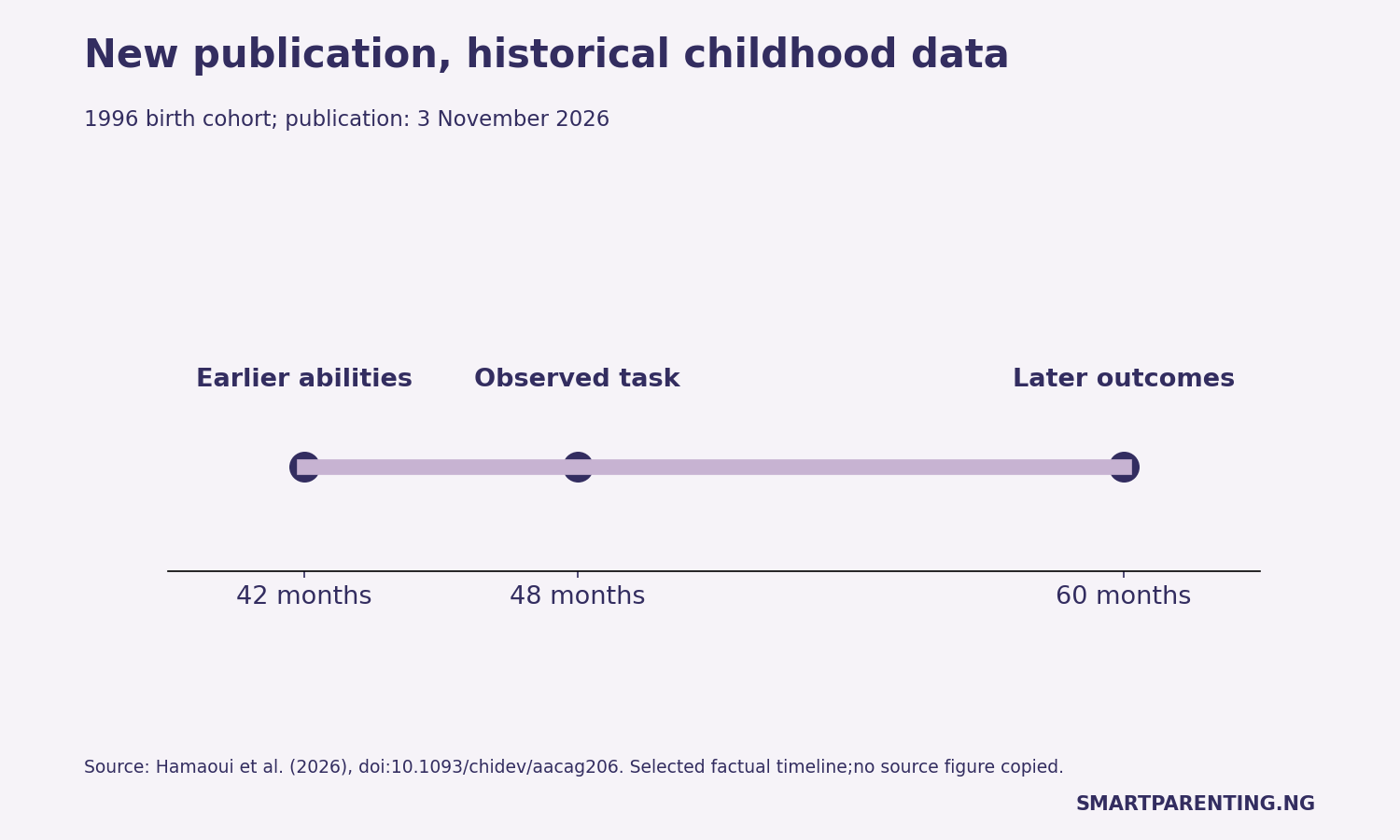
A study by Hamaoui and colleagues, published on 3 November 2026, analysed 193 mother–child pairs from a Quebec cohort born in 1996. Researchers observed a number task at 48 months and outcomes at 60 months. Earlier abilities were measured at 42 months.
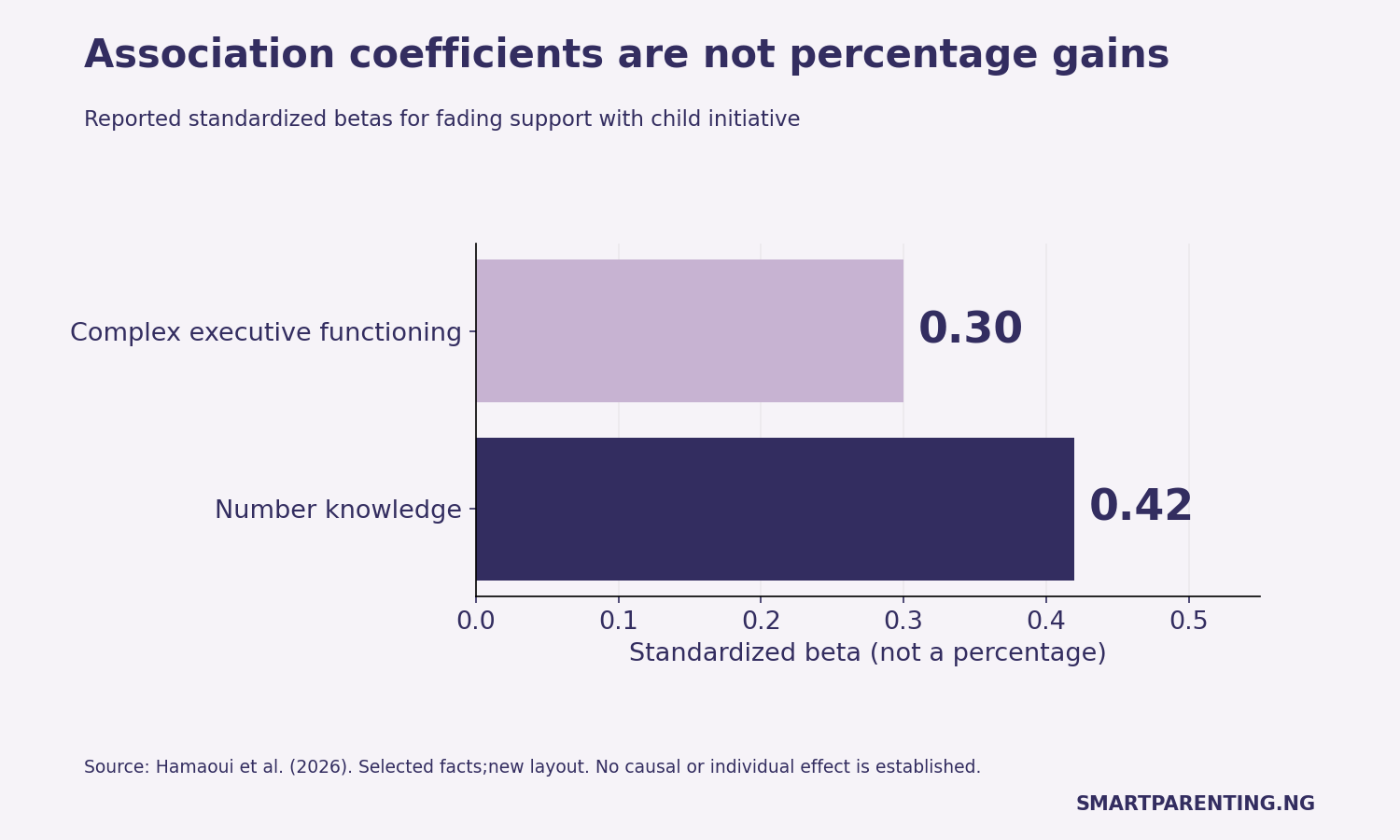
Stronger fading of adult support alongside child initiative was associated with later complex executive functioning (standardized beta 0.30) and number knowledge (0.42). These are model coefficients, not percentage gains or proof of causation. Earlier child abilities also related to support patterns; the findings do not justify blaming parents.
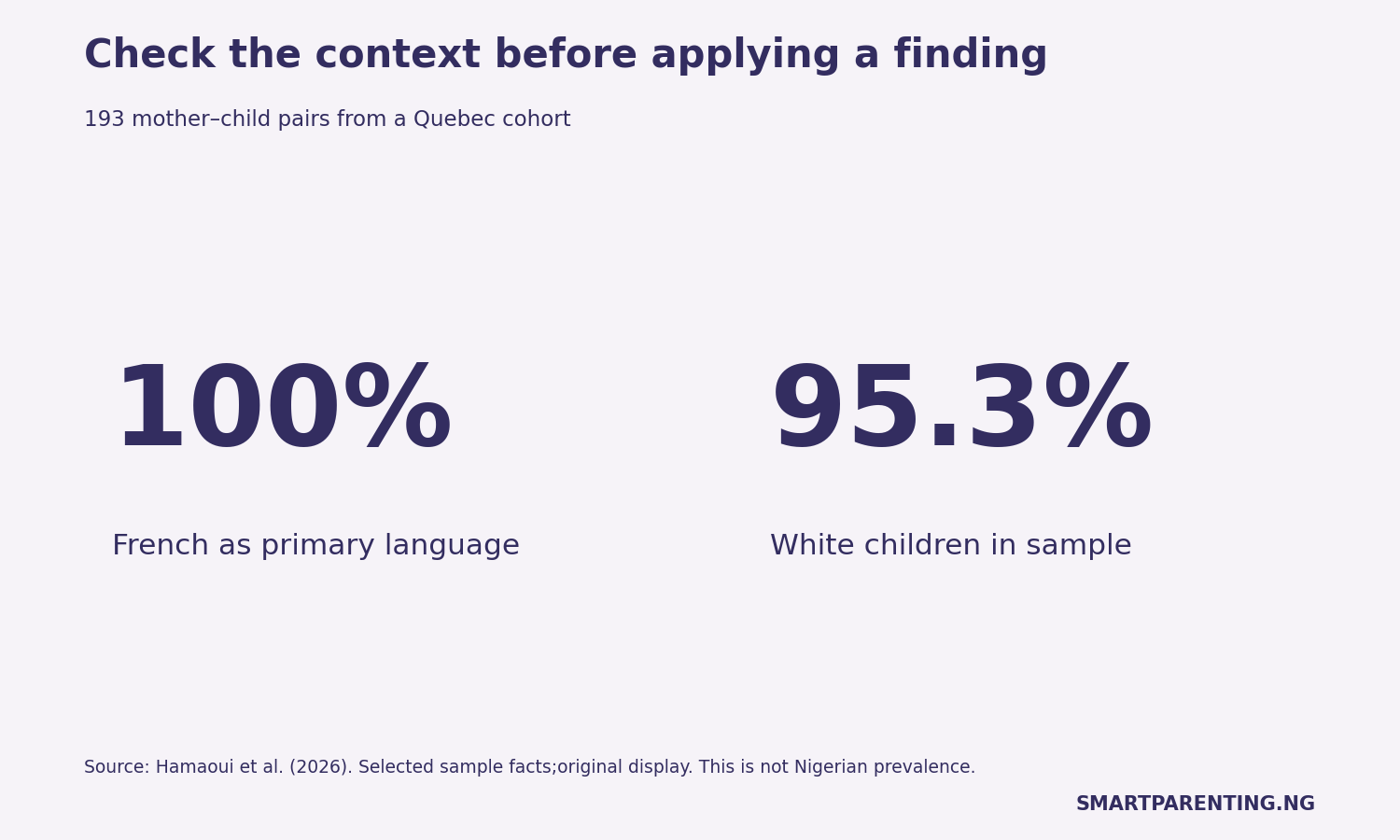
All children spoke French; 95.3% were White. The mother-only historical sample cannot establish how every Nigerian caregiver or child learns. Our activity below is an editorial demonstration, not the study’s assessment or an experimentally proven programme.
Choose a small, safe activity
For the fictional demonstration, an adult and child sort a few large wooden shapes into shallow trays. They can look for shapes that match and count a small group together. Use age-appropriate materials that the caregiver judges safe, with close supervision. Avoid small loose objects that could pose a choking risk.
First, ask an early-years teacher whether the activity’s difficulty fits the child. Choose a familiar language and a comfortable setting. The aim is a chance to take part, not a timed challenge. No special app, paid kit or recording is required.
Keep the task brief enough to change or stop easily. A child’s request to stop is part of the context, not evidence of low ability. Likewise, an adult can simplify the activity without turning that change into a failure.
Show one step, then observe the response
In our fictional scene, the adult places one large circle in a tray and describes what they did. Next, the child chooses what to do with another shape. The adult watches rather than completing the whole arrangement.
That example is a demonstration of a possible adult action. It is not a prescribed number of demonstrations. Some children or tasks need more explanation. Others already have a way to begin. Record what actually happened instead of following a fixed sequence for its own sake.
If the child asks for help, a short question may be useful. For instance, “Which shape looks like this one?” leaves room for an attempt. However, if the question adds confusion, the adult can show the step again or choose an easier activity.
Prompt, wait, increase support or stop
A pause gives space for a response, but silence is not automatically helpful. Pay attention to the child’s communication and comfort. When the task no longer makes sense, waiting longer may simply leave the child without needed support.
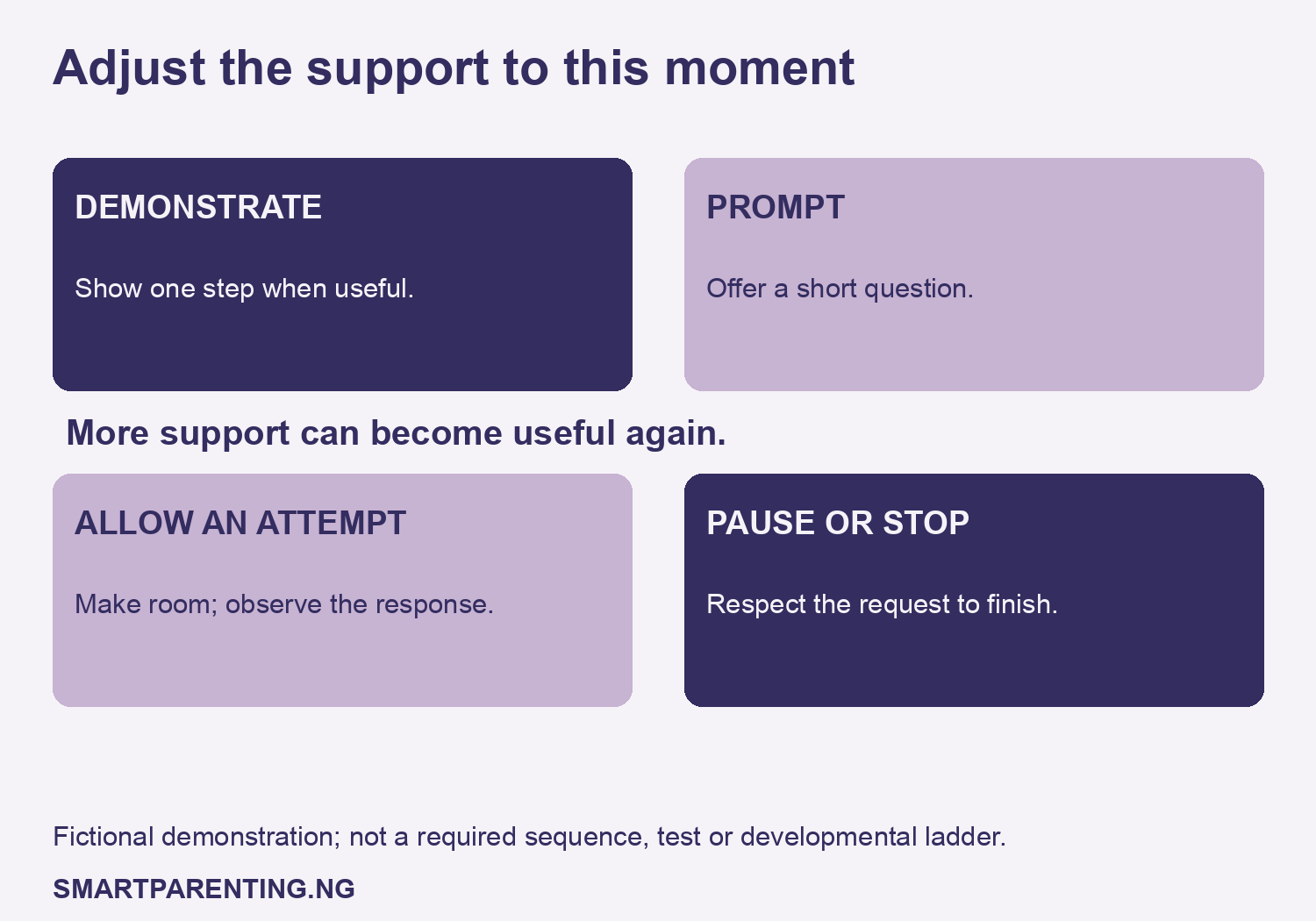
The illustration deliberately allows movement back to more support. For example, a child may try one grouping independently and then ask the adult to demonstrate a different one. Returning to a demonstration can be a practical response. It does not erase the earlier attempt.
Similarly, stopping can be the right endpoint for that activity. A log should capture the request and what happened next. Do not use the sheet to pressure the child to finish six rows in one sitting.
Use six rows to describe adult actions
Our fictional file contains two demonstrations, two prompts, one wait and one stop. Therefore, the action counts sum to six recorded attempts. They describe the adult’s actions in an invented example. They do not identify an ideal balance.
Parenting Made Just for You
Get personalized Parenting Solutions tailored to your child’s needs. Transform your parenting journey with expert guidance in 1-3 days.
Get Started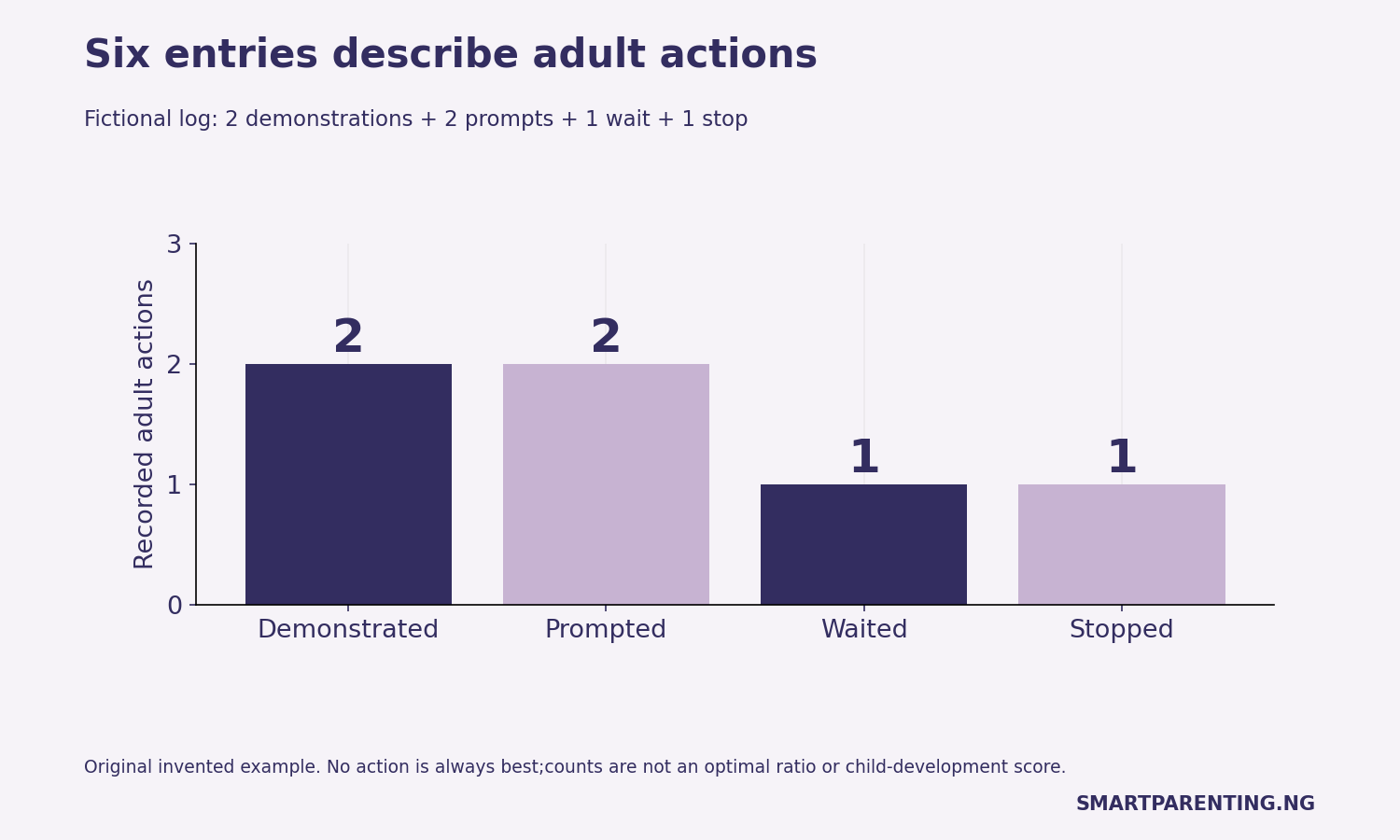
A count also loses the order of events. That is why the next chart keeps the sequence visible. The adult demonstrates, prompts, waits, prompts again, demonstrates again and then stops. No line slopes upwards to suggest developmental progress.
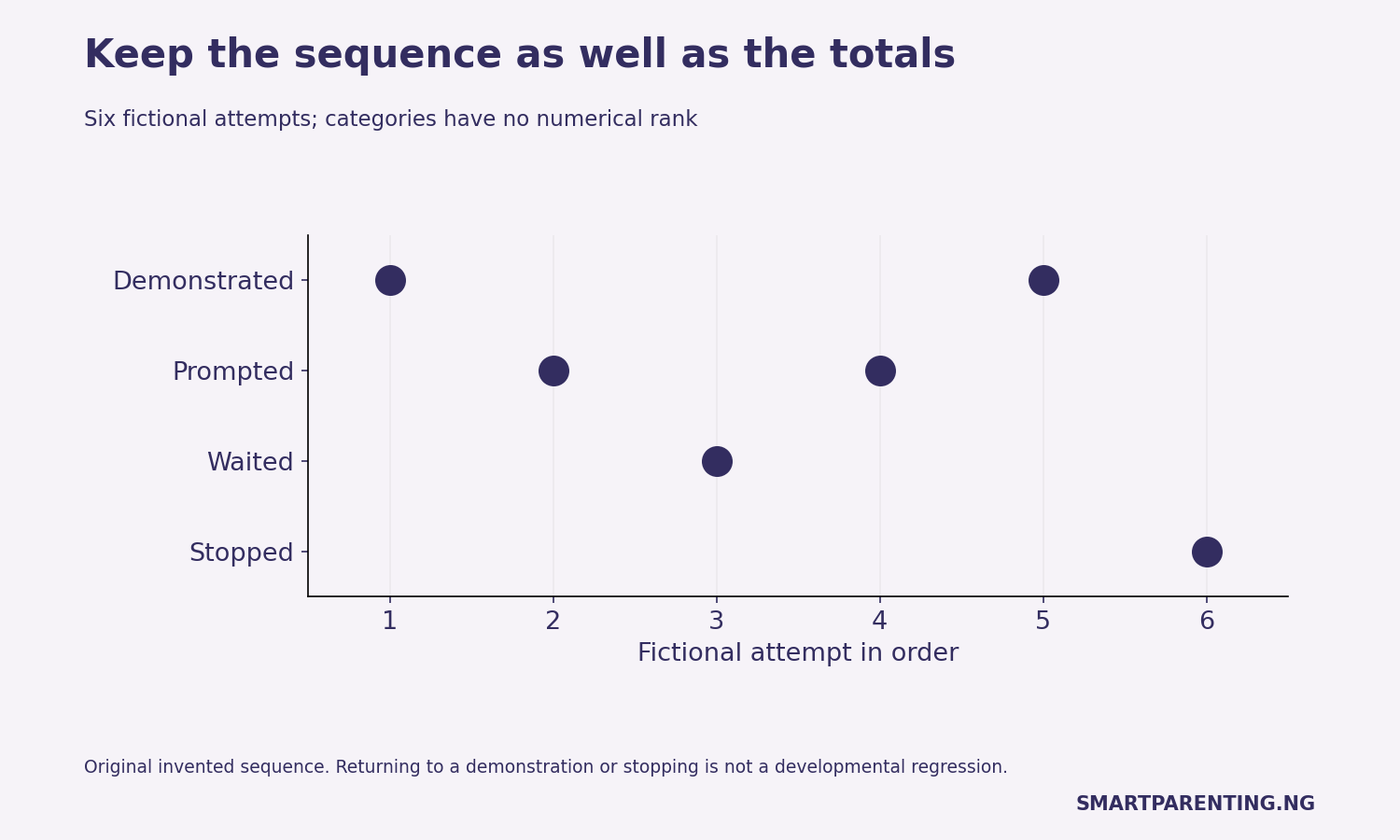
For a real note, describe the child’s response in ordinary words. “Placed a circle in the tray” is more useful than an unsupported label such as “advanced”. Also note the task and any change in context. Avoid comparing one child’s sheet with another child’s.
What the observation sheet contains
| Field | Purpose | Limit |
|---|---|---|
| Task | Describe the activity actually offered | Not a standardised test |
| Child’s attempt | Record what the child tried | Not a score or diagnosis |
| Adult action | Demonstrated, prompted, waited or stopped | No category is always best |
| Child response | Note the immediate response in plain language | Meaning may need clarification |
| Next change | Record a possible adjustment to discuss | Not a treatment plan |
The blank sheet has six rows for convenience, not a target. A family can use one row or leave the page unused. Keep it private and omit names or identifying information from any version shared beyond those supporting the child. This website asks for no upload or video.
Download the observation tools
- Selected study facts and interpretation limits (CSV): publication date, observation ages and reported coefficients with source links.
- Blank six-attempt observation sheet (CSV): private notes without a scoring formula.
- Fictional six-attempt worked example (CSV): the invented entries behind the action charts.
- Fictional adult-action counts (CSV): a reproducible summary of those six entries.
The worksheet does not require a correct-answer count, percentage improvement or age comparison. If someone asks for a “good score”, explain that the tool has no score. Its purpose is to help describe an interaction before discussing it with an educator.
Talk to a teacher about fit
Ask whether the task is too easy, too difficult or unclear. You can also ask which materials and language would make it easier to participate. If concerns persist, discuss them with an appropriately qualified professional. A blog activity cannot establish their cause.
Our home reading support research guide uses the same distinction between an everyday log and a learning assessment. Meanwhile, the school-decision meeting guide explains why direct observations and adult interpretations need separate fields.
Methods, rights and limitations
We checked the primary study on 6 November 2026. Selected factual findings appear with attribution; the paper carries a non-commercial reuse licence. We reproduce no source figure, assessment task, questionnaire or table. Our charts use newly drawn explanatory layouts, and the activity, worksheet and fictional examples are original editorial work.
The counts sum adult actions only. They cannot show whether the child learned, whether support caused an outcome or whether a caregiver used the “right” ratio. The requested early-years educator review was approved before publication on 6 November 2026. Its purpose remains observation and discussion, with no ranking, pressure or promise of a developmental gain.


