







Walking to preschool can sound like a simple way to add movement. However, new physical activity evidence does not tell a Nigerian family that changing transport will produce a fixed benefit. Start with adult accompaniment, local conditions and the child’s needs. Then read what the study actually compared.
Featured image: AI-generated conceptual scene with fictional Nigerian parent and child. It is not a study photograph or an assessment of any real school route.
This report provides two original uncertainty charts, a route-decision infographic and four free CSV tools. It audits a Swedish study published on 5 November 2026. Importantly, the full accepted manuscript dates its measurements to September–November 2018. Publication is fresh; the observations are not November 2026 activity records.
What walking to preschool physical activity evidence measured
The BMC Public Health paper by Campos-Garzón and colleagues analysed 323 children, with a mean age of 4.7 years. Parents recorded travel modes and devices measured daily movement. The accepted manuscript’s methods report 27 participating municipal preschools in Stockholm and 1,309 observation days. This was a cross-sectional analysis, not a walking programme assigned at random.
Active travel included walking and child cycling. A child sitting on a bicycle or riding in a stroller was classified as travelling passively. Therefore, these estimates should not be advertised as the isolated effect of walking. The daily categories were active both ways, active one way and passive both ways.
Read the minutes separately from the steps
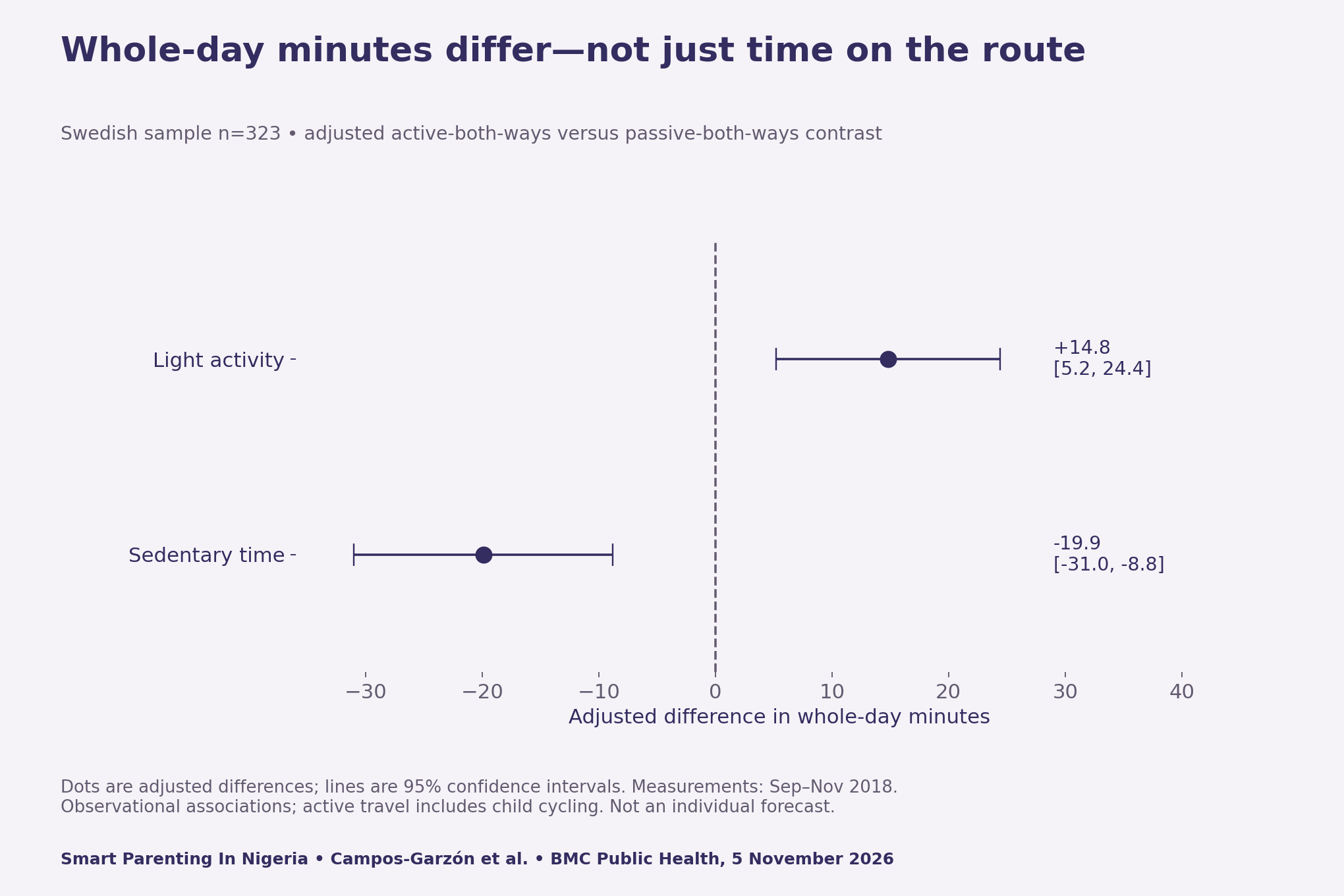
Compared with passive travel both ways, active travel both ways was associated with 14.8 more light-activity minutes daily, with a 95% confidence interval of 5.2–24.4. The sedentary-time difference was −19.9 minutes, with an interval of −31.0 to −8.8. These are adjusted whole-day differences, not just minutes on a pavement.
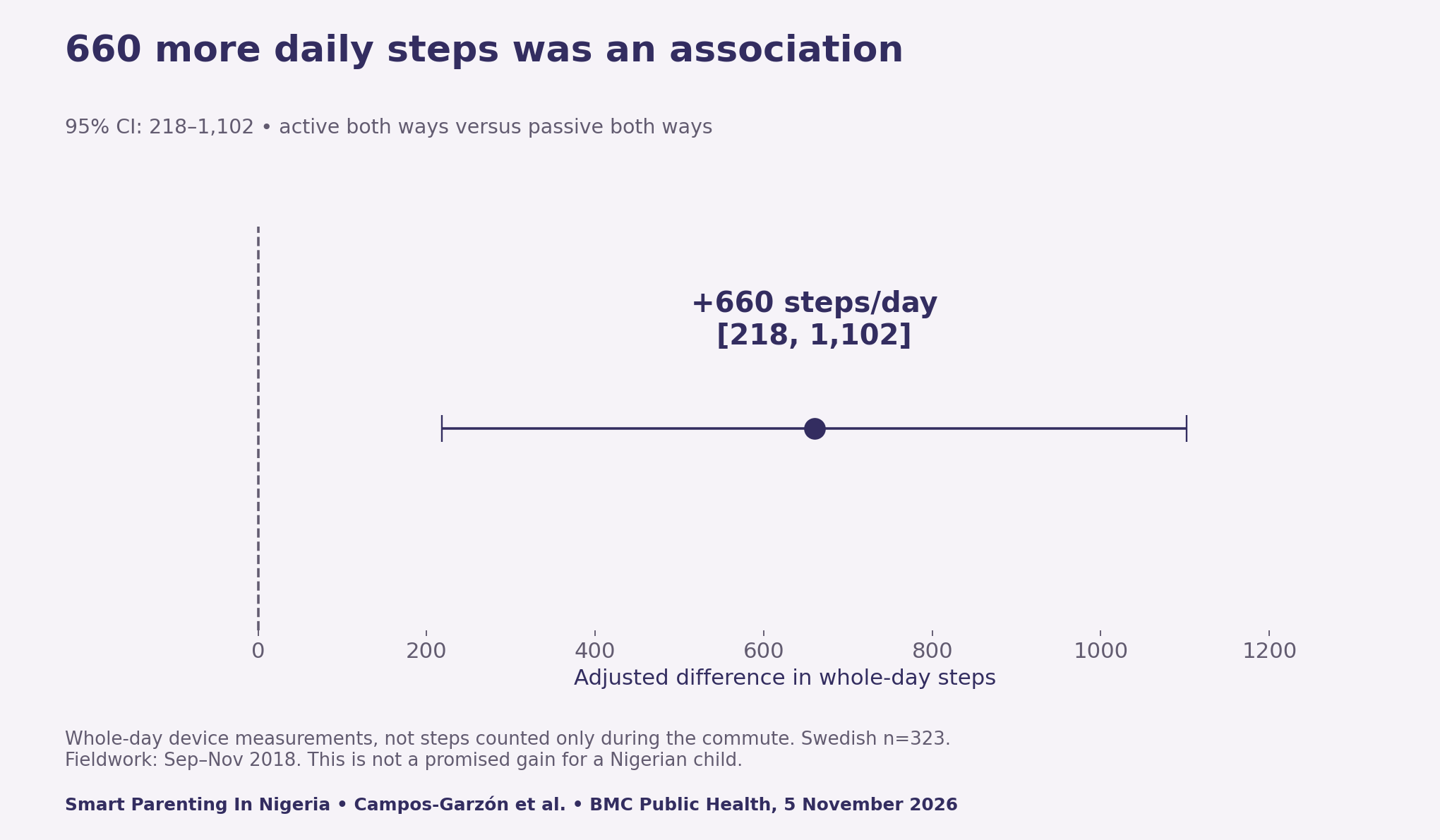
The corresponding step difference was 660 daily steps, with an interval of 218–1,102. A confidence interval represents uncertainty around the model’s association. It does not give a guaranteed minimum for an individual child. Nor does it say the commute itself supplied all 660 steps.
One-way non-significance is not a verdict on your routine
The source reported no statistically significant one-way active-travel comparisons. We have not transcribed their detailed coefficients here. Missing estimates are clearly marked as not transcribed rather than plotted as zeros. A finding that misses a significance threshold is not proof that every one-way walk has no value.
| Daily travel pattern | Evidence shown here | What it cannot decide |
|---|---|---|
| Active both ways | Selected adjusted differences and 95% intervals | Whether this child will gain those exact amounts |
| Active one way | Source reports non-significant comparisons; coefficients not transcribed | That a one-way walk has no benefit |
| Passive both ways | Reference category | Whether an individual family has chosen badly |
Keep the family decision separate from this statistical distinction. A caregiver may be available in only one direction. The return trip may involve a different responsible adult or different weather. Those constraints deserve a practical plan rather than an attempt to reproduce a research category.
Why a daily association is not a route experiment
Families who choose different travel modes may differ in ways a model cannot fully resolve. Whole-day movement also includes preschool and home routines. Device measurement improves the activity record, but it does not turn transport selection into random assignment. Likewise, a questionnaire about travel is not a minute-by-minute route trace.
The original analysis adjusted for several measured characteristics. Adjustment still cannot settle every local difference or establish causality. A child’s circumstances, access needs and adult availability remain relevant even when a coefficient has a narrow interval. Do not use a numerical headline as a reason to accept an unsuitable route.
Put an accompanied-route decision before an activity target
For a Nigerian reader, the useful application is an unscored review of an actual accompanied journey. Record the route without uploading a home address or child’s name. Identify crossings, separation from vehicles, surface continuity, accessibility requirements, shade, heat, security concerns and the school handover. These are editorial planning prompts, not a validated safety checklist.
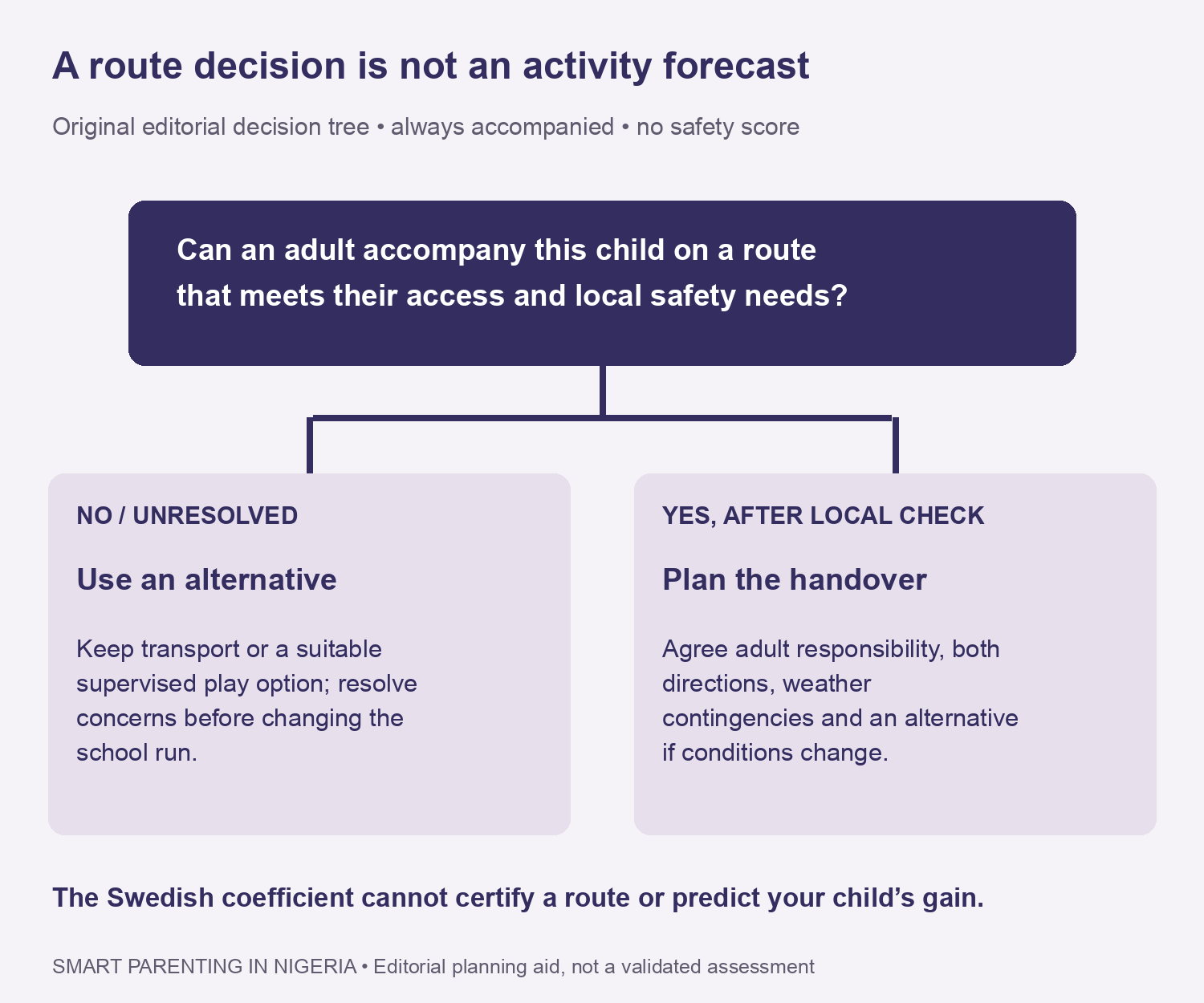
If important concerns remain unresolved, keep an appropriate transport alternative. Do not send a preschool child alone to test the research claim. Where suitable, a family can discuss supervised indoor or enclosed-play opportunities instead. This article does not claim those alternatives reproduce the study’s estimated differences.
For broader organisation, see our school-run planning guide. Our general physical-activity article covers a wider topic. This report’s narrower purpose is to interpret a specific research comparison and keep it separate from the household’s route decision.
Use the blank assessment and private travel diary
The route worksheet leaves every local observation blank. It records the accompanying adult’s role, unresolved issues, handover and alternative transport. It produces no numerical safety score, approval badge or predicted step gain. Completing a box is not evidence that a road crossing or venue is safe.
Parenting Made Just for You
Get personalized Parenting Solutions tailored to your child’s needs. Transform your parenting journey with expert guidance in 1-3 days.
Get StartedThe optional diary distinguishes travel to preschool from the return journey. It can help adults remember why a plan changed. Keep completed notes private and avoid names, addresses or identifiable child details. No responses are collected by this website, and no Nigerian route data were gathered for this report.
- Selected daily activity associations and confidence intervals (CSV)
- Three travel modes and evidence dictionary (CSV)
- Blank accompanied-route assessment (CSV)
- Blank private two-direction travel diary (CSV)
Methods, dates and limits of this report
We checked the publisher’s early-access page and the full 13-page accepted manuscript. The latter resolved the collection-date gap in the initial brief: September–November 2018. The publisher says the accepted version remains subject to editing. The selected charts reproduce factual estimates with original design; no participant data or model refit is presented.
This is Swedish observational evidence, not a Nigerian trial or national estimate. It cannot certify a local route, distinguish the causal effect of walking alone, or predict an individual child’s response. Suggested citation: Smart Parenting In Nigeria, 9 November 2026, “Walking to Preschool: Read the Activity Evidence First”; study findings attributed to Campos-Garzón and colleagues, DOI 10.1186/s12889-026-30258-3.


