




Checking sensory play programme evidence at nursery starts with a clear question: what exactly are you paying for? A label on a room, a kit or a timetable cannot answer that alone. For Nigerian parents comparing an optional add-on, the useful next step is to match the nursery’s claim to a specific activity, source and price.
A new scoping review offers context, rather than a winner among commercial programmes. Below, three charts explain the evidence map. A comparison infographic and four CSV tools then help you ask focused questions without turning a child’s participation into a score.
What the sensory play programme evidence maps
Waghorn and Francis published their open-access scoping review on 11 November 2026, although its journal volume is dated 2027. It included 120 documents from six academic databases and supplementary searching. Thirty-three explicitly defined or described sensory play. The review maps varied literature; it does not pool an effect for a named paid nursery programme.
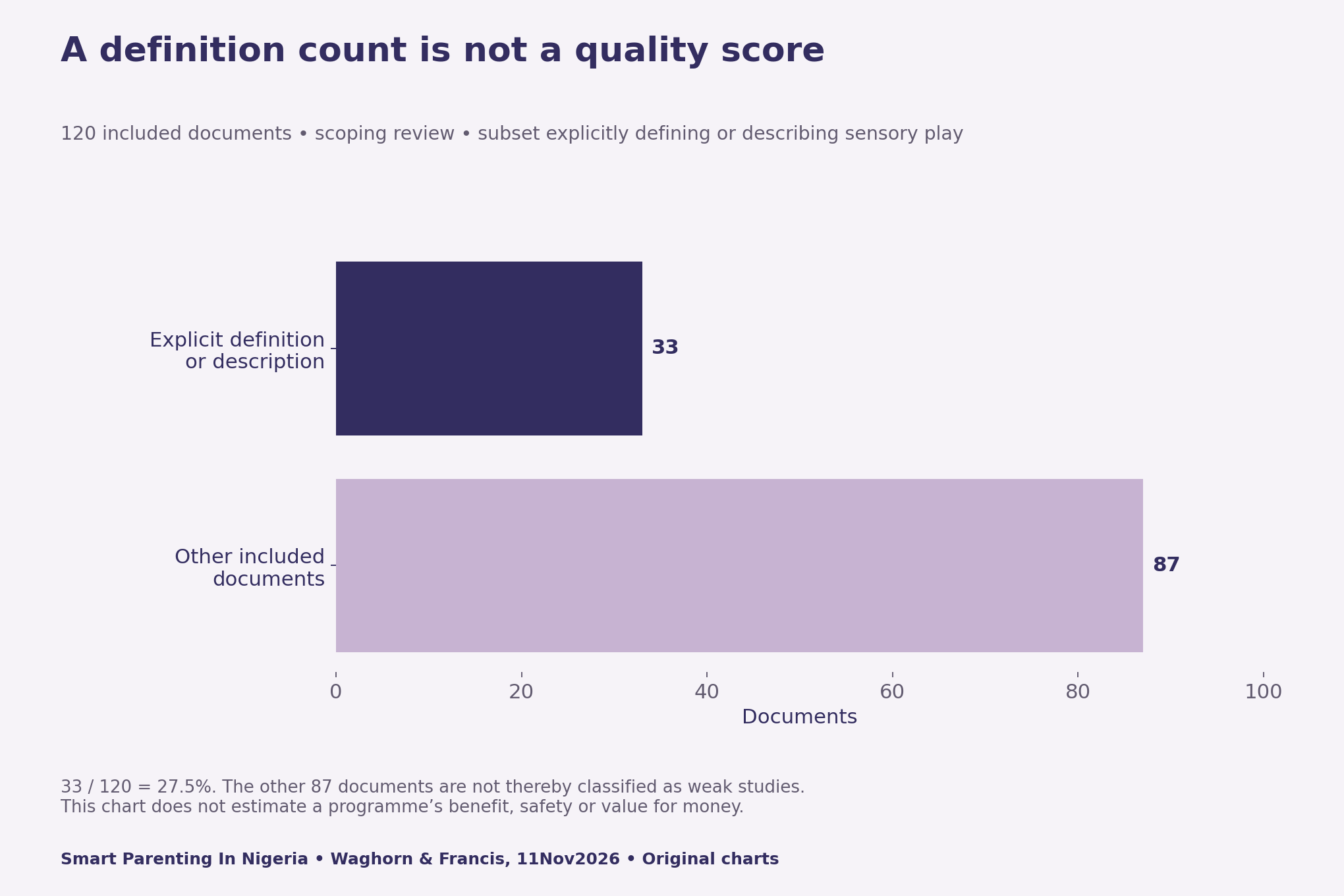
If a nursery cites the review, ask which part supports its own wording. A broad statement about play differs from a promise that a particular weekly package produces a measured improvement. Keep the original claim in the comparison sheet so that an answer to a different question cannot quietly replace it.
Recent research is not the same as a matched programme
The review reports that 52.5% of its documents were published during 2020–2025. Our calculation gives 63 documents in that interval and 57 outside it. These are publication dates, not a measure of the size or reliability of any benefit.
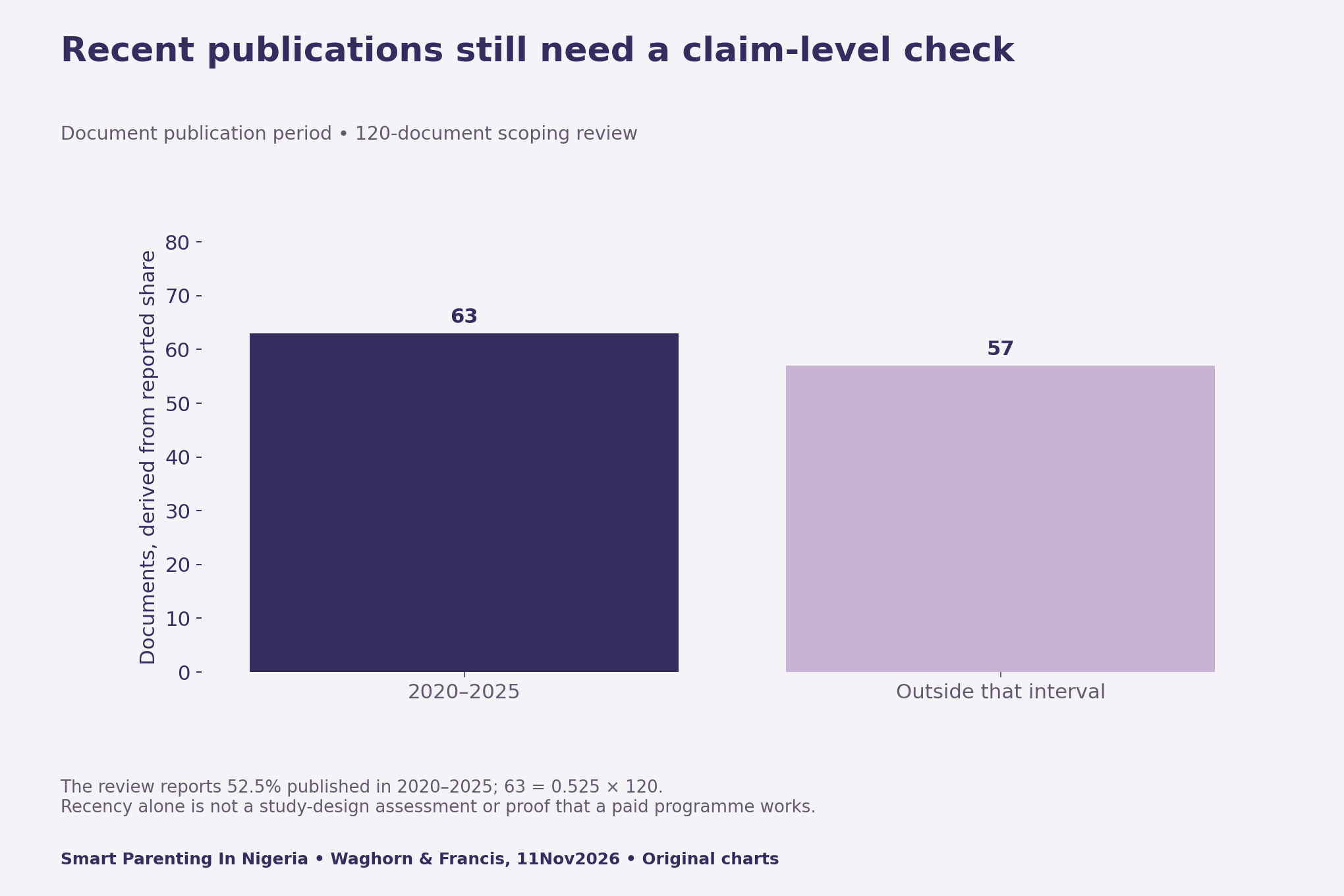
Likewise, a source can be relevant to learning while remaining a poor match for a particular purchase. Check the age group, setting, activity, comparison and outcome. Record a missing answer as unknown. Do not treat an attractive room photograph, testimonial or impressive equipment list as a substitute for that information.
Ask how the setting transfers to your nursery
The review reports selected regional shares of 26.7% for North America, 24.2% for Europe, 13.3% for Oceania and 15% for multinational work. These descriptors are not a Nigerian provider evaluation. They do not identify the effect a particular child would experience in a local nursery.
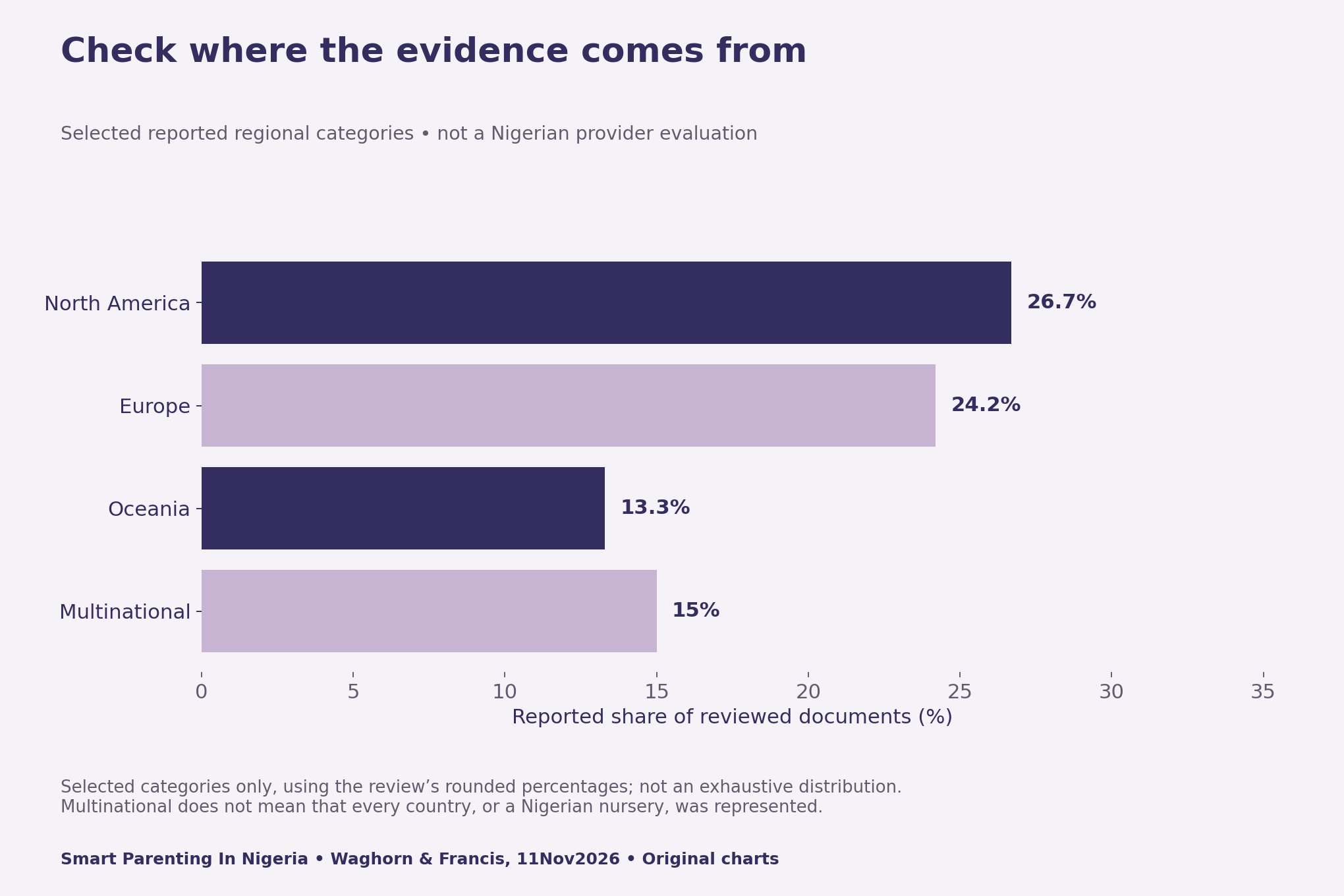
For a Nigerian family, practical transfer questions might concern the language used, class size, available space, supervision and whether the child can choose another activity. These are questions to take to the provider, not findings measured by our article. Write down the response, its date and any agreement that needs follow-up.
Use the claim-to-evidence comparison matrix
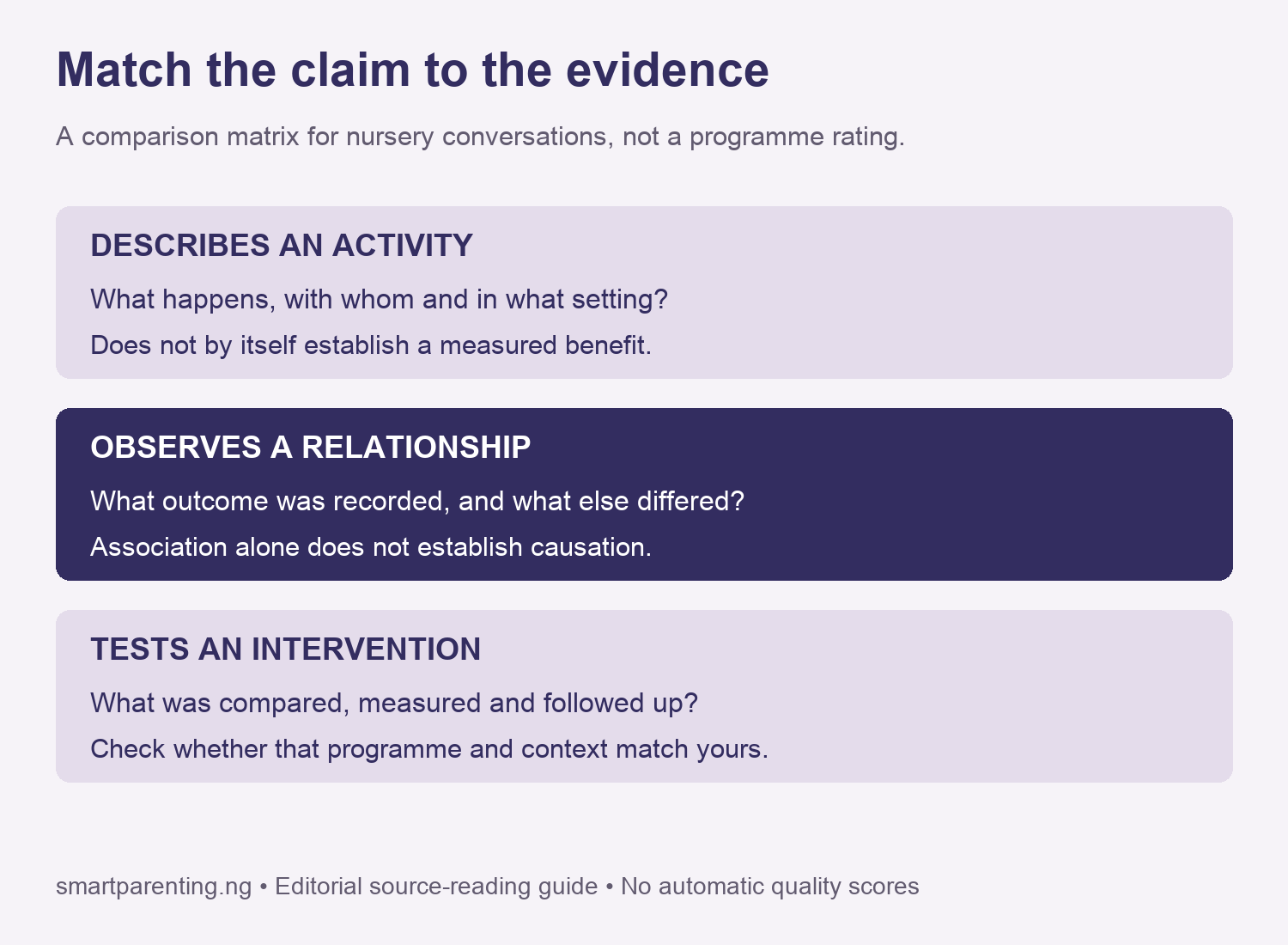
Start with the methods of the specific source a provider cites. A description may explain how an activity was delivered. An observational study may record a relationship. A tested intervention may compare outcomes under specified conditions. None should be relabelled from its title alone, and a comparison still needs to fit the claim.
The blank source map leaves space for each of those details. It intentionally contains no automatic quality total. A completed row should show what a source supports, what it leaves unanswered and when you checked it. If the provider cannot identify a source, keep that field blank and ask for clarification.
Compare participation, access and the actual quote
| Ask about | Record | Avoid assuming |
|---|---|---|
| The activity | What the child actually does and the intended educational purpose | The label guarantees an outcome. |
| Choice and access | Supervision, adjustments, alternatives and how a child can decline | Every child should tolerate the same experience. |
| The quote | Date, billing period, base fee and required extras | An unquoted cost is zero. |
| Review | Who discusses participation with you and when | A provider’s score is a clinical assessment. |
Use dated, real quotations only. Compare the same billing period and ask which costs are required rather than optional. There are no invented Nigerian prices or provider rankings here. If the nursery’s base fee already includes the activity, record that clearly before comparing it with a separately priced add-on elsewhere.
Educational play and clinically prescribed therapy are different services. A nursery’s sensory-play label does not diagnose a condition, establish a cure or replace an individual professional plan. Ask the provider to explain its service honestly, including staff responsibilities and what lies outside that service.
Participation should be willing, age-appropriate and safely supervised. Ask how staff respond when a child withdraws or needs an alternative; do not use forced exposure as a buying criterion. This guide deliberately gives no small-object activity recipes. For broader school-choice considerations, see our first-school selection guide; this article focuses specifically on checking an add-on’s claims.
Download the private comparison tools
- Selected review measures and calculation notes (CSV)
- Blank nursery programme claim-and-quote comparison (CSV)
- Blank claim-level evidence source map (CSV)
- Comparison-field dictionary and privacy notes (CSV)
Keep completed worksheets privately. They do not require uploading a child’s name, photograph, diagnosis or health history. Use a provider reference rather than identifying a child. Review unanswered points with the nursery before making a decision; the spreadsheet does not make that decision for you.
Method and limitations
We extracted selected aggregate descriptors, checked the arithmetic and drew original charts. Three figures answer different context questions; further statistical charts would imply detail not established here. We did not independently recode the120 documents, evaluate a commercial programme or estimate effects for Nigerian children. A missing explicit definition is not proof of a poor study.
Parenting Made Just for You
Get personalized Parenting Solutions tailored to your child’s needs. Transform your parenting journey with expert guidance in 1-3 days.
Get StartedSuggested citation: Smart Parenting In Nigeria (13 November2026), “Sensory Play at Nursery: Check the Programme Evidence”, selected-source analysis and parent comparison tools. Retain the source date, denominators and limitations with reused figures.


