







Parenting app child protection evidence needs more than an impressive headline. The ParentApp trial tested a supported programme in Tanzania. It did not test whether downloading any parenting app, on its own, keeps a child safe.
The 10 November Lancet abstract describes 2,396 caregiver–adolescent pairs across 80 sub-wards. Adolescents were 10–17. Recruitment ran from May to October 2023. The trial compared a blended parenting programme with a water, sanitation and hygiene app programme.
Parenting app child protection evidence: keep the package intact
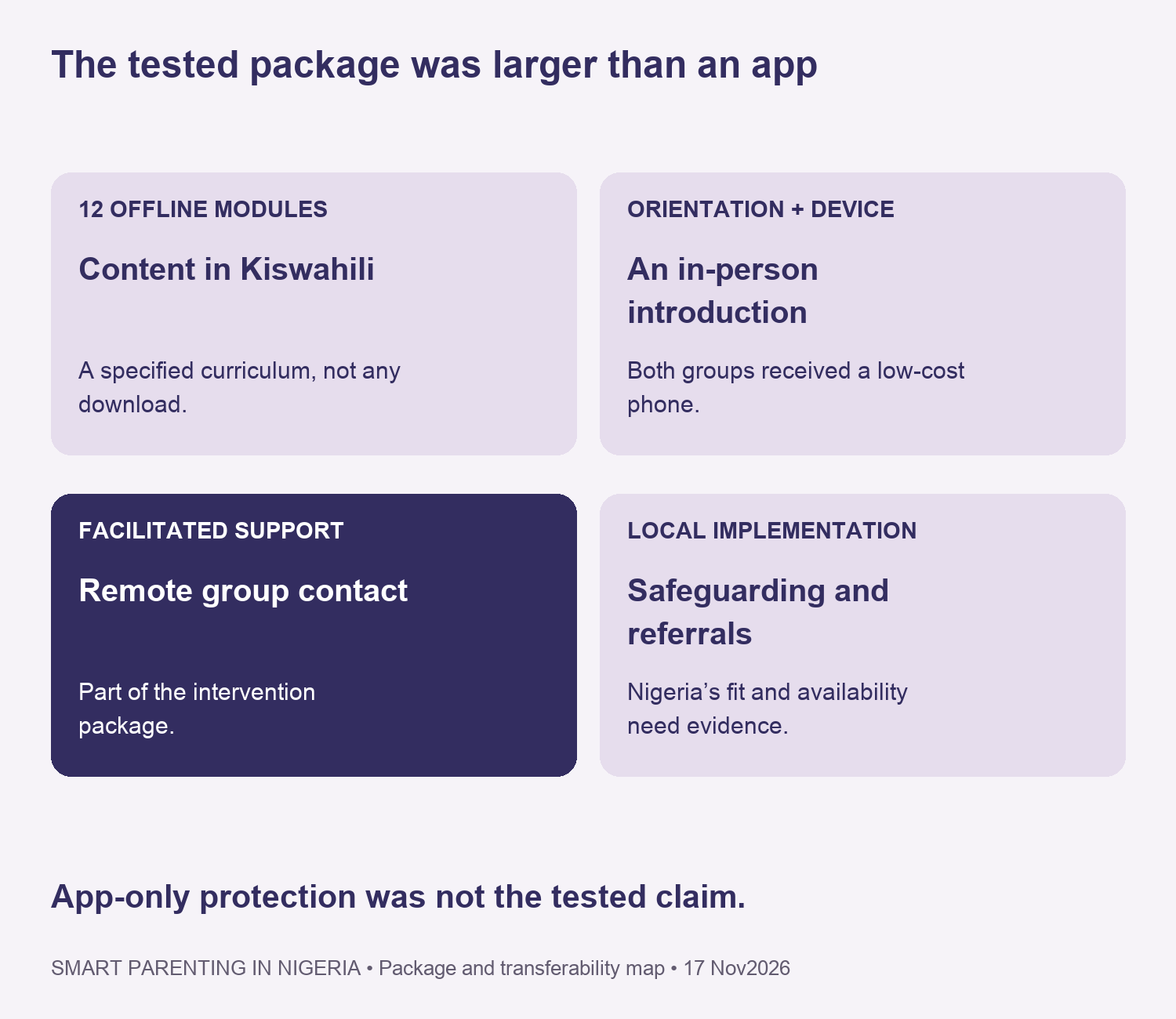
ParentApp combined 12 offline-first modules, an in-person orientation and remote support through facilitated groups. Both trial groups received a low-cost phone and orientation. The contrast therefore concerns those specified packages, not a smartphone versus no support of any kind.
When a service advertises these findings, ask what it actually supplies. Is there a trained facilitator? Who supervises that person? Which safeguarding and referral arrangements exist? A similar app name or attractive interface cannot answer those questions.
Read the outcome and recall window together
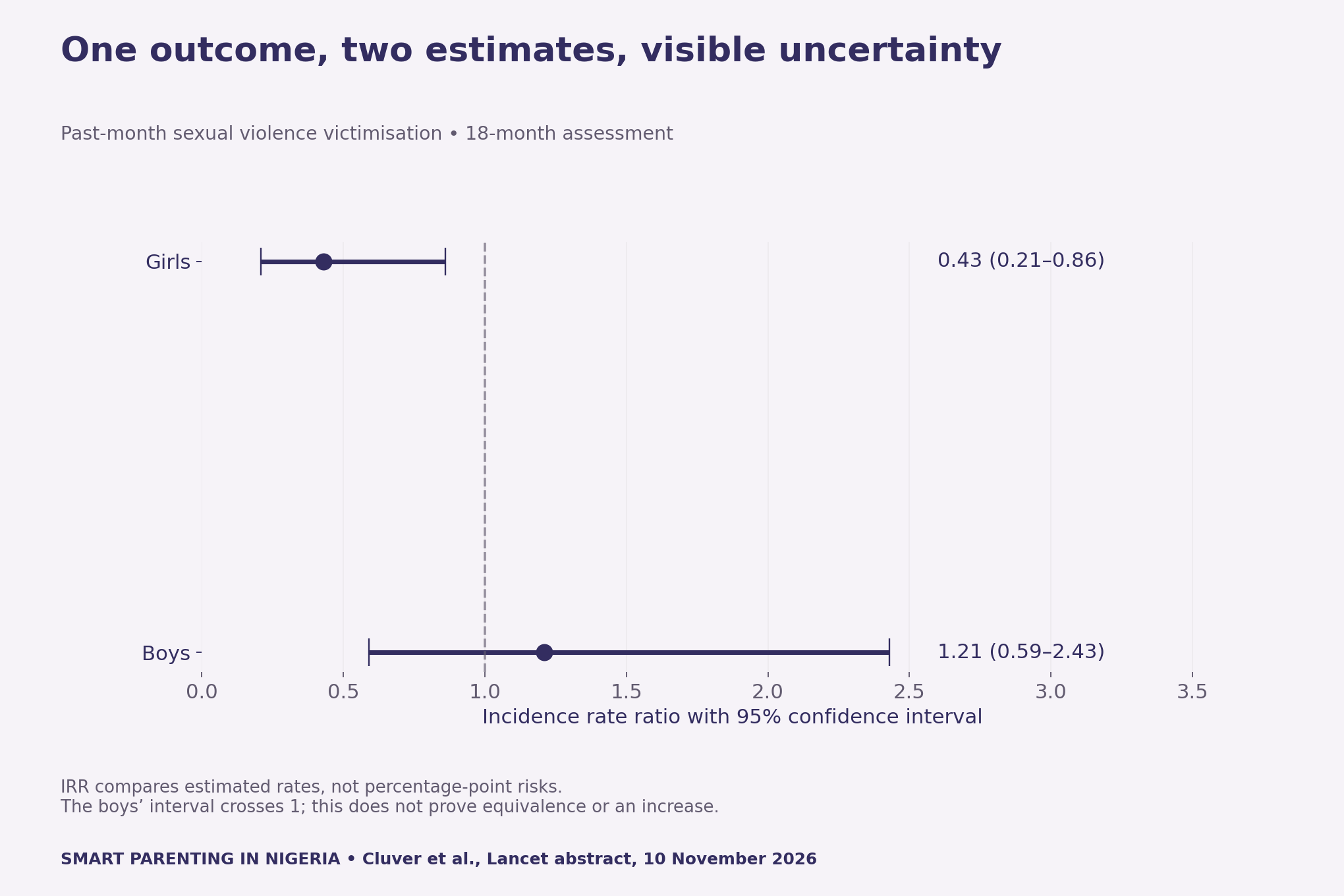
At the 18-month assessment, the abstract reports a girls’ past-month incidence rate ratio of 0.43. That corresponds to a 57% lower estimated rate for that specified outcome, calculated as (1−0.43)×100. It is not a 57-percentage-point fall or a guarantee for an individual child.
Oxford’s release gives a 67% lower rate for a preceding-year outcome. That is a different recall window. Do not replace the past-month estimate with 67%, or put both on an unlabeled chart as if they measured the same thing.
The boys’ estimate is 1.21, with a wide interval from 0.59 to 2.43. It is not statistically significant. That uncertainty does not establish that the programme harms boys, that effects are identical, or that a future study could not find a difference.
Retention is not completion or effectiveness
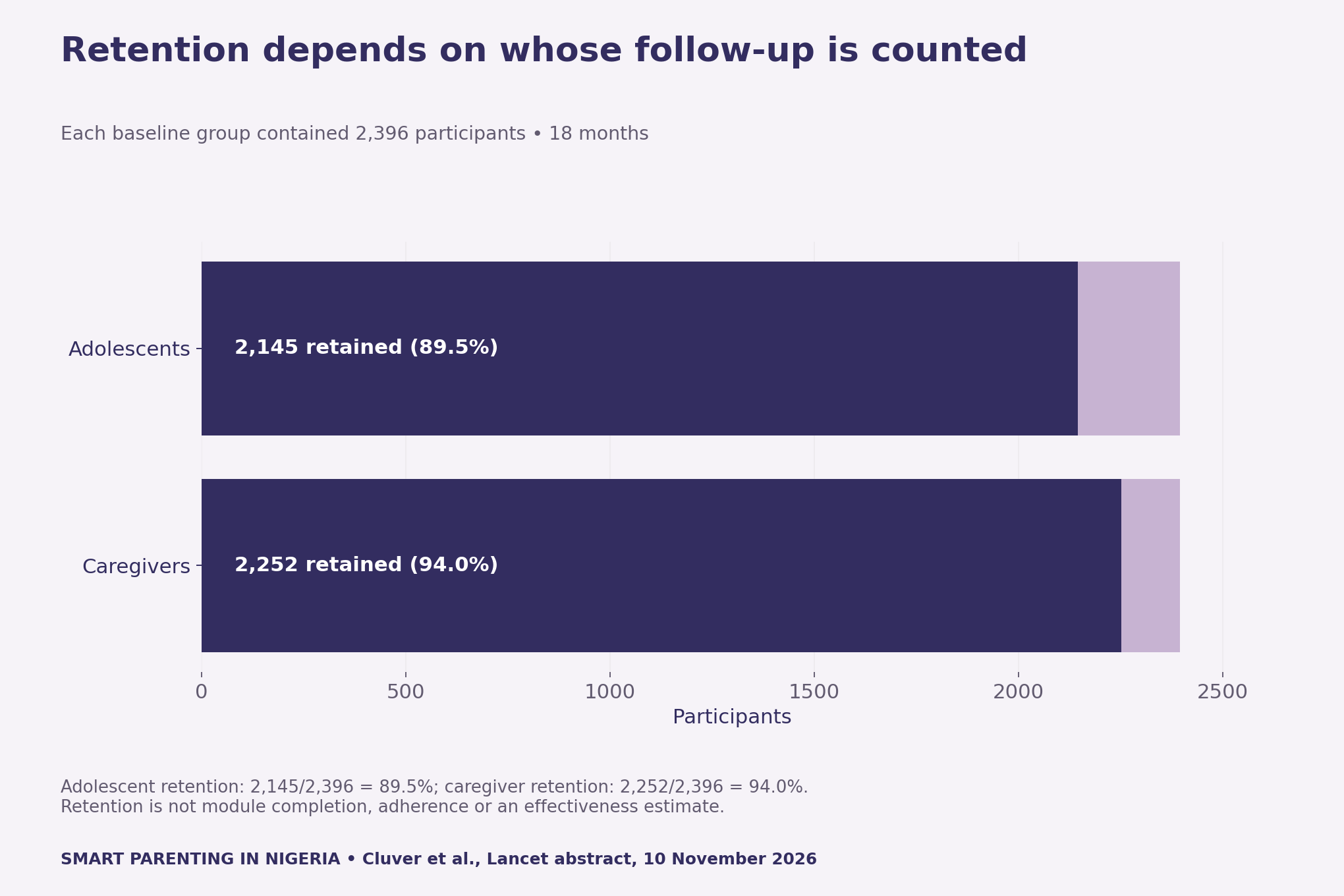
The abstract reports 89.5% adolescent retention and 94.0% caregiver retention at 18 months. Keep the role beside the percentage. A family may remain in follow-up without completing every module, so these are different measures.
A useful source register records the participant group, time point, outcome wording and measure. This is especially helpful when a press release simplifies a research result. Our CSV preserves those fields rather than merging several encouraging numbers into one claim.
Ask about language, privacy and safeguarding
The service-question sheet is an editorial tool for comparing a real offer with the programme described in the research. Record a provider’s answer, its date and the evidence supporting it. A blank answer means unverified; it should not quietly become a pass.
Check who can see group messages, how personal disclosures are handled and where concerns are referred. Do not enter a child’s account of abuse into an unverified app or upload completed family records here. No app guarantees safety, and responsibility for abuse lies with perpetrators.
The local-adaptation register keeps differences visible: language, age range, facilitator support, access and referral context. Nigerian effectiveness, current availability and price have not been verified. A foreign delivery-cost estimate is not a local household price quote.
Method, access limits and four CSV tools
We checked the PubMed abstract and Oxford release on 17 November 2026. The publisher’s full-text page stopped at security verification, so this is not a complete methods or supplement audit. Confidence intervals are reproduced, not re-estimated from participant data.
The two charts separate statistical uncertainty from follow-up retention. The infographic separates programme components. Our question sheets are optional and unvalidated; they are not safeguarding assessments or substitutes for qualified support. See also our guide to checking what a digital tool can miss.
- Outcome and recall-window source table(CSV)
- Role-specific retention calculations(CSV)
- Blank service and safeguarding question sheet(CSV)
- Blank local-adaptation evidence register(CSV)
Suggested citation: Smart Parenting In Nigeria, “Parenting Apps and Child Protection: Check the Support Behind the Download”,17 November 2026. Sources: Cluver and colleagues, Lancet abstract and Oxford release. Editorial checks and calculations by this publication.
Parenting Made Just for You
Get personalized Parenting Solutions tailored to your child’s needs. Transform your parenting journey with expert guidance in 1-3 days.
Get Started


