




Overview of Traditional Outdoor Games and Cultural Insights
Traditional outdoor games take many different forms.
These games reveal communal values and shared expectations.
Games often take place outdoors in shared community spaces.
Types of Games
For instance, some games emphasize teamwork and shared goals.
Additionally, some games test speed, agility, and physical coordination.
Moreover, other games highlight strategy, memory, and tactical thinking.
Furthermore, some games incorporate storytelling, music, or rhythmic movement.
- Team-based games encourage cooperation and shared responsibility.
- Individual skill games develop personal mastery and focus.
- Strategic games train planning and assessing options.
- Musical or rhythmic games blend movement with communal expression.
Cultural Values Revealed
For example, they emphasize cooperation over individual achievement.
Additionally, games promote respect for rules and community norms.
Moreover, play often reinforces fairness and orderly turn-taking.
Furthermore, healthy competition teaches resilience and sportsmanship.
Also, play nurtures creativity and adaptive problem solving.
Social Roles and Learning
Adults actively guide children’s play and offer gentle correction.
Consequently, play becomes a tool for mentorship and teaching.
Moreover, children learn leadership by organizing peers during activities.
Parenting Made Just for You
Get personalized Parenting Solutions tailored to your child’s needs. Transform your parenting journey with expert guidance in 1-3 days.
Get StartedAdditionally, elders transmit practical knowledge through rules and stories during play.
Finally, social roles get practiced and negotiated within game contexts.
Play Settings and Occasions
Furthermore, play appears at gatherings and informal neighborhood moments.
Also, games align with daily routines and seasonal rhythms.
Moreover, groups form spontaneously and invite varied participants to join.
How Games Connect Generations
Older players teach rules and meaningful stories to younger participants.
Consequently, shared play strengthens family and neighborhood bonds.
Additionally, traditions persist as children adapt play to new contexts.
Furthermore, games create a living link between past and present social life.
Broader Community Meanings
Collective play reinforces a sense of belonging and shared identity.
Moreover, games can ease tensions and build mutual understanding.
Additionally, play cultivates skills useful for cooperative community tasks.
Finally, traditional games offer insight into values that guide everyday interactions.
Games Parents Can Teach
Parents can teach simple outdoor games to children.
Unveil the Perfect Name that Tells Your Family's Story
Let us help you find a name that embodies your family's values, traditions, and dreams. Our personalized consultation weaves cultural insights to create a name that's uniquely yours.
Get StartedThese activities encourage physical skill and social play.
Across sections this guide explains game types and teaching steps.
Chase and Tag Games
These games focus on movement, quick thinking, and safe pursuit.
They encourage physical activity and playful interaction among children.
Parents should emphasize gentle tagging and safe stopping techniques.
Teaching Steps
First choose a flat open safe outdoor area for play.
Next mark clear boundaries with visible objects or cones.
Then explain tagging rules and demonstrate gentle contact.
- First, choose a flat, open, and safe outdoor area for play.
- Next, mark clear boundaries with visible objects or cones.
- Then, explain the simple goal of tagging without rough contact.
- Afterward, demonstrate gentle tagging and safe stopping techniques.
- Finally, rotate chaser roles so every child practices being safe leaders.
Toss and Aim Games
These games develop hand-eye coordination and friendly competition.
They often use small objects and a visible target to aim for.
Parents should select soft safe objects for tossing practice.
Counting and Strategy Games
These games build memory, counting skills, and tactical choices.
They feature turns, simple scoring, and predictable rules for learning.
Encourage simple choices to develop strategy during play.
Team Relay and Rhythm Games
These games emphasize cooperation, timing, and shared celebration.
They often combine movement with clapping, chanting, or simple rhythms.
Cooperative play builds teamwork through coordinated actions.
Safety and Adaptations for Different Ages
Prioritize safety through supervision and age-appropriate modifications.
Always supervise play closely and remain ready to intervene.
Also adapt equipment sizes and distances to match abilities.
- Always supervise play closely and remain ready to intervene.
- Also, simplify rules and shorten play times for younger children.
- Additionally, increase challenge with larger spaces for older children.
- Finally, adapt equipment sizes and distances to match abilities.
Low-Cost Materials and Simple Setups
Choose materials already present in your home.
Favor lightweight items that remain durable in use.
Ensure children can handle items safely during play.
Selecting Everyday Household Materials
Consider containers for organizing and defining play elements.
Include soft fabrics and rags as gentle tossing objects.
Add simple markers to indicate goals and lanes.
Categories of Useful Materials
Materials fall into clear categories for simple play.
Containers and markers help define goals and boundaries.
Small sound-makers and makeshift targets add variety.
- Containers and markers can define goals and boundaries.
- Soft fabrics and rags work as safe tossing objects.
- Small sound-makers add rhythm without complex instruments.
- Makeshift targets help create measurable game objectives.
Basic Setup Techniques
Clear a flat area before arranging materials.
Next, use markers to outline play zones and lanes.
Balance lightweight items with small weights when needed.
Position materials to avoid traffic and obstacles.
Adapting Setups for Small Spaces
Reduce distances to fit courtyards or narrow streets.
Fold or compress materials for compact storage when possible.
Use vertical space when horizontal area is limited.
Limit player numbers to maintain safe spacing.
Safety and Care Tips
Inspect items quickly before each play session.
Smooth or wrap any sharp edges to prevent cuts.
Store materials in a single container after use.
Clean fabrics regularly to maintain hygiene.
Quick Assembly Checklist
Find durable items that children can hold easily.
Create clear boundaries using visible markers.
Keep a first aid kit nearby for minor scrapes.
Ensure adult supervision during active play sessions.
- Find durable items that children can hold easily.
- Create clear boundaries using visible markers.
- Keep a first aid kit nearby for minor scrapes.
- Ensure adult supervision during active play sessions.
Explore Further: How to Turn Everyday Chores Into Fun Learning Activities
Regional and Ethnic Variations in Game Play
Regional and ethnic groups shape local game forms.
These patterns reflect cultural choices and social practices.
Adjustments affect how communities organize and enjoy play.
Different Names and Local Terms
Local communities give similar games different names.
Yet players still recognize core actions and goals.
Names can reflect language, rhythm, or memorable phrases.
Consequently a visitor may hear several names for one activity.
Rule Variations and Game Flow
Communities adapt rules to fit local preferences and customs.
As a result teams often differ in size and play areas.
Scoring methods can change to emphasize cooperation or competition.
Additionally some groups shorten rounds for quick play.
Accompanying Music and Chants
Communities add songs, chants, and rhythms to games.
These sounds shape timing and player movements.
Call and response patterns guide younger players.
Equipment and Material Adaptations
Players reuse everyday items as improvised equipment during games.
Therefore the same game may use different materials locally.
Material size and decoration reflect local preferences.
Social Context and Age Roles
Communities assign roles by age and experience.
Some groups emphasize mixed-age play for mentoring.
Rules can shift to include or exclude participants.
Seasonal and Event Based Differences
Games occur more often during certain seasons or community events.
As a result communities tailor games to fit celebrations or rest.
Events often influence how frequently and how large games become.
Teaching and Transmission of Variations
Elders and experienced players pass on variations orally.
Songs and gestures carry collective memory of play.
Adaptations continue as communities interact and change.
See Related Content: How to Make Weekend Family Time More Engaging and Memorable
Games That Teach Cultural Values
Games teach cultural values through play and shared interaction.
For example, leaders can highlight learning goals before gameplay begins.
During debriefs, facilitators ask reflective questions to strengthen understanding.
Cooperation and Teamwork
Games often require players to work together to reach a common goal.
Additionally, facilitators can emphasize shared objectives before play begins.
Also, rotating tasks during play encourages equitable contribution from all participants.
- Prompt players to describe how they helped teammates during play.
- Prompt players to suggest one change to improve team collaboration next time.
- Prompt players to name a moment when listening improved group performance.
Respect and Social Etiquette
Games create natural moments to practice polite communication and patience.
Therefore, leaders can model turn-taking and attentive listening before the game.
Furthermore, acknowledging good behavior during play reinforces respectful interactions.
- Ask players how they showed respect to others during the game.
- Ask players what they learned about waiting for their turn gracefully.
- Ask players to suggest one friendly rule to keep for future games.
Storytelling and Oral Tradition
Games offer spaces to share short stories that connect play to cultural memory.
Additionally, leaders can invite participants to tell brief tales linked to game themes.
Moreover, retelling stories after activities helps strengthen language and memory skills.
- Invite a player to summarize the story they heard during the activity.
- Invite players to add one line to a collective story after each round.
- Invite elders or older youth to model storytelling before play begins.
Community Roles and Responsibility
Games can mirror community roles by assigning helpful tasks during play.
Consequently, rotating responsibilities teaches flexibility and shared accountability.
Also, debriefing roles after play clarifies each participant’s contribution.
- Have players reflect on which role they enjoyed and why.
- Have players propose a fair method to rotate roles for the next session.
- Have players identify one responsibility they will practice outside play.
Explore Further: Creative Home Activities to Keep Nigerian Kids Engaged and Learning
Age-Appropriate Modifications and Approaches
This section focuses on age appropriate modifications and approaches.
It explains principles and practical planning for inclusive play.
Also, it outlines support strategies for mixed age groups and disabilities.
Guiding Principles for Inclusive Play
Prioritize safety and enjoyment for every participant.
Additionally, allow flexible rules that accommodate different abilities.
Also offer choices so children can opt into roles comfortably.
Observe and adjust based on each child’s response.
Adapting Games by Age Level
- Simplify rules for younger children while preserving core fun.
- Increase complexity for older children with added challenges or roles.
- Shorten rounds to match shorter attention spans among little ones.
- Scale playing areas to suit varying physical abilities and ages.
Approaches for Mixed-Age Groups
Pair older children with younger ones for mentorship and shared play.
Assign roles that match different skill levels within teams.
Rotate tasks so each child practices multiple skills and stays engaged.
Use cooperative goals to encourage teamwork across ages.
Supportive Strategies for Children with Disabilities
Offer alternative equipment when standard items create barriers to participation.
Additionally, provide simple visual cues for rules and game flow.
Allow extra time for tasks and flexible turn taking arrangements.
Furthermore, create quiet or lower stimulus options for sensory sensitive participants.
Finally, invite caregivers to share helpful accommodations confidentially before play.
Practical Planning and Communication
Plan simple adaptations during preparation to reduce on the spot decisions.
Communicate expectations clearly and demonstrate actions before starting play.
Moreover, check the play area for accessibility and remove obvious obstacles.
Additionally, gather brief feedback after play to improve future adaptations.
Learn More: How to Plan Family-Friendly Trips Within Nigeria
Safety, Supervision and Practical Parenting Tips for Outdoor Play
Walk the play area before children arrive.
Position adults so they can see all children.
Pack a basic first aid kit for every outing.
Assessing Play Areas
Also look for sharp objects and unstable surfaces.
Remove obvious hazards or mark them off.
Then choose areas with clear sightlines for supervision.
Supervision Strategies
Assign specific roles to each supervising adult.
- Designate a boundary monitor to watch perimeters.
- Assign a first aid keeper to carry medical supplies.
- Choose an activity lead to manage game flow.
Rotate supervisors frequently to maintain attention.
Also use simple signals to regain group attention.
Basic First Aid and Emergency Planning
- Pack bandages and sterile dressings in the kit.
- Carry antiseptic wipes to clean minor cuts.
- Bring disposable gloves for basic wound care.
Also keep a charged phone for emergencies.
Furthermore, identify the nearest clinic before play begins.
Plan simple evacuation paths from the play area.
Weather and Environmental Precautions
Monitor weather conditions before and during play.
Provide shade and water to prevent overheating.
Meanwhile, pause activities during heavy rain or thunder.
Check for insect nests or local animal hazards.
Clothing, Footwear and Gear
Ask children to wear sturdy shoes and sun hats.
Also choose breathable clothing for hot days.
Pack spare clothes for messy or wet play.
- Bring simple protective gear for fast running activities.
- Carry a small towel and extra water bottles.
Managing Group Dynamics and Boundaries
Set clear play boundaries before starting activities.
Explain rules in simple and positive language.
Use turns and timers to manage conflicts fairly.
Teach children to signal for help when needed.
Involving Local Community and Other Caregivers
Invite nearby caregivers to share supervision duties.
Also communicate schedules and roles with them.
Respect mutual expectations about safety and privacy.
Additionally, discuss pickup and dropoff procedures together.
Practical Scheduling and Routine Tips
Plan playtimes around cooler morning or late afternoon hours.
Also keep sessions short to match children’s stamina.
Use consistent start and end signals each day.
Review routines briefly with children after play.
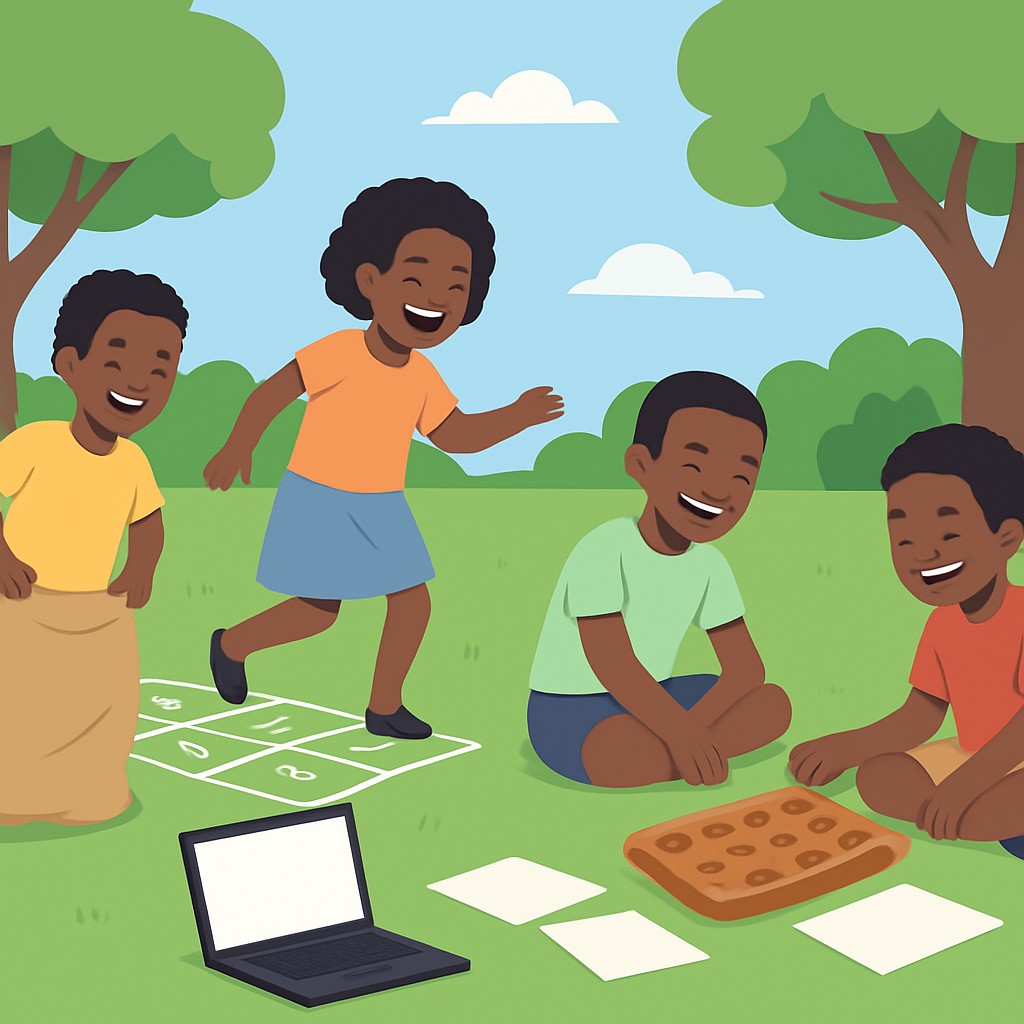
Adapting Games for Urban Spaces
This guide explains how to adapt games for compact urban spaces.
First, choose games that fit small footprints and limited clearances.
Then modify rules to reduce running and to shorten playing zones.
Choosing Games That Fit Small Spaces
Choose games that require minimal running and limited clearances.
Additionally, prefer games that use turns or stationary play elements.
Similarly, pick games that scale easily for two to four players.
Modifying Rules for Limited Area
Reduce team sizes to fit a smaller footprint.
Alternatively, shorten playing zones and redefine goal distances.
Moreover, convert continuous movement into point-based or proximity challenges.
Also, simplify scoring to encourage quick rounds and reuse of space.
Balcony and Staircase Friendly Variations
Use balconies and stair landings for observation and non-running roles.
Meanwhile, design activities that move along a vertical or linear path.
Alternatively, adapt chant and rhythm games to balcony-to-balcony exchanges.
Turn-Based and Sequential Formats
Convert simultaneous play into turns to limit crowding in tight areas.
Consequently, players wait and prepare without overlapping movement.
Moreover, design relay sequences that use short passes and staged positions.
Portable Equipment and Quick Setup
Create compact kits that open and close for fast transitions.
Likewise, choose items that store flat and assemble quickly.
Furthermore, keep simple markers for redefining boundaries on different surfaces.
Noise and Neighbor Coordination
Notify neighbors when planning louder or shared outdoor activities.
Additionally, schedule higher-energy play during considerate daytime windows.
Also, adopt quiet scoring methods indoors like hand signals or gestures.
Fostering Shared Play in Apartment Communities
Coordinate common-area times to enable safer, organized group play.
Similarly, agree simple ground rules that everyone can follow easily.
Finally, rotate facilitation to encourage broader participation among neighbors.
Quick Adaptation Checklist
Use this checklist for quick setup and efficient adaptation.
Apply compact modifications and simple rules to keep play safe.
Then consult the checklist items to finalize your plan.
- Limit running and redefine scoring for compact areas.
- Use turns and sequential play to reduce overlap.
- Favor compact, easily stored equipment for spontaneous games.
- Coordinate times and rules with neighbors to share spaces.
Strengthening Identity Through Play
This section explains ways to use local language and stories in play.
It describes chants, proverbs, and folktales as play resources.
The guidance aims to support caregivers and facilitators in practice.
Why Include Local Language and Stories
Local language and stories connect children to community memory.
Additionally, they create familiar rhythms for group play.
Moreover, they invite shared meaning during outdoor activities.
Practical Ways to Use Local Language
Start with short, repeated phrases that children can mimic.
Next, teach simple commands in the local tongue for game directions.
Also, use call and response to build participation quickly.
Simple Calls and Chants
Create rhythmic chants that pair words with movements.
Also, keep lines short and easy to repeat.
Use these chants to support group play.
Labeling and Instruction
Label play items with local words to reinforce vocabulary gently.
Combine spoken labels with gestures and demonstrations.
This approach reinforces vocabulary during play.
Using Proverbs in Games
Introduce proverbs as prompts for action or movement challenges.
For instance, pause games and ask players to act out short proverb ideas.
Then invite teams to interpret proverb cues through movement.
- Use a proverb fragment and ask children to complete it with gestures.
- Create a relay where each team expresses a proverb through movement.
- Hold a freeze game where a proverb cue triggers a specific pose.
Bringing Folktales into Outdoor Play
Use short story beats as a basis for movement sequences.
Then, assign roles and simple lines for dramatized play.
Also, encourage children to create their own endings after the tale.
Props and Simple Costumes
Use natural items for props to avoid material barriers.
Keep costumes optional and symbolic rather than elaborate.
This approach reduces material barriers to participation.
Planning and Facilitation Tips
Prepare short scripts or cue cards for nonfluent caregivers.
Invite older children to lead language portions of play.
Rotate languages so many children hear different tongues.
Ensure respect for cultural sources during storytelling and play.
Examples and Activity Ideas
Use templates rather than specific cultural texts to adapt local content safely.
- Call and response chant paired with a running lap.
- Freeze pose prompted by a proverb phrase.
- Short dramatized scene based on a folktale beat.
- Vocabulary scavenger hunt using local words for items.
Start small and adapt play ideas based on children’s responses.
Organising Community Events, School Programmes and Neighborhood Tournaments
Form a small planning committee from interested community members.
First, define clear goals for participation and cultural engagement.
Then choose dates and times that suit most participants and secure outdoor space.
Planning and Coordination
Invite diverse community members to join the planning committee.
Next, set measurable goals for participation and cultural engagement.
Also select dates and times that accommodate most participants.
Roles and Responsibilities
Assign clear roles to streamline event operations.
Additionally name a lead organiser who manages communication and logistics.
Also arrange a contact person for first aid and emergencies.
- Assign a lead organiser to coordinate communications and logistics.
- Designate volunteers to set up and manage activity stations.
- Appoint referees or facilitators to oversee fair play.
- Arrange a contact person for first aid and emergencies.
Programme Structure
Begin each event with a short demonstration of every featured game.
Then rotate participants through multiple play stations to increase engagement.
Moreover include brief cultural segments that explain each game’s significance.
Finally schedule free-play time for informal interaction among participants.
Community Engagement and Promotion
Start promotion early so community members can plan participation.
Use posters, local announcements, and personal invites to spread the word.
Also involve local leaders to encourage broader attendance.
Logistics and Resources
Prepare a clear layout plan for activity stations and spectator areas.
Provide basic supplies and secure shared equipment before the event.
Moreover plan simple refreshment arrangements for participants and helpers.
Inclusivity and Accessibility
Ensure activities welcome different ages and abilities.
Also design activities so participants of varying skill levels can join.
Additionally provide reasonable adjustments to improve access and participation.
Scheduling School Programmes
Coordinate with teachers to fit sessions into school calendars.
Design sessions with clear learning aims tied to play activities.
Also plan short sessions suitable for class periods and assemblies.
Neighborhood Tournaments
Invite nearby families to register teams or participate informally.
Then create simple brackets or round-robin schedules to manage matches.
Additionally celebrate participation with certificates or public recognition.
Sample Event Timeline
Open events with a welcome and cultural introduction.
Next offer demonstrations and warm-up activities to prepare participants.
Then run rotating game stations or scheduled matches, followed by free play.
- Begin with an opening welcome and cultural introduction.
- Offer demonstrations and warm-up activities.
- Run rotating game stations or scheduled matches.
- Allow free-play and informal community mingling.
- Finish with awards and closing remarks.
Modern Adaptations
This section presents modern adaptations of traditional play.
It highlights combined formats, technology use, and hybrid spaces.
Also, it focuses on rules, piloting, and inclusion.
Combining Traditional Moves with Sports Formats
Communities adapt traditional moves into time-based drills and team sports.
Additionally, players blend relay formats with tag-style chases to create hybrids.
Groups set clear scoring rules that merge customary and modern styles.
Using Simple Technology to Enhance Play
Facilitators use basic timers to structure short practice segments and rounds.
Also, simple recording devices help review movement and refine game flow.
Furthermore, digital displays show scores during group play for instant feedback.
Moreover, caregivers and leaders use generic smartphones for light coordination and communication.
Designing Hybrid Equipment and Spaces
Coaches repurpose cultural items into adaptable training aids for mixed activities.
Similarly, teams mark play areas using portable boundaries and flexible goal markers.
Teams create modular setups that adapt quickly to constrained or open spaces.
Rules, Fair Play, and Skill Development
Designers write concise hybrid rules that stay easy to teach and learn.
Additionally, they include clear turn-taking and respectful competition guidelines for fairness.
Coaches emphasize transferable skills that support many game varieties.
Piloting and Iteration
Groups pilot new game versions with small teams before broader use.
Moreover, leaders collect feedback from players and caregivers after trial sessions.
Then, teams refine rules and gear based on simple observations and feedback.
Inclusive Practices and Accessibility
Designers adapt hybrids to suit mixed ages and diverse abilities during play.
Also, they offer varied roles and tasks to match different energy levels.
Furthermore, simple technology can assist players with communication and participation needs.
Piloting Documentation
Groups document variants to keep cultural links visible while adapting play styles.
This practice helps preserve local meaning during change.
Documentation supports teams when they adapt and reuse play ideas.
Ways Parents Can Document Preserve and Pass On Traditional Games
Parents play a central role in keeping family game traditions alive.
Therefore, simple repeatable habits help preserve play for future family members.
Start small and maintain regular practice to embed these traditions in daily life.
Record Play and Memories
Record short audio or video while family members play traditional games.
Then label each file with the date and names of participants for retrieval.
Also keep brief notes about special rules or local variations heard during play.
Write and Organize Instructions
Write clear concise instructions that describe setup and basic play steps.
Store these instructions in a single family notebook or a digital folder for access.
Finally, update instructions after testing to reflect common variations.
Teach Through Stories and Rituals
Embed games within family stories to give play emotional meaning.
Create simple rituals around teaching moments to make lessons memorable.
Repeat storytelling during play to reinforce rules and shared memories.
Mentor and Rotate Teaching Roles
Assign older siblings or relatives to mentor younger players during playtimes.
Rotate teaching roles so many family members gain transmission experience.
Encourage mentors to explain reasons for rule choices to strengthen learning.
Preserve Physical Pieces and Craft Skills
Keep a secure box for storing game pieces and repair materials at home.
Label the box clearly so family members can find pieces easily.
Teach children how to make and mend simple pieces to retain craft knowledge.
Share and Archive with Community Support
Invite willing neighbors or elders to demonstrate versions and share memories.
Create community copies of recordings and instructions for broader safekeeping.
Coordinate with relatives to ensure multiple archived copies exist across households.
Practical Steps to Start Today
Start by gathering family members for a short play session this week.
Then save that recording and add a note about any rule changes observed.
Finally, assign one family member to care for game pieces and storage.
- Begin a family play notebook with dates and short notes about each game.
- Record one short play session and store that file safely for reference.
- Ask an older relative to teach one child and observe the teaching process.
- Designate a small box to hold game pieces and label it clearly.
Keeping Traditions Alive
Establishing simple habits ensures games move naturally between family members.
Consequently, families preserve cultural play while creating lasting memories together.
Sustain these habits by scheduling regular play and by sharing responsibilities.
Additional Resources
Bing search results for Fun Outdoor Games That Reflect Nigerian Culture Activities and Entertainment


