




Introduction
Encouraging Practical Learning
Everyday chores offer excellent opportunities for children to learn practical skills.
They help kids understand responsibility through hands-on activities.
Moreover, chores encourage problem-solving and critical thinking.
Building Important Life Skills
Doing chores teaches time management and organization.
Children develop independence by completing tasks on their own.
These experiences build confidence and a sense of accomplishment.
Enhancing Parent-Child Interaction
Turning chores into learning moments strengthens family bonds.
Parents can guide children while sharing valuable knowledge.
Additionally, it creates positive memories around everyday activities.
Fostering a Positive Attitude Towards Learning
Integrating fun elements makes chores enjoyable and engaging for children.
This approach motivates them to embrace learning beyond the classroom.
Consequently, children develop curiosity and enthusiasm for new challenges.
Identifying Age-Appropriate Chores
Assessing Developmental Milestones
First, observe motor skills and language skills to match chores to abilities.
Then, consider attention span and sequencing skills when selecting tasks.
Also, consult pediatric occupational therapist Maria Lopez for specific concerns.
Parenting Made Just for You
Get personalized Parenting Solutions tailored to your child’s needs. Transform your parenting journey with expert guidance in 1-3 days.
Get StartedInclude children in short conversations to learn about their preferences.
Chore Ideas for Toddlers and Preschoolers
-
For starters, assign simple pick-up tasks using low bins for easy access.
Olivia Martinez asks her daughter to sort blocks by color.
-
Next, assign gentle dusting with a sock on a hand for fine motor practice.
Encourage watering indoor plants with a small cup to teach care.
-
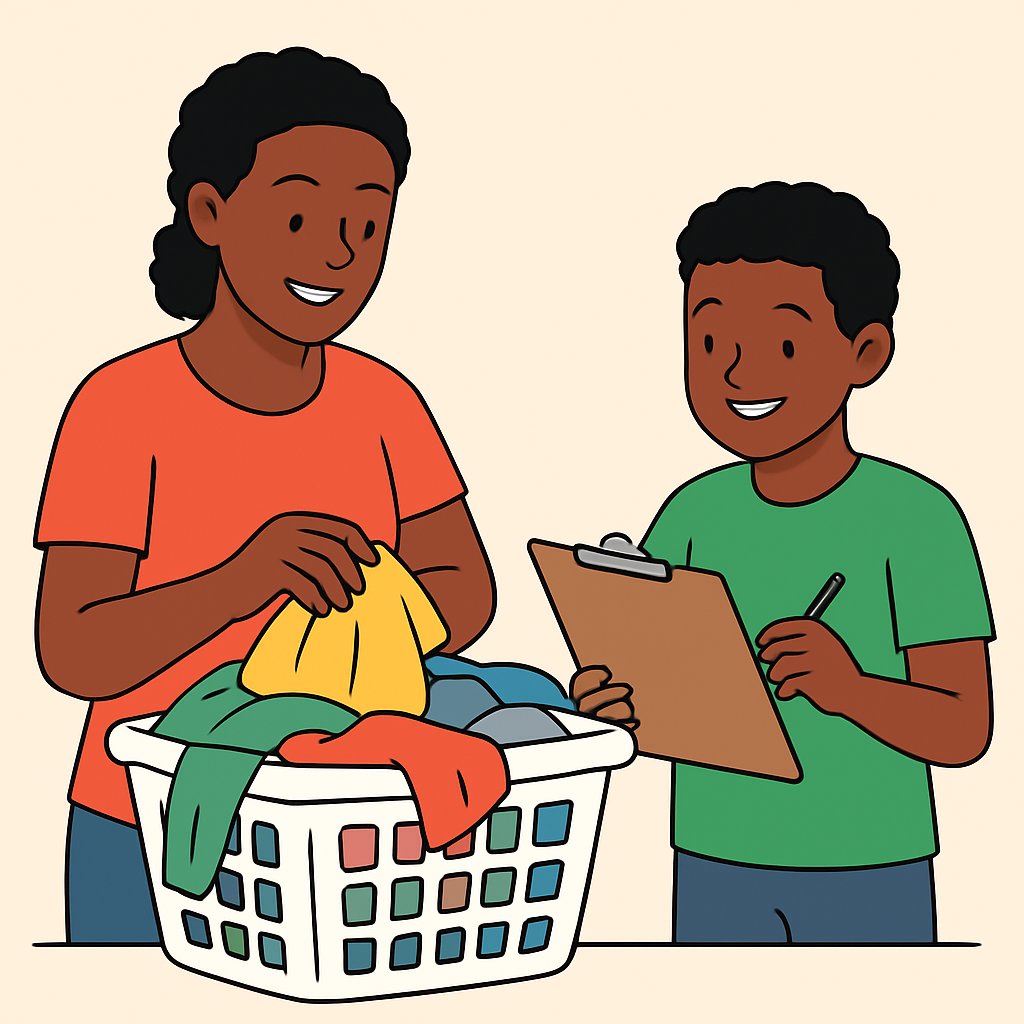
Introduce sorting laundry by colors to teach matching skills.
Sing short songs to turn routine into memory practice.
-
Let toddlers help set lightweight napkins at the table.
Little Sprouts Daycare uses this task to teach sequencing.
Chore Ideas for Early Elementary Children
-
Ask children to make their beds to build daily responsibility.
Then, teach them to unload low shelves of the dishwasher safely.
-
Involve children in simple cooking tasks like stirring batter.
Measure ingredients to reinforce basic math skills practically.
-
Assign pet feeding with a checklist to improve routine building.
Use a family chart to track completed chores visibly.
Chore Ideas for Older Children and Preteens
-
Have them prepare simple meals to learn planning and timing.
Marcus Rivera’s son practices reading recipes and timing tasks.
-
Assign laundry responsibilities including sorting and operating machines.
Teach budgeting by giving grocery lists and spending limits.
-
Include yard tasks like raking leaves under adult supervision.
Involve older kids in recycling sorting to teach environmental care.
Mapping Chores to Learning Objectives
-
Math skills grow through measuring, counting, and managing time during chores.
Baking reinforces fractions and sequencing in a fun way.
-
Science understanding develops from observing plants and simple home experiments.
Watering schedules teach cause and effect in nature care.
-
Language skills improve when children read labels and follow written instructions.
Narrating tasks builds vocabulary and storytelling ability.
-
Executive function strengthens through planning, task switching, and delayed gratification.
Checklists promote organization and self-monitoring effectively.
-
Social skills enhance when children work with siblings or family members.
Cooperative chores teach negotiation and shared responsibility.
Safety, Supervision, and Helpful Tools for Chores
Always match tool size to the child for safe handling.
Choose child-safe scissors and utensils from Evergreen Play Tools.
Explain hazards clearly before assigning new tasks at home.
Register questions with pediatrician Dr. Emily Chen when needed.
Set clear supervision rules and gradually increase independence safely.
Creating a Simple Chore Plan for Children
-
List appropriate tasks for each child and post them visibly.
Model the task step-by-step and let the child try with support.
-
Set short routines and use BrightStart Learning Co. charts.
Give immediate positive feedback to reinforce good habits consistently.
-
Review progress weekly and adjust tasks as skills improve.
Celebrate milestones with small rewards that encourage continued effort.
Incorporating Basic Math Skills Through Household Tasks
Sorting Laundry to Practice Counting and Categorizing
Sorting laundry offers a practical way to introduce counting skills.
Ask children to count the number of socks or shirts.
This activity improves their ability to categorize items by color or type.
Additionally, sorting encourages pattern recognition and grouping techniques.
Parents like Sarah Martinez use this method to make chores engaging and educational.
Measuring Ingredients to Understand Fractions and Volumes
Measuring ingredients during cooking introduces basic concepts of fractions and volumes.
Children learn to use measuring cups and spoons accurately.
They also practice following instructions and reading measurement labels.
Unveil the Perfect Name that Tells Your Family's Story
Let us help you find a name that embodies your family's values, traditions, and dreams. Our personalized consultation weaves cultural insights to create a name that's uniquely yours.
Get StartedCooking with family members like David Allen enhances both math skills and bonding time.
This hands-on approach makes abstract math more tangible and fun.
Tips to Enhance Learning Through Household Chores
- Use visual aids like colorful measuring cups or labeled baskets.
- Encourage estimating amounts before measuring to foster critical thinking.
- Make comparisons, such as which pile is larger or smaller, to build reasoning.
- Celebrate progress to motivate continued learning during chores.
Discover More: How to Make Weekend Family Time More Engaging and Memorable
Teaching Responsibility Through Chore Schedules
Creating Clear and Achievable Schedules
Setting up chore schedules teaches children how to manage tasks responsibly.
Parents can work with kids like Maya and Ethan to list daily chores.
Each chore should have a clear description and expected completion time.
This clarity helps children understand their responsibilities better.
Moreover, it reduces confusion about what tasks need attention.
Parents can use colorful charts or printable calendars to make schedules visually appealing.
Visual aids encourage kids to follow their plans consistently.
Assigning Age-Appropriate Tasks
Choose chores that fit your child’s age and capabilities.
For example, Olivia can help set the table while Lucas tidies his toys.
This ensures children feel confident and successful in their responsibilities.
Age-appropriate tasks prevent frustration and build positive habits.
Encouraging Accountability and Ownership
Encourage children to check off completed chores independently.
This practice builds a sense of accomplishment and ownership over their tasks.
Additionally, families like the Garcias celebrate chore completion with small rewards.
Recognition boosts motivation and reinforces responsibility.
Improving Time Management with Timers
Introducing Timers as Practical Tools
Timers help children like Ava understand how long chores should take.
Using timers creates a fun challenge to finish tasks efficiently.
For instance, a kitchen timer or app can signal when time is up.
This encourages focus and prevents distractions during chores.
Setting Realistic Time Limits
Parents should set reasonable timeframes based on each chore’s difficulty.
Jacob’s room cleanup might take 15 minutes, while watering plants needs 5.
Appropriate limits support skill development without causing stress.
Gradually, children learn to estimate and manage their time better.
Incorporating Breaks and Transitions
Offer short breaks between tasks to maintain energy and enthusiasm.
The Martinez family uses timers to signal chore time and break time distinctly.
Scheduled transitions help kids switch tasks smoothly without feeling rushed.
This balance fosters better time awareness and self-discipline.
Using Technology and Tools to Enhance Learning
Recommended Apps for Chore Management
Several apps can assist in making chore schedules interactive and fun.
For example, “ChoreMonster” motivates kids with rewards and progress tracking.
“Cozi Family Organizer” helps the Thompson family coordinate multiple schedules.
These tools simplify planning and keep children engaged in responsibility.
Combining Timers with Digital Helpers
Pair timers with apps to provide reminders and alerts for chores.
Emma sets a smartphone timer synced with her chore checklist app.
This integration teaches her promptness and prioritization effectively.
With technology, managing chores becomes a structured and rewarding experience.
Explore Further: Creative Home Activities to Keep Nigerian Kids Engaged and Learning
Enhancing Language and Communication Skills by Describing Chores and Giving Instructions
Encouraging Detailed Descriptions
Start by asking children to describe each chore they perform.
This exercise improves vocabulary and observational skills simultaneously.
For example, have Mia explain how she folds laundry step by step.
Encourage her to use descriptive adjectives to make the task vivid.
Consequently, this practice sharpens both speaking and listening abilities.
Practicing Clear Instructions for Chores
Next, invite children like Lucas to give you instructions for chores.
This helps them organize thoughts logically and use precise language.
For instance, Lucas can guide you through washing dishes carefully.
Encourage the use of sequencing words such as first, then, and finally.
Thus, they learn how to communicate processes effectively to others.
Benefits of Role-Playing Scenarios
Create role-playing situations where kids act as instructors or helpers.
For example, Emily can pretend to teach her brother how to sweep the floor.
This interactive approach boosts confidence in speaking and comprehension.
Moreover, it solidifies understanding of chore-related vocabulary.
Therefore, learning becomes engaging and memorable through practical application.
Supporting Learning with Visual Aids and Labels
Label household items involved in chores with their names in readable fonts.
This visual cue supports word recognition and spelling skills.
Parents like Sophia can encourage children to read and follow labeled instructions.
Additionally, creating simple checklists for chores can reinforce sequence and clarity.
As a result, learners become more independent in completing tasks accurately.
Encouraging Reflection and Constructive Feedback
After completing chores, invite children to discuss what they did and how.
This reflection encourages articulation of experiences and problem-solving language.
For instance, Noah can share challenges he faced while vacuuming the carpet.
Offer constructive feedback to guide improved communication and task management.
This process enhances expressive skills and critical thinking abilities.
See Related Content: How to Plan Family-Friendly Trips Within Nigeria
Exploring Science Through Mixing Activities
Understanding Chemical Reactions
Mixing household ingredients reveals exciting chemical reactions.
For example, combining baking soda and vinegar creates gas bubbles.
These reactions introduce basic chemistry concepts to learners.
Moreover, observing changes in color or texture reinforces scientific observation skills.
Encouraging Safe Experiments
Always supervise children when they mix substances.
Use non-toxic ingredients like flour, water, and food coloring.
This safe environment builds curiosity and confidence in scientific exploration.
Children learn through hands-on experience and discover cause and effect.
Learning Science Through Cleaning Chores
Exploring Physical Properties of Materials
Cleaning tasks highlight properties like solubility and absorption.
Washing dishes shows how soap breaks grease into smaller particles.
Additionally, wiping surfaces demonstrates the concept of friction and texture.
Teaching these principles makes chores educational and engaging.
Observing Changes During Cleaning
Children notice before-and-after differences while cleaning.
This observation helps develop critical thinking skills.
Explaining why water softens dirt connects science to daily life.
Furthermore, it encourages mindful and effective cleaning habits.
Using Plant Care to Demonstrate Biological Science
Understanding Plant Growth
Taking care of plants introduces basic botany concepts.
Children learn how sunlight, water, and soil nutrients affect growth.
Watching seeds sprout illustrates life cycles and germination.
This ongoing process fosters responsibility and curiosity about nature.
Exploring Photosynthesis and Plant Health
Discuss how plants convert sunlight into energy through photosynthesis.
Explain why leaves change color or wilt when conditions vary.
Such explanations link plant care activities to scientific theory.
Consequently, children appreciate the importance of their chores.
Engaging With the Environment
Gardening activities connect children with the natural world.
They cultivate patience and observation skills.
Furthermore, caring for plants encourages environmental stewardship.
These lessons extend beyond chores and enrich lifelong learning.
Find Out More: Building Bonds Through Shared Hobbies and Games
Encouraging Creativity and Problem-Solving During Home Organization or Decoration Tasks
Transforming Organization Into a Creative Challenge
Start by viewing tidying up as a creative opportunity rather than a chore.
Invite family members to brainstorm unique storage ideas together.
For example, Laura suggested using colorful bins to categorize toys.
This approach makes organizing more enjoyable and stimulates inventive thinking.
Moreover, it encourages everyone to find practical yet imaginative solutions.
Engaging Through Hands-On Problem Solving
Present each organizing task as a puzzle to solve.
Ethan faced the challenge of fitting books onto crowded shelves creatively.
He experimented with arranging books by size and color for visual appeal.
Through trial and error, Ethan improved his spatial reasoning skills.
Consequently, problem-solving becomes a natural part of daily maintenance tasks.
Incorporating Art and Design into Decoration
Use decoration projects to boost artistic creativity.
Isabella enjoys painting small accent pieces for her living room walls.
This hands-on activity encourages her to think about color schemes and textures.
Furthermore, family members can collaborate on designing mood boards.
These collaborative efforts nurture innovative thinking and teamwork.
Practical Tips to Spark Innovation at Home
- Encourage everyone to suggest new organization methods openly.
- Introduce simple challenges like repurposing everyday items creatively.
- Use rewards to motivate creative participation in chores.
- Discuss the benefits of an organized and beautiful space regularly.
- Share stories of creative problem solving to inspire confidence.
By applying these tips, mundane tasks become opportunities for learning and fun.
Making Chores Interactive with Games
Creating Fun and Engaging Tasks
Transforming simple chores into games motivates participation.
Timing laundry folding makes the task exciting.
Sorting socks by color turns cleaning into a challenge.
Children enjoy challenges that feel like play, not work.
This approach encourages teamwork and friendly competition.
Incorporating Educational Elements
Games can teach math by counting items while tidying.
Parents can create puzzles around organizing books by genre.
Sorting recyclables teaches kids environmental responsibility.
This method improves problem-solving and critical thinking skills.
Encouraging Challenges to Boost Motivation
Setting Goals to Achieve
Clear and achievable goals make chores more rewarding.
For example, challenge children to clean their rooms in 15 minutes.
Gradually increasing difficulty keeps children focused and interested.
Goals that involve creativity, such as decorating a chore chart, add fun.
Tracking Progress and Improvement
Keeping a visible chart motivates consistent effort.
Regularly updating the chart celebrates successes publicly.
This visual encouragement builds self-esteem and responsibility.
A shared family chore challenge fosters a supportive environment.
Using Rewards to Reinforce Positive Behavior
Implementing Immediate and Long-Term Rewards
Small rewards after chores maintain enthusiasm.
Examples include choosing a family movie or extra playtime.
Long-term rewards, like a special outing, encourage sustained effort.
Rewards should be meaningful and not undermine intrinsic motivation.
Balancing Rewards with Learning Objectives
Rewards highlight the value of completing tasks well.
They need to align with educational goals to remain effective.
For example, earning a book after organizing the bookshelf.
This balance promotes both fun and skill development.
Involving Children in Planning Household Activities
Encouraging Choice and Responsibility
Invite children to help create a list of chores for the day.
Give them the freedom to select which tasks they want to do.
This approach makes children feel valued and encourages ownership.
Also, it helps develop their decision-making skills over time.
Setting Goals Together
Sit down with your child and discuss what you hope to accomplish.
Agree on achievable goals that motivate them to participate actively.
Consequently, this practice boosts their planning and organizational abilities.
Moreover, it teaches children how to balance priorities effectively.
Fostering Critical Thinking Through Discussion
Asking Open-Ended Questions
During chores, ask questions like “How would you organize these tasks?”
Encourage children to explain their reasoning clearly and thoughtfully.
This method stimulates problem-solving and analytical thinking skills.
Furthermore, it keeps children engaged and curious about the process.
Evaluating Outcomes Together
After completing chores, review what went well and what could improve.
Discuss how different choices affected the results of the tasks.
This reflection strengthens their ability to think critically about actions.
In addition, it helps children learn from experience more effectively.
Making Decision-Making Enjoyable and Educational
Using Visual Aids and Tools
Introduce charts or checklists to plan and track chores together.
Visual tools make abstract concepts like planning concrete for children.
They also encourage kids to take the lead in managing their tasks.
As a result, children gain confidence in their decision-making skills.
Celebrating Successful Plans
Recognize and praise good planning and effective decision-making.
Use small rewards or positive feedback to motivate continuous effort.
This practice reinforces the value of thoughtful participation in daily tasks.
Ultimately, children associate learning with fun and accomplishment.
Tips for Maintaining a Positive Attitude and Motivation Around Chores
Embrace a Growth Mindset
Recognize that chores offer opportunities to learn new skills.
Approach tasks as chances to improve rather than obligations.
Moreover, view mistakes during chores as valuable learning moments.
Encourage family members like Emma and Carlos to adopt this mindset.
Set Clear and Achievable Goals
Break down chores into small, manageable tasks to prevent overwhelm.
Establish clear goals for each chore with specific outcomes.
For example, Sarah aims to organize the pantry within thirty minutes.
This clarity boosts motivation and provides a sense of accomplishment.
Make Chores Social and Interactive
Invite friends or family to join and make chores a group activity.
For instance, Mark and his sister turn laundry into a fun challenge.
Using friendly competition often increases engagement and enjoyment.
Additionally, sharing tasks strengthens relationships and team spirit.
Incorporate Rewards and Positive Reinforcement
Recognize efforts with simple rewards like extra leisure time.
Angela’s parents praise her creativity after completing art-related chores.
Such reinforcement encourages consistent participation and enthusiasm.
Gradually, internal motivation will develop alongside external rewards.
Use Music and Entertainment to Boost Energy
Play upbeat music or audiobooks during chores to make time fly.
Leo listens to his favorite podcast while washing dishes every evening.
This approach creates a pleasant atmosphere and reduces boredom.
Thus, chores become moments of entertainment as well as productivity.
Maintain a Consistent Routine
Establishing regular chore times helps build habits and predictability.
Jasmine sets daily times for tidying her room, improving discipline.
Consistency decreases resistance and increases automatic participation.
Over time, chores will feel less like chores and more like routine.
Focus on the Benefits Chores Bring to Home Life
Remind yourself and others about the benefits chores bring to home life.
For example, Ethan knows cleaning keeps the house healthy and safe.
Connecting tasks to meaningful outcomes increases motivation significantly.
Therefore, keeping this perspective sustains long-term positive attitudes.
Additional Resources
21 learning activities for babies and toddlers | UNICEF Parenting


